Clara Shinta
A groundbreaking study by researchers at the Bank for International Settlements (BIS) has exposed significant inconsistencies in how the economic activity of cryptocurrencies is measured, finding that estimates of Bitcoin’s on-chain transfer values can vary by as much as sixfold. This substantial discrepancy, detailed in BIS Working Paper No. 1377, underscores a pervasive challenge in accurately quantifying the scale and scope of the rapidly evolving digital asset ecosystem, extending beyond Bitcoin to Ethereum and stablecoins. The findings highlight that commonly cited metrics, often presented with an aura of precision, are frequently "noisy approximations" that obscure rather than clarify underlying economic realities.
The Crucial Role of On-Chain Data and the BIS’s Stance
On-chain data, derived directly from public blockchain ledgers, is often hailed as the definitive source of truth for understanding cryptocurrency networks. Unlike traditional financial markets where transaction data can be opaque or centralized, blockchain technology offers a transparent, immutable record of every transaction. This transparency is a cornerstone of the crypto ethos, allowing anyone to verify activity. However, the BIS study reveals that the interpretation of this raw data is far from straightforward, leading to widely divergent conclusions depending on the methodology employed.
The Bank for International Settlements, often referred to as the "central bank for central banks," plays a pivotal role in fostering international monetary and financial cooperation. Its research and policy recommendations carry significant weight among global financial institutions and regulators. The BIS has historically maintained a cautious, if not critical, stance on cryptocurrencies, often highlighting their volatility, scalability issues, and potential risks to financial stability. This latest report, while not a policy document, reinforces the BIS’s consistent message regarding the immaturity and inherent complexities of the crypto market, particularly from a systemic measurement perspective. It builds upon previous statements from BIS leaders, such as Agustín Carstens, who has expressed skepticism about stablecoins’ credibility for payments at scale, further solidifying the institution’s view that the digital asset space still grapples with fundamental structural and operational hurdles.
Bitcoin’s Measurement Quandary: The UTXO Model’s Impact
The most striking revelation from the BIS study concerns Bitcoin, the world’s oldest and largest cryptocurrency. Researchers discovered that on-chain transfer value estimates for Bitcoin could differ by a factor of six. This substantial variance is not related to trading volumes on centralized exchanges, which are themselves subject to scrutiny, but rather to the fundamental way transactions are recorded and interpreted on the Bitcoin blockchain.
At the heart of this issue lies Bitcoin’s Unspent Transaction Output (UTXO) model. Unlike traditional bank accounts where balances are held, Bitcoin transactions involve spending previously received UTXOs. When a user wishes to spend a certain amount of Bitcoin, they select one or more UTXOs as inputs. If the total value of these inputs exceeds the desired payment, the excess amount is returned to the sender as "change." This change is effectively a new UTXO sent back to an address controlled by the original sender.
The problem arises in how these change outputs are counted. Some measurement methodologies treat every output of a transaction, including change, as a "transfer" of value. This inflates the perceived transaction volume significantly because the change output does not represent a transfer of funds to a new party for an economic purpose. It’s akin to taking a $20 bill to buy a $5 item and receiving $15 back; counting the $15 change as a separate "transfer" to yourself would misrepresent the actual economic exchange. The BIS researchers emphasize that different approaches to filtering out these change outputs, alongside other transfers back to the sender, are the primary drivers of the sixfold gap in Bitcoin transfer value estimates.
This inherent structural characteristic of Bitcoin transactions has long been a known challenge for blockchain analytics firms. While sophisticated algorithms and heuristics have been developed to identify and exclude change outputs, their effectiveness can vary, and there is no universally agreed-upon standard. This lack of standardization leads to different data providers presenting vastly different figures for what should, in theory, be an objectively verifiable metric.
Beyond Transaction Volume: Market Capitalization Distortions
The measurement problem extends beyond daily transaction volumes to fundamental valuation metrics like Bitcoin’s market capitalization. The BIS study found that the conventional measure of market capitalization, which simply multiplies the total circulating supply by the current market price, has at times been as much as four times higher than "realized capitalization."

Realized capitalization offers an alternative, arguably more conservative, valuation metric. It values each unit of Bitcoin (or other cryptocurrencies) not at its current market price, but at the price it was last moved on-chain. This approach attempts to filter out "lost" coins or those held in long-term dormant wallets, providing a snapshot of the value based on when coins were last actively traded or transferred. The significant difference between conventional and realized capitalization suggests that a substantial portion of Bitcoin’s circulating supply may be held by long-term investors or is otherwise inactive, making the conventional market cap a potentially misleading indicator of liquid, economically active value. This distinction is critical for investors trying to gauge market health and for regulators assessing systemic risk.
Ethereum’s Smart Contract Complexity: A New Frontier of Measurement Challenges
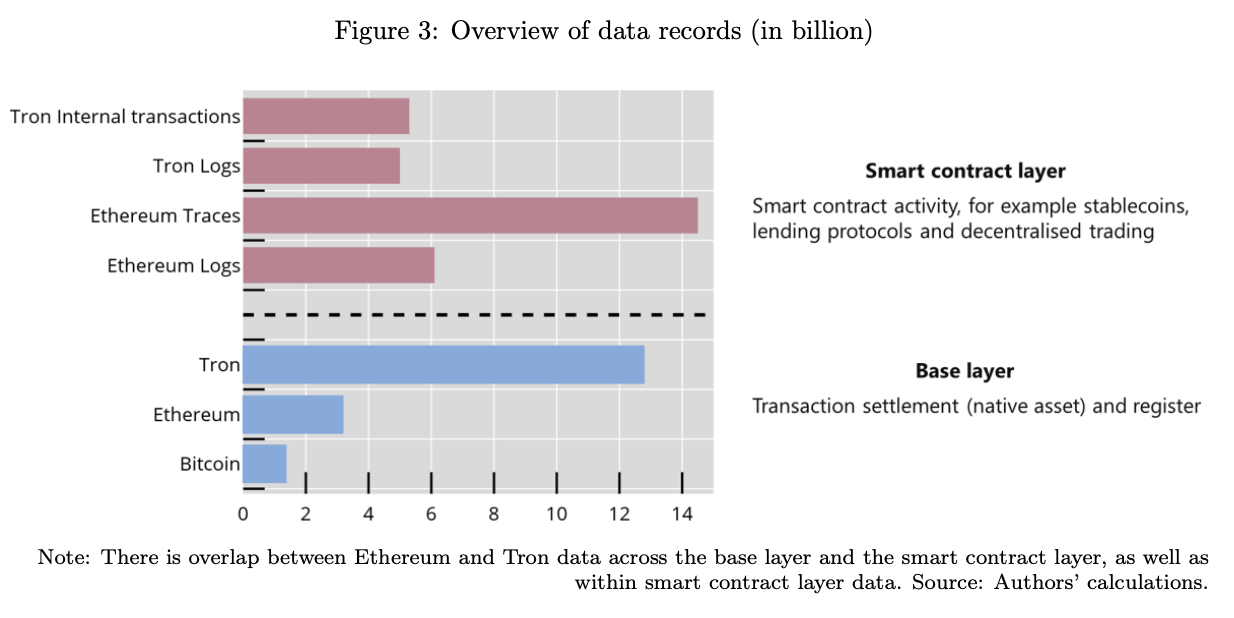
The complexities identified by the BIS are not confined to Bitcoin. The study, which analyzed over 100 billion blockchain records across Bitcoin, Ethereum, and Tron, found similar, and in some cases, entirely new, measurement challenges within the broader crypto ecosystem. Ethereum, with its robust smart contract functionality, presents its own unique set of interpretative hurdles.
The proliferation of smart contracts on Ethereum introduces a layer of complexity absent in Bitcoin’s simpler transaction model. Smart contracts are self-executing agreements whose terms are directly written into code, enabling a vast array of decentralized applications (dApps), decentralized finance (DeFi) protocols, and non-fungible tokens (NFTs). The BIS researchers examined approximately 67.5 million active smart contracts on Ethereum, but a staggering 54 million of these — nearly 80% — could not be categorized using the study’s established classification frameworks.
This inability to categorize the vast majority of smart contracts highlights a fundamental challenge: understanding the purpose and economic function of on-chain activity. Without clear classifications, it becomes exceedingly difficult to distinguish between genuine economic transactions, protocol-internal operations, speculative activity, or even dormant contracts. For policymakers and economists attempting to assess the real-world utility and impact of the Ethereum network, this lack of clarity is a significant impediment. It means that raw transaction counts on Ethereum, which include interactions with smart contracts, can be highly misleading indicators of actual economic value creation or transfer.
Stablecoins: Purpose-Driven Discrepancies Across Chains
Stablecoins, designed to maintain a stable value relative to a fiat currency like the US dollar, are increasingly vital to the crypto ecosystem, serving as a bridge between traditional finance and decentralized applications. However, the BIS study found that interpreting stablecoin activity presents another intricate challenge, primarily due to the varied use cases and economic functions they serve across different blockchains.
The researchers specifically examined Tether (USDT), the largest stablecoin by market capitalization, across Ethereum and Tron. Their analysis revealed stark differences in how USDT is utilized on each network. USDT on Ethereum was found to be more closely linked to DeFi activity, integrated into lending protocols, decentralized exchanges, and other financial applications. This is evidenced by the share of USDT held by smart contracts on Ethereum, which exceeded 20% in 2022.
In contrast, USDT on Tron was predominantly associated with payment-like and store-of-value purposes. The share of USDT held by smart contracts on Tron was significantly lower, around 1%. This divergence in usage patterns underscores a critical point: the same asset can fulfill fundamentally different economic roles depending on the underlying blockchain and its ecosystem.
The implication of these differing use cases is profound. The BIS researchers caution that simply aggregating USDT activity across blockchains can "conflate different types of economic activity and obscure how stablecoins are actually being used." For instance, a high volume of USDT transfers on Tron might indicate significant cross-border remittances or peer-to-peer payments, while a similar volume on Ethereum could reflect complex DeFi arbitrage strategies or liquidity provision within decentralized protocols. Without disaggregating and understanding these distinct purposes, any aggregated stablecoin metric would present a distorted and potentially misleading picture of their overall economic impact. This poses a significant hurdle for regulators seeking to understand potential systemic risks, monitor illicit finance, or formulate appropriate policy responses for stablecoins.
The Broader Implications: "Noisy Approximations" and Regulatory Concerns
The overarching conclusion from the BIS researchers is clear: on-chain indicators, despite their apparent transparency, should be treated as "noisy approximations rather than direct measures of economic activity." This statement carries significant weight for various stakeholders, from individual investors to global financial regulators.
For investors, relying on potentially inflated or miscategorized on-chain data can lead to misguided investment decisions. An inflated transaction volume might suggest greater network adoption or liquidity than is genuinely present, while an inaccurate market capitalization figure could distort valuation assessments.
For developers and project teams, accurately measuring their dApp’s or protocol’s usage is crucial for iterative improvement and demonstrating value. If the tools used to measure activity are flawed, it hinders their ability to make informed strategic decisions.
Most critically, for regulators and policymakers, these measurement challenges complicate efforts to understand, monitor, and regulate the rapidly expanding crypto market. Accurate data is foundational for assessing systemic risk, detecting market manipulation, identifying illicit financial flows, and formulating proportionate regulatory frameworks. If the underlying metrics are unreliable, policy interventions risk being miscalibrated, potentially stifling innovation or failing to address genuine threats effectively. The BIS’s findings reinforce the concerns of global financial bodies like the Financial Stability Board (FSB) and the International Monetary Fund (IMF), which have consistently highlighted data gaps and the need for improved analytics in the crypto space.
Industry Efforts Towards Refined Metrics: Visa’s Onchain Analytics
The challenges highlighted by the BIS are not entirely new to the cryptocurrency analytics community. Many analytics providers and data scientists have long recognized the distinction between raw blockchain activity and adjusted measures designed to better reflect genuine economic activity. Indeed, some prominent players in the traditional financial sector are actively working to bridge this gap.
Visa, a global payments technology company, offers a notable example through its Onchain Analytics dashboard, powered by data from Allium Labs. This platform explicitly differentiates between "total" and "adjusted" stablecoin transaction volumes. Visa’s adjusted methodology aims to filter out various forms of activity that do not represent genuine economic transfers between distinct parties. This includes high-frequency trading bots, bridge routing transactions (where assets move between different blockchain networks), and internal exchange operations (such as rebalancing hot wallets or moving funds between an exchange’s own addresses).
The discrepancy between total and adjusted volumes on Visa’s dashboard is striking. For instance, the dashboard might show $6.4 trillion in total stablecoin transaction volume across tracked networks over a recent 30-day period, but only $313.1 billion in adjusted volume. This enormous difference — a factor of over 20 — underscores the sheer volume of non-economic or internal blockchain activity that can inflate raw metrics. Visa’s approach represents a proactive effort by a major financial player to provide more accurate and economically meaningful insights into stablecoin usage, acknowledging the inherent "noise" in raw on-chain data. This initiative also reflects a growing trend where traditional financial institutions are increasingly engaging with blockchain technology, not just for innovation, but also for a deeper, more nuanced understanding of its underlying dynamics.
The Path Forward: Standardization and Collaboration
The BIS study serves as a stark reminder of the complexities inherent in quantifying the digital asset landscape. It is not merely a technical challenge but a fundamental hurdle for the maturation and mainstream integration of cryptocurrencies. The implication is clear: a concerted effort is needed from across the industry and regulatory bodies to develop standardized methodologies for measuring on-chain activity.
This standardization would involve:
- Clear Definitions: Establishing universally accepted definitions for what constitutes an "economic transfer" versus internal network operations (like change outputs, smart contract calls that don’t move value, or internal exchange movements).
- Improved Heuristics: Developing more robust and transparent heuristics for identifying and filtering non-economic activity across diverse blockchain architectures (UTXO-based, account-based, smart contract platforms).
- Collaborative Data Sharing: Fostering greater collaboration between blockchain analytics firms, academic researchers, and regulatory bodies to share best practices and validate methodologies.
- Education and Transparency: Educating market participants about the limitations of raw on-chain data and promoting the use of adjusted, economically meaningful metrics.
Without such efforts, the narrative surrounding cryptocurrency growth and adoption will continue to be plagued by ambiguity. The crypto market, with its global reach and innovative potential, demands a level of analytical rigor commensurate with its aspirations. The BIS’s findings are not a condemnation but a crucial call to action for the industry to evolve its data practices, ensuring that the transparency promised by blockchain technology translates into genuinely informative and reliable economic insights. The journey towards a truly measurable and understandable digital asset ecosystem is ongoing, and this report marks a significant step in acknowledging the scale of the challenge.