
 Clara Shinta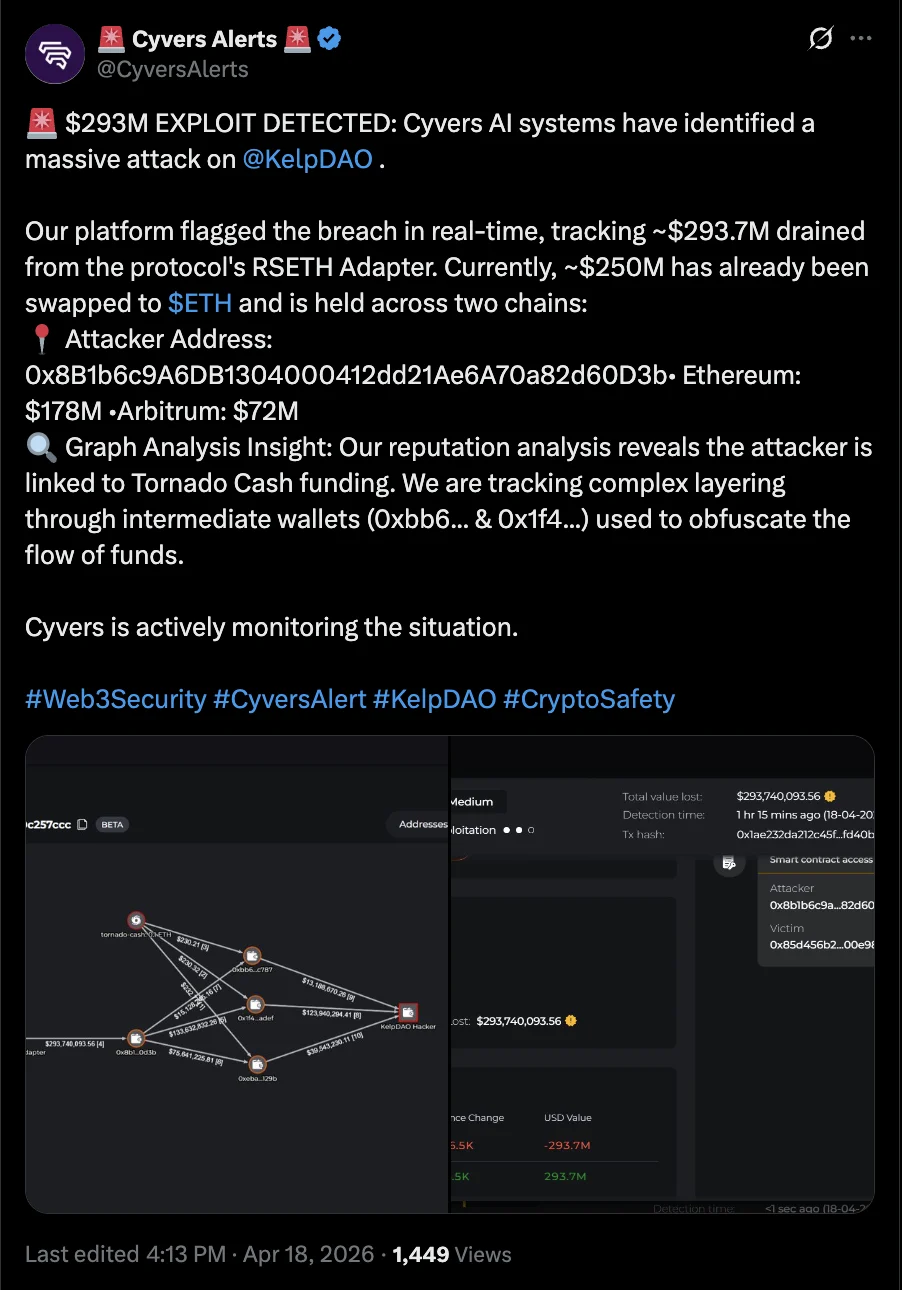
Kelp, a prominent liquid restaking protocol, became the latest victim in a series of sophisticated cyberattacks targeting the decentralized finance (DeFi) ecosystem, suffering a significant exploit on Saturday that resulted in an estimated loss of $293 million. The incident forced the platform to immediately pause smart contracts for its restaking token (rsETH) across multiple networks as it launched an urgent investigation into the breach. The attack has sent ripples through the DeFi community, prompting major platforms to freeze related markets and underscoring the inherent risks associated with the interconnected nature of blockchain protocols.
The Anatomy of the Attack and Immediate Fallout
The initial alert came directly from the Kelp platform via an X (formerly Twitter) post, stating, "Earlier today, we identified suspicious cross-chain activity involving rsETH. We have paused rsETH contracts across mainnet and several Layer-2s." This swift action was a direct response to the detection of unauthorized transactions draining substantial funds. Blockchain security firm Cyvers swiftly confirmed the exploit, identifying the rsETH adapter bridge contract as the critical vulnerability point. This specific piece of software code is responsible for managing Kelp’s rsETH token across different blockchain networks, making it a high-value target for attackers.
According to Cyvers, the attacker successfully exploited this bridge contract, siphoning approximately $293 million in digital assets. Further analysis by Cyvers revealed a calculated move by the perpetrator to obscure the trail of stolen funds. The attacker utilized an address initially funded through Tornado Cash, a well-known crypto mixer, which is designed to obfuscate transaction origins and destinations. Subsequently, a substantial portion of the stolen assets, estimated at $250 million, was converted into Ether (ETH), the native cryptocurrency of the Ethereum layer-1 blockchain network. The conversion into a widely liquid asset like ETH, combined with the use of a mixer, significantly complicates tracking and recovery efforts for law enforcement and blockchain security experts.
The ripple effect of the Kelp exploit was immediate and far-reaching within the tightly interwoven DeFi landscape. Decentralized finance giant Aave, a leading lending and borrowing protocol, promptly announced the freezing of rsETH markets on both its V3 and V4 platforms. This defensive measure aimed to prevent further contagion and protect users from potential cascading liquidations or further exploits linked to the now-compromised token. Cyvers reported that at least nine other crypto protocols, which had exposure to rsETH through various integrations and liquidity pools, also moved to freeze activity on their respective platforms in response to the breach.
Deddy Lavid, CEO of Cyvers, articulated the broader implications of the incident, telling Cointelegraph, "This is exactly the kind of incident that highlights the risks of composability in DeFi." His statement underscores a critical challenge in the decentralized ecosystem: while composability (the ability for different protocols to seamlessly integrate and build upon each other) fosters innovation, it also creates systemic vulnerabilities where a breach in one component can rapidly spread throughout the entire network, affecting multiple interdependent platforms. Despite attempts to reach Kelp for further comment, the platform did not provide an immediate response by the time of publication, indicating the intense focus on investigation and mitigation efforts.
A Disturbing Trend: The Escalating Wave of Web3 Exploits
The Kelp attack is not an isolated incident but rather the latest in a troubling and escalating series of cybersecurity hacks and exploits that have plagued crypto platforms over recent months. The first quarter of 2026 alone saw staggering losses from Web3 hacks and scams, totaling approximately $482 million. This figure highlights the persistent and growing threat landscape faced by decentralized applications, blockchain networks, and their users.
Earlier in the year, another significant incident involved a fake Ledger Live app on the Apple App Store, which was reported to have drained $9.5 million from victims. This particular scam showcased a different, yet equally insidious, attack vector: social engineering and impersonation, targeting users directly through seemingly legitimate applications. These diverse attack methods, ranging from sophisticated smart contract exploits to user-facing scams, paint a grim picture of the constant vigilance required in the Web3 space.

Case Study: The Drift Protocol Infiltration and its Precedent
Adding to the recent history of high-profile breaches, decentralized cryptocurrency exchange Drift Protocol suffered a major exploit in April 2026, which ultimately drained approximately $280 million from its platform. The Drift incident provided chilling insights into the increasing sophistication and long-term planning employed by attackers.
In a detailed post-mortem update, the Drift team revealed that the attack was not a spontaneous event but rather involved "months of deliberate preparation." Alarmingly, their investigation suggested that the team had been infiltrated by suspected North Korean state-affiliated hackers. These state-sponsored groups are known for their advanced persistent threat (APT) capabilities, extensive resources, and strategic long-term goals, often driven by geopolitical motives and the need for illicit fundraising.
The method of infiltration described by Drift was particularly concerning. The team disclosed that they had met the attackers at a "major" crypto conference. This initial interaction evolved into a collaborative relationship over several months, during which the attackers seemingly gained trust and access. This period of clandestine cooperation culminated in the deployment of malware on developer machines, leading to the compromise of the platform’s internal systems and ultimately enabling the multi-million dollar exploit. This sophisticated supply chain attack, leveraging social engineering alongside technical prowess, sets a dangerous precedent for the industry, highlighting the vulnerability of even well-resourced projects to highly organized and patient adversaries. The incident underscored that the human element, alongside technical vulnerabilities, remains a critical attack surface in the decentralized world.
Understanding Liquid Restaking and its Attractiveness to Attackers
Kelp operates as a liquid restaking protocol, a relatively new but rapidly growing segment within the Ethereum ecosystem. Liquid restaking builds upon the concept of liquid staking, where users can stake their ETH to secure the Ethereum network while receiving a liquid staking token (LST) that represents their staked ETH. This LST can then be used in other DeFi protocols, maintaining liquidity. Liquid restaking takes this a step further by allowing users to re-stake their LSTs on other protocols (often called "Actively Validated Services" or AVSs) that are built on Ethereum’s EigenLayer, earning additional rewards. The rsETH token issued by Kelp represents a user’s restaked assets.
The appeal of liquid restaking protocols lies in their promise of amplified yields and capital efficiency. However, this complexity also introduces multiple layers of smart contracts, cross-chain interactions, and reliance on various underlying protocols, significantly expanding the attack surface. The rsETH adapter bridge contract, as the point of failure in the Kelp exploit, is crucial for enabling the seamless movement and utility of rsETH across different blockchain environments, including Ethereum mainnet and various Layer-2 scaling solutions. Bridges are notoriously complex and have been frequent targets for attackers due to the vast amounts of capital they often secure and the intricate cryptographic operations they perform. A vulnerability in such a contract can lead to direct fund drainage, as seen with Kelp.
The Role of Composability in Amplifying Risk
Deddy Lavid’s observation about the "risks of composability" strikes at the heart of DeFi’s structural challenges. Composability, often lauded as DeFi’s superpower, allows protocols to act like Lego bricks, snapping together to create complex financial products and services. While this innovation drives efficiency and new use cases, it also means that a vulnerability in one "brick" can compromise the entire structure built upon it.
In the case of Kelp’s rsETH, its integration into numerous other DeFi protocols meant that when rsETH became compromised, those dependent protocols immediately faced severe risk. Aave’s swift action to freeze rsETH markets was a textbook example of mitigating this systemic risk. Had Aave or other platforms not acted quickly, users could have deposited compromised rsETH, leading to further losses, or the collateralization ratio of loans could have been severely affected, triggering widespread liquidations and potential insolvency for parts of the ecosystem. This interconnectedness means that security audits and robust risk management are not just about a single protocol but about the entire web of dependencies.

Security Measures and the Industry’s Evolving Response
The ongoing onslaught of exploits necessitates a multi-faceted approach to security within the DeFi space. For individual protocols, rigorous smart contract audits by reputable third-party firms are paramount, although even audited contracts can contain undiscovered vulnerabilities. Bug bounty programs, which incentivize ethical hackers to find and report flaws, also play a crucial role in proactive defense.
Post-incident responses, such as Kelp’s immediate pausing of contracts and the initiation of an investigation, are critical for containing losses and understanding the exploit mechanism. However, the decentralized nature of many DeFi protocols can complicate rapid decision-making and coordinated responses, especially when a governance vote might be required for significant changes.
For the broader ecosystem, the role of blockchain security firms like Cyvers is indispensable. Their rapid detection, analysis, and dissemination of information are vital for alerting affected protocols and enabling timely defensive actions. Furthermore, efforts to trace stolen funds, often in collaboration with law enforcement, are ongoing, though the use of mixers like Tornado Cash presents significant hurdles. The regulatory landscape is also evolving, with increasing scrutiny on DeFi security practices and anti-money laundering (AML) compliance, particularly concerning mixers that facilitate illicit financial flows.
Financial Implications and Future Outlook
The immediate financial implication of the Kelp hack is the direct loss of $293 million for the protocol and its users. While recovery efforts may be initiated, the chances of recouping such a large sum from a sophisticated attacker who has utilized mixers are historically low. Beyond the direct monetary loss, such incidents erode user trust, a fundamental pillar of any financial system, especially in the trust-minimized world of DeFi.
The market impact, while not always leading to a dramatic crash in broader crypto prices, often results in increased volatility for affected tokens and a general dampening of sentiment towards specific categories of protocols, such as liquid restaking. Investors and users may become more cautious, leading to outflows from similar platforms or a slowdown in adoption.
Looking ahead, the DeFi space faces a relentless challenge in securing its rapidly evolving infrastructure. The sophistication of attackers, particularly state-sponsored groups, is continually advancing, forcing protocols to invest heavily in security research, threat intelligence, and proactive defense mechanisms. The ongoing cat-and-mouse game between innovators and exploiters will define the future trajectory of decentralized finance, emphasizing the critical need for robust security, transparent operations, and a collective commitment to safeguarding user assets in this frontier of digital finance. The Kelp exploit serves as another stark reminder that while the promise of DeFi is immense, so too are the inherent risks that demand unwavering attention and continuous innovation in security.








