Clara Shinta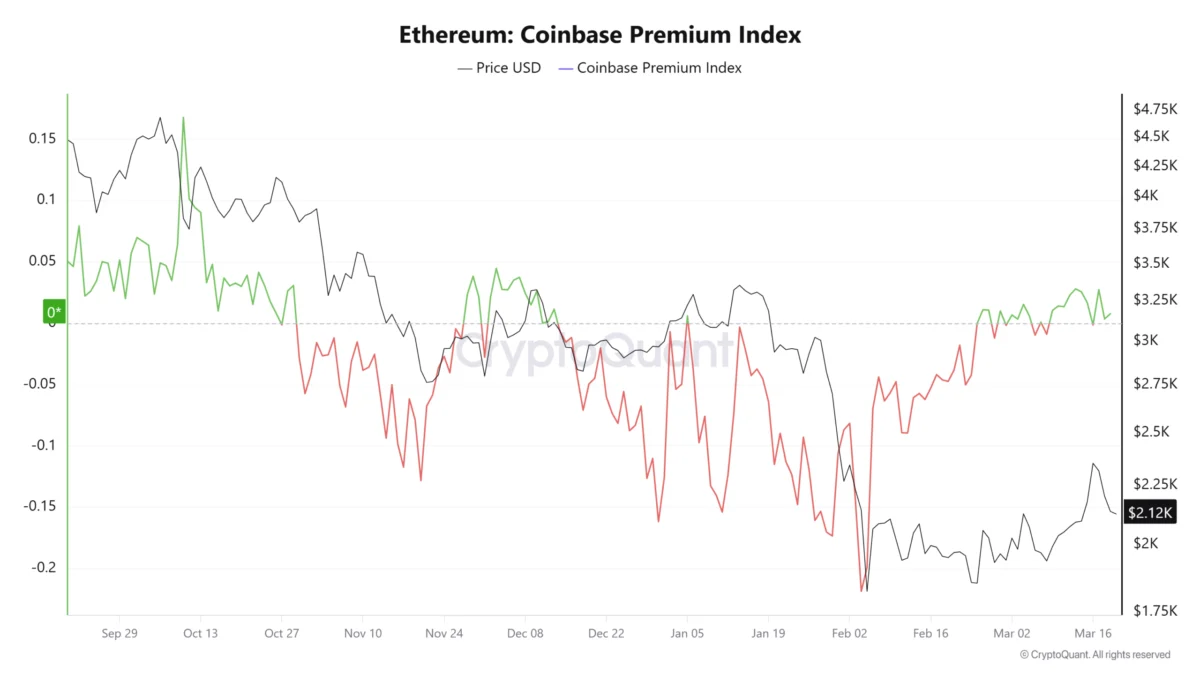
A pivotal onchain indicator for Ether (ETH), the native cryptocurrency of the Ethereum network, has recently ascended to its highest point in over three years, a level last observed during the trough of the 2022 bear market cycle. This significant surge in positive net taker volume is prompting analysts to consider the possibility of an early bottoming phase for ETH, even as the broader market grapples with subdued spot demand and relatively muted price action. While data hints at a potential stabilization around the $2,000 mark, the dynamic nature of cryptocurrency markets means that a sweep of lower price levels remains a tangible, albeit less likely, prospect in the coming weeks.
Deciphering the Taker Flow: A Bullish Undercurrent
The core of this optimistic signal lies in the 30-day average of positive Ether net taker volume, which dramatically climbed to $142 million on March 17. This figure is not merely a data point; it represents a significant psychological and technical shift, mirroring levels last recorded on July 18, 2022. To understand its importance, one must delve into the mechanics of net taker volume. This metric quantifies the difference between aggressive buyers and sellers within derivatives markets. When a market participant places a "taker" order, they are actively taking liquidity from the order book by matching an existing "maker" order. A positive reading, therefore, indicates that market orders are predominantly leaning towards buyers, suggesting an aggressive accumulation phase.
Historically, such pronounced surges in net taker volume have coincided with critical transitional periods in Ether’s price trajectory. The mid-2022 spike, for instance, occurred when ETH was navigating a severe correction phase, ultimately establishing a significant bottom before a subsequent recovery. Similarly, August 2020 saw a comparable expansion in taker volume, preceding a substantial upward movement in Ether’s price. These historical precedents suggest that the current surge could be indicative of traders strategically repositioning their portfolios and increasing their exposure to ETH while the price hovers near what could be a crucial market floor. This pattern implies that sophisticated market players might be accumulating Ether, anticipating a future price appreciation, despite the prevailing lack of strong bullish momentum in the spot market.

The Context of the 2022 Bear Market Lows
To fully appreciate the significance of the current taker flow, it’s essential to recall the market conditions of July 2022. This period represented one of the most challenging phases in recent cryptocurrency history. The collapse of the Terra/LUNA ecosystem in May 2022 sent shockwaves across the digital asset landscape, wiping out billions in market capitalization and severely eroding investor confidence. This was followed by the insolvency of major crypto lenders like Celsius Network and Three Arrows Capital (3AC), further exacerbating the liquidity crisis and market contagion. By July, the market was gripped by extreme fear, with Bitcoin hovering around $20,000 and Ether struggling to maintain support above $1,000. It was amidst this backdrop of widespread capitulation and uncertainty that the Ether net taker volume registered its previous high.
At that time, the aggressive buying indicated by the taker volume suggested that some astute investors were viewing the market downturn as a generational buying opportunity, accumulating ETH at deeply discounted prices while others were liquidating their holdings. Following this July 2022 spike, Ether did indeed stabilize and subsequently embark on a relief rally that carried it well above the $1,500 mark by August 2022, demonstrating the indicator’s predictive power in identifying market bottoms. The current replication of this pattern, therefore, lends considerable weight to the argument for an imminent or already established local floor for ETH.
Complementary Signals: The Coinbase Premium and US Institutional Interest
Further bolstering the bullish onchain narrative is the Ethereum Coinbase premium index, which has maintained a positive trajectory since February 24. This index measures the price difference of Ether on Coinbase Pro compared to other exchanges, particularly those catering to Asian markets. A sustained positive premium on Coinbase, a platform heavily favored by US-based institutional investors and larger retail participants, is often interpreted as a sign of robust buying pressure originating from the United States.

The consistent positivity of this premium suggests that US investors are willing to pay a slight premium for Ether, indicating strong underlying spot demand. This demand is critical, as it signifies actual asset accumulation rather than speculative derivatives trading. Given the increasing institutional interest in cryptocurrencies, particularly with the recent approval of Bitcoin spot ETFs and ongoing discussions around similar products for Ethereum, a healthy Coinbase premium suggests that sophisticated capital continues to flow into the asset. This influx of capital from a key demographic is a powerful counterpoint to the overall "muted price action" observed by some analysts, implying that while overall market sentiment might be cautious, a specific segment of powerful buyers remains actively engaged.
The Paradox of Bullish Onchain Data and Muted Price Response
Despite these compelling onchain signals pointing towards a potential bottom, the market’s immediate price response has remained relatively subdued. Crypto analyst Pelin Ay of CryptoQuant highlighted this paradox, noting that while the "supply side is bullish," there appears to be a noticeable absence of dominant buy demand capable of driving significant price appreciation. Ay suggested that buyers might still perceive the current price levels as expensive, preferring to wait for a potential deeper correction before committing substantial capital.
This phenomenon can be attributed to several factors. Firstly, market psychology plays a crucial role. After periods of volatility or uncertainty, investors often become more risk-averse, preferring to err on the side of caution. The memory of recent market downturns might lead to a collective "wait-and-see" approach, where even strong onchain signals are met with skepticism until confirmed by more decisive price movements. Secondly, the broader macroeconomic landscape continues to present headwinds. Persistent inflation concerns, evolving monetary policies from central banks, and geopolitical tensions can inject uncertainty into all asset classes, including cryptocurrencies. Investors might be holding cash, anticipating further market-wide corrections that could present even more attractive entry points.
Furthermore, the "supply side is bullish" aspect Pelin Ay refers to can be elaborated. Ethereum’s supply dynamics have been increasingly favorable. The implementation of EIP-1559 in August 2021 introduced a mechanism that burns a portion of transaction fees, making Ether a deflationary asset during periods of high network activity. Coupled with the massive amount of ETH locked in staking contracts (currently over 26% of the total supply), the available supply on exchanges has been steadily decreasing, indicating a long-term holding sentiment among many participants. While this reduction in liquid supply is inherently bullish, its impact on price can be dampened if new demand doesn’t materialize aggressively enough to absorb the existing supply at current levels. This creates a delicate balance where fundamental strength is present, but short-term price discovery is stalled by cautious demand.

Critical Price Levels and Liquidation Dynamics
The immediate future for Ether’s price action hinges on several critical technical levels. Short-term support is currently aligned with the 100- and 200-period exponential moving averages (EMAs), traditional indicators often used to gauge momentum and identify potential support or resistance. Ether’s price has been observed compressing near an ascending trendline, a pattern that, while typically bullish, can lead to a significant move in either direction upon a breakout or breakdown. A breach of this trendline could shift focus towards lower liquidity zones, potentially triggering a cascade of selling pressure.
Analysts are closely monitoring the internal liquidity zones between $2,100 and $2,000, with a more pronounced cluster of liquidity identified near $1,905. These levels are significant because they often represent areas where a large volume of buy or sell orders are concentrated, acting as either strong support or resistance. A particularly concerning point for traders is a substantial liquidation cluster positioned at $1,976. At this level, over $3 billion in long positions are open, meaning that if the price falls to or below this point, these leveraged positions could be automatically closed out by exchanges. Such forced liquidations can create a short-term imbalance in the market, pushing prices even lower as a wave of sell orders hits the market, a phenomenon known as a "liquidation cascade."
However, this scenario also presents a dual possibility. If strong buying demand emerges at these critical junctures, particularly around the $2,000 psychological barrier, these liquidation zones could transform into powerful demand zones. In such a scenario, new buyers might step in to absorb the selling pressure from liquidations, thereby supporting a price rebound and preventing a deeper downturn. This dynamic interplay between liquidation risk and potential demand absorption will dictate Ether’s immediate price trajectory.
Prominent crypto trader EliZ has underscored the paramount importance of the $2,000 threshold on the daily timeframe. According to EliZ, maintaining a price above this level is crucial for keeping Ether’s medium-term trend intact. A sustained break below $2,000, however, would likely shift market sentiment towards aggressive short exposure, with lower price targets coming into sharp focus. These lower targets, depending on the severity of the breakdown, could range from the aforementioned $1,905 liquidity cluster down to potentially even $1,800 or lower, should panic selling ensue.

Broader Market Sentiment and Implications
The current situation for Ether is a microcosm of the broader cryptocurrency market’s evolving landscape. The "Crypto Fear and Greed Index," a widely followed gauge of market sentiment, has shown signs of rebounding from extreme lows. This suggests that while caution persists, the deepest levels of fear might be receding, potentially paving the way for renewed investor interest. This aligns with the onchain data suggesting accumulation, as periods of extreme fear often present the best long-term buying opportunities for contrarian investors.
The implications of these conflicting signals are multifaceted. For individual investors, the current environment demands a nuanced approach. While the onchain indicators suggest underlying strength and potential for a bottom, the lack of immediate price confirmation and the presence of significant liquidation risks necessitate careful risk management. Traders might eye the $2,000 level as a critical pivot, adjusting their strategies based on its defense or breach.
For the Ethereum ecosystem, continued accumulation by aggressive buyers and sustained institutional interest (as indicated by the Coinbase premium) are positive signs for its long-term health. These metrics suggest that despite short-term price volatility, confidence in Ethereum’s fundamental value proposition – its role as a leading smart contract platform, the backbone of decentralized finance (DeFi), and the host for countless dApps and NFTs – remains robust. The ongoing development of Layer 2 solutions and scalability improvements further enhance its utility and potential for future growth, making it an attractive asset for long-term holders.
However, the path forward is unlikely to be linear. The crypto market remains highly sensitive to macroeconomic shifts, regulatory developments, and major industry events. Any significant change in global interest rates, stricter regulatory frameworks, or another major industry setback could quickly override even the most bullish onchain signals. Therefore, while the current onchain data offers a glimmer of optimism, market participants are advised to exercise prudence and conduct thorough due diligence, recognizing that investment in digital assets carries inherent risks. The next few weeks will be crucial in determining whether these bullish onchain signals translate into a definitive price recovery or if Ether is destined for a retest of lower support levels before finding its true floor.