Lina Wu
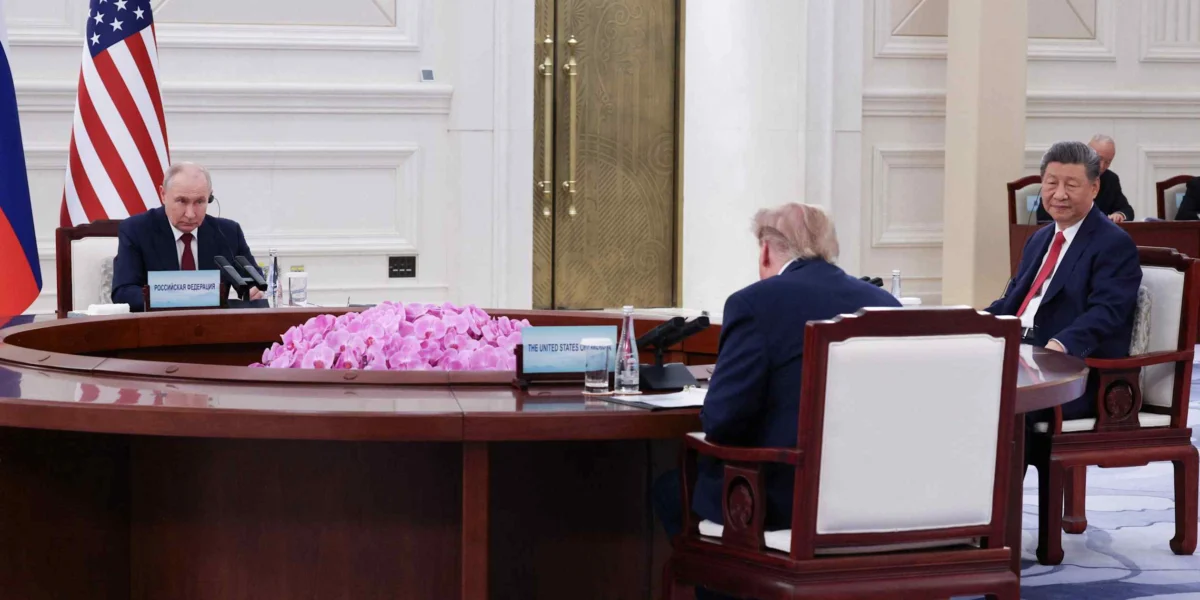
The recent trilateral summit held on the sidelines of the Asia-Pacific Economic Cooperation (APEC) Leaders’ meeting in Shenzhen, China, has ignited a flicker of hope for renewed dialogue on arms control with two of the world’s most significant nuclear powers: China and Russia. The meeting, which convened U.S. President Donald Trump with Chinese President Xi Jinping and Russian President Vladimir Putin, marks a pivotal moment in a geopolitical landscape increasingly defined by strategic competition and the erosion of existing arms control frameworks. While the summit has undeniably opened a door for future discussions, the path toward substantive arms talks and verifiable agreements is likely to be protracted and fraught with challenges, necessitating careful diplomatic maneuvering and a clear understanding of the underlying strategic motivations of each participating nation.

A Diplomatic Breakthrough Amidst Rising Tensions
The gathering in Shenzhen on November 19, 2026, was notable not only for its high-profile attendees but also for its timing. It occurred against a backdrop of escalating global security concerns, including ongoing territorial disputes in the South China Sea, persistent tensions on the Korean Peninsula, and the broader strategic competition between the United States and both China and Russia. The erosion of key arms control treaties, such as the Intermediate-Range Nuclear Forces (INF) Treaty and the Open Skies Treaty, has further contributed to an atmosphere of uncertainty and distrust. Against this backdrop, the willingness of all three leaders to engage in direct dialogue, even if informal and brief, is a significant diplomatic development.
The image of Presidents Trump, Xi, and Putin engaged in a meeting, captured and widely disseminated, symbolized a potential shift in approach. For years, the prevailing narrative has been one of increasing confrontation, with limited channels for de-escalation or strategic communication between these major powers. The Shenzhen summit, therefore, represents a potential recalibration, signaling a recognition of the shared risks associated with an unconstrained arms race and the imperative of establishing clearer lines of communication.

The Genesis of the Shenzhen Summit
The impetus for such a meeting, while not officially detailed, can be inferred from the evolving geopolitical realities. The United States, under the Trump administration, had previously expressed concerns about the growing capabilities of both China and Russia, particularly in the realm of advanced weaponry and nuclear modernization. Beijing, in turn, has consistently advocated for multilateral arms control discussions that include all nuclear-armed states, a stance that implicitly challenges the traditional bilateral frameworks that have dominated the arms control landscape. Moscow, meanwhile, has sought to reassert its global influence and has expressed frustration with what it perceives as U.S. unilateralism in security matters.
The APEC summit provided a convenient and pre-existing platform for these leaders to convene. The agenda of APEC, which focuses on economic cooperation, often brings together leaders from across the Pacific Rim. However, the geopolitical implications of such a meeting often transcend its stated economic objectives. The opportunity for a high-level, albeit informal, interaction between the leaders of the world’s three largest military powers was too significant to pass up, especially for those seeking to inject a degree of predictability into the international security environment.

Potential Avenues for Arms Talks
The opening provided by the Shenzhen summit suggests several potential avenues for future arms control discussions:
-
Multilateral Nuclear Dialogue: The long-standing call for a multilateral approach to nuclear disarmament, championed by China and increasingly supported by Russia, could gain traction. Such a framework would necessitate the inclusion of all nuclear-armed states, not just the U.S. and Russia, thereby broadening the scope of discussions beyond traditional bilateral agreements. This could involve exploring confidence-building measures, transparency initiatives, and ultimately, verifiable reductions in nuclear arsenals.

-
Strategic Stability Talks: The concept of strategic stability, which aims to prevent escalation during crises and maintain a balance of power, could be a focal point. Discussions could center on emerging technologies, such as hypersonic weapons, artificial intelligence in military applications, and cyber warfare capabilities, which are increasingly challenging existing arms control paradigms. The aim would be to establish norms of behavior and reduce the risk of miscalculation.
-
Conventional Arms Control: While nuclear weapons often dominate headlines, discussions could also encompass the proliferation and development of advanced conventional weaponry. This could include limiting the deployment of certain types of missiles, naval assets, or the development of autonomous weapons systems that raise ethical and strategic concerns.

-
Transparency and Verification Mechanisms: A crucial element of any future arms control regime will be robust verification and transparency mechanisms. The summit may have laid the groundwork for discussions on how to establish such systems, particularly in light of the complexities introduced by new technologies and the differing approaches of the U.S., China, and Russia to intelligence sharing and on-site inspections.
Challenges and Obstacles Ahead
Despite the potential for progress, the road to meaningful arms control agreements with China and Russia is likely to be long and arduous. Several significant challenges loom large:

-
Deep-Seated Mistrust: Decades of strategic competition have fostered a deep-seated mistrust among the U.S., China, and Russia. Overcoming this ingrained suspicion will require sustained diplomatic engagement, consistent communication, and a demonstrable commitment to de-escalation from all sides.
-
Divergent Strategic Interests: Each nation possesses distinct strategic interests and threat perceptions. China’s focus on regional security and its growing global ambitions, Russia’s desire to reassert its influence and counter perceived Western encroachment, and the U.S. commitment to maintaining its global leadership all create complex overlapping and conflicting objectives that will need to be carefully navigated.

-
The Nature of Modern Warfare: The rapid evolution of military technology, particularly in areas like cyber warfare, artificial intelligence, and autonomous systems, presents novel challenges for traditional arms control frameworks. Defining and verifying limits on these new domains of conflict will require innovative approaches and a willingness to adapt existing treaties or create entirely new ones.
-
The Role of Domestic Politics: Domestic political considerations within each country will inevitably influence their negotiating positions. In the United States, for example, different administrations may adopt varying approaches to arms control, potentially creating instability in long-term diplomatic efforts. Similarly, domestic priorities in China and Russia could shape their willingness to engage in concessions or embrace new arms control measures.

-
The Multilateral Dilemma: While a multilateral approach is often seen as the most equitable way forward, it also presents its own set of complexities. Reaching consensus among a larger group of nations, each with its own unique interests and concerns, can be a protracted and challenging process.
Expert Reactions and Inferred Responses
While official statements following the summit were likely to have been carefully calibrated to reflect a sense of measured optimism, reactions from defense analysts and security experts have been more varied. Many have lauded the initiative for opening dialogue, emphasizing that any communication is better than none. However, concerns have also been raised about the substance of the discussions and the likelihood of concrete outcomes.

For instance, it can be inferred that the U.S. delegation, while engaging in dialogue, would likely have reiterated its concerns about China’s rapidly expanding nuclear arsenal and Russia’s perceived violations of past arms control agreements. China, in turn, would likely have reiterated its stance on the need for all nuclear powers to participate in disarmament talks and its opposition to missile defense systems that it views as threatening its strategic deterrent. Russia might have used the occasion to press for greater strategic parity and to express its concerns about NATO expansion and U.S. military deployments.
The absence of a joint communiqué or a detailed agreement from the summit suggests that the discussions were primarily exploratory. However, the very fact that the leaders met and reportedly engaged in discussions on security matters is a significant signal. It implies a recognition, at the highest levels, that the current trajectory of military competition is unsustainable and carries unacceptable risks.

Looking Ahead: A Long Game of Diplomacy
The Shenzhen summit, therefore, should be viewed not as an immediate solution to the complex challenges of arms control but as a crucial first step. The opening of a channel for dialogue with China and Russia on strategic stability and arms control is a positive development, but the real work of building trust, identifying common ground, and forging verifiable agreements lies ahead.
The success of these future endeavors will depend on a sustained and patient diplomatic effort, a clear understanding of the strategic motivations of all parties, and a willingness to adapt to the evolving nature of warfare. The world will be watching closely to see if the nascent hope sparked in Shenzhen can be translated into tangible progress that enhances global security and reduces the specter of a new arms race. The coming months and years will reveal whether this summit was a fleeting moment of diplomatic engagement or the harbinger of a more stable and secure future. The challenges are immense, but the potential rewards of successful arms control negotiations are equally profound, offering a path towards a less volatile and more predictable international security environment.