Clara Shinta
Somewhere between a significant cryptocurrency exchange hack and the United States midterm elections, Paul Sztorc’s long-anticipated Bitcoin fork, christened the eCash network, officially commenced operations on October 29, 2022. This launch marks a pivotal moment for Sztorc, the founder of LayerTwo Labs and the principal architect behind the Bitcoin Drivechain proposals BIP300 and BIP301, as it introduces a distinct Bitcoin derivative designed to enhance capabilities for payments, privacy, and a broader array of decentralized applications, all built upon Bitcoin’s foundational code.
Sztorc’s motivation for initiating this hard fork stems from a profound disagreement with what he perceives as "degrowth policies" and "complacency narratives" stifling innovation within the Bitcoin ecosystem. He expressed his conviction to Magazine, stating, "We need to actively sabotage the ‘degrowth’ policies killing Bitcoin." He further articulated a desire to empower true Bitcoin builders, providing them with the necessary tools for innovation, and extending an invitation to "open-minded, risk-taking contrarians to come and build." The activation of the eCash network provides a notable, immediate benefit to eligible Bitcoin holders: a 1:1 distribution of the new chain’s native token, ECX, mirroring their Bitcoin balance at the time of the fork. This development prompts crucial questions regarding the practical advantages eCash offers to developers and the utility of these newly acquired coins for Bitcoin HODLers.
The Genesis of eCash: A Vision for Scalability and Innovation
eCash emerges as a direct hard fork of Bitcoin, conceived and developed by Sztorc’s LayerTwo Labs. Its creation is a testament to Sztorc’s long-standing frustrations with the perceived stagnation and "cult-like toxicity" he believes have impeded Bitcoin’s evolutionary trajectory. For over a decade, Sztorc has been a vocal advocate for Drivechains, a concept he posits as essential for unlocking Bitcoin’s full potential. His argument centers on the idea that Bitcoin’s notoriously conservative development philosophy, while prioritizing security and decentralization, has inadvertently suppressed the experimental drive necessary for broader adoption and utility. "Anything that isn’t maximizing network usage is simply a distraction," Sztorc asserts, emphasizing that "users, the ones who actually pay transaction fees to miners, will win in the long run."
The core innovation underpinning eCash is its implementation of Drivechains, a sophisticated system designed to grant developers unparalleled freedom to construct independent sidechains. These sidechains can host diverse features and applications without necessitating modifications to the eCash base-layer protocol, mirroring the original intention for Bitcoin’s base layer. This architectural choice allows for rapid experimentation across various domains, including enhanced payment systems, privacy-centric applications, digital asset management, and prediction markets. Simultaneously, this model is engineered to incentivize miners by offering additional transaction fees generated from these sidechains, thereby enabling them to "maximize their revenues."
Drivechains Explained: Technical Deep Dive and Philosophical Underpinnings
Drivechains, formally introduced through Bitcoin Improvement Proposals (BIPs) 300 and 301, represent a distinctive approach to Bitcoin scalability and extensibility. Unlike other Layer-2 solutions like the Lightning Network, which focuses on off-chain payment channels, or federated sidechains like Liquid, which rely on a trusted federation of functionaries, Drivechains propose a "two-way peg" mechanism that is secured by the main chain’s miners. This mechanism allows Bitcoin (or in this case, ECX) to be transferred to and from a sidechain in a trust-minimized manner.
The crucial technical component is the "blind merged mining" feature. Miners on the main eCash chain implicitly secure transactions on the attached Drivechains without needing to understand or validate the specific rules of each sidechain. This is achieved by including "sidechain withdrawal votes" within the main chain blocks. When users wish to withdraw funds from a sidechain back to the main chain, a sufficient number of these miner votes over a specific period (the "withdrawal period") are required to authorize the release of funds. This design offloads the complexity of sidechain rule enforcement from the main chain, preserving the simplicity and security of the base layer while allowing for extensive innovation on parallel chains.
Sztorc’s vision for Drivechains is rooted in a belief that Bitcoin’s core should remain immutable and minimalist, serving as a robust settlement layer, while innovation should be pushed to sidechains. This contrasts sharply with the "maximalist" viewpoint prevalent in some Bitcoin circles, which often views any significant alteration or fork as a dilution of Bitcoin’s fundamental value proposition. Sztorc, however, argues that the lack of flexibility on Bitcoin’s mainnet has pushed innovation towards alternative cryptocurrencies (altcoins), and that Drivechains provide a mechanism to bring that innovation back to a Bitcoin-derived security model. He views Drivechains not just as a scaling solution, but as an "altcoin killer," by providing a superior, more secure environment for developing novel blockchain applications.
Initial Sidechain Offerings and Future Prospects
Accompanying the launch of eCash’s mainnet were five distinct sidechains, each targeting specific use cases and demonstrating the versatility of the Drivechain architecture. These include:
- BitNames: Likely designed for decentralized identity or domain name services, offering human-readable addresses or verifiable digital identities.
- BitAssets: Intended for the creation and management of various digital assets, potentially including tokenized securities, stablecoins, or NFTs, allowing for more flexible asset issuance than currently possible on Bitcoin.
- Thunder: Aims to provide fast, high-volume transactions, potentially competing with or complementing existing payment networks, perhaps with a focus on micro-payments or instant settlements.
- Truthcoin: Historically, "Truthcoin" refers to Sztorc’s own earlier work on decentralized prediction markets, suggesting this sidechain will enable censorship-resistant forecasting platforms.
- zSide: Implies a focus on enhanced privacy, potentially integrating zero-knowledge proofs or other cryptographic techniques to obscure transaction details while maintaining verifiability.
Looking ahead, LayerTwo Labs has announced two additional sidechains currently under development:
- Photon: Expected to focus on quantum resistance, a critical area of research given the theoretical threat quantum computing poses to current cryptographic standards.
- CoinShift: Envisioned as a decentralized exchange (DEX), offering peer-to-peer trading of various digital assets without relying on centralized intermediaries.
The breadth of these initial and upcoming sidechains underscores Sztorc’s ambition to create a vibrant, developer-friendly ecosystem that addresses a wide spectrum of decentralized application needs, leveraging the security foundation of a Bitcoin-derived blockchain.
Accessing and Managing ECX Tokens
The eCash fork officially occurred at Bitcoin block 973,728. Consequently, any individual or entity holding the private keys to their Bitcoin at that precise moment automatically became eligible to receive an equivalent balance of ECX tokens on the new eCash network. LayerTwo Labs affirmed the simplicity of this distribution, stating, "If you held the keys to your BTC at that exact block, you now own the exact same amount of ECX. It is that simple, and you can access them right now."

However, the practicalities of accessing and managing these new tokens are more nuanced. Bitcoin holders who self-custody their coins must navigate a specific process to separate their ECX from their BTC holdings. A critical warning issued by LayerTwo Labs pertains to replay protection: "Never move your BTC first, as an ordinary, unprotected BTC spend can easily be replayed on the ECX network." This is due to the shared transaction history between the two chains. While replay controls are reportedly built into the eCash protocol, the company strongly advises users to move their ECX first before transacting with their BTC to mitigate the risk of unintended double-spending on the parallel chain.
For Bitcoin holders whose assets reside on centralized exchanges, the process is largely dependent on the exchange’s policies. These users are "at their mercy regarding distribution," meaning they must await an announcement from their respective exchange regarding support for the fork and the planned distribution of ECX tokens. As with any significant financial event involving new asset classes, potential tax implications arise from receiving new coins via a fork. Users are strongly advised to consult with tax professionals to understand their obligations before filing their next tax return.
Market Reception and Trading Availability
The initial market reception for ECX has been characterized by limited liquidity and fragmented exchange support, which is typical for newly launched hard fork tokens. While accessing ECX tokens is the first step, the ability to trade or convert them into other assets is crucial for realizing their value. As of the initial reporting period around November 5, 2022, availability on major cryptocurrency exchanges remained scarce.
NeoxEX was among the first platforms to announce support, opening native ECX deposits, withdrawals, and trading on October 29, offering ECX/USDT, ECX/USDC, and ECX/BTC trading pairs. CoinW also indicated plans to distribute ECX to eligible Bitcoin holders, with details on deposits, withdrawals, and trading to be announced at a later date. Decentralized finance (DeFi) avenues also emerged, with Orca, a decentralized exchange on the Solana blockchain, allowing users to swap USDC for wrapped ECX (wECX) through a dedicated liquidity pool. While this provides an alternative trading route, it involves a wrapped token on a different blockchain, rather than direct trading of native ECX on the eCash network itself.
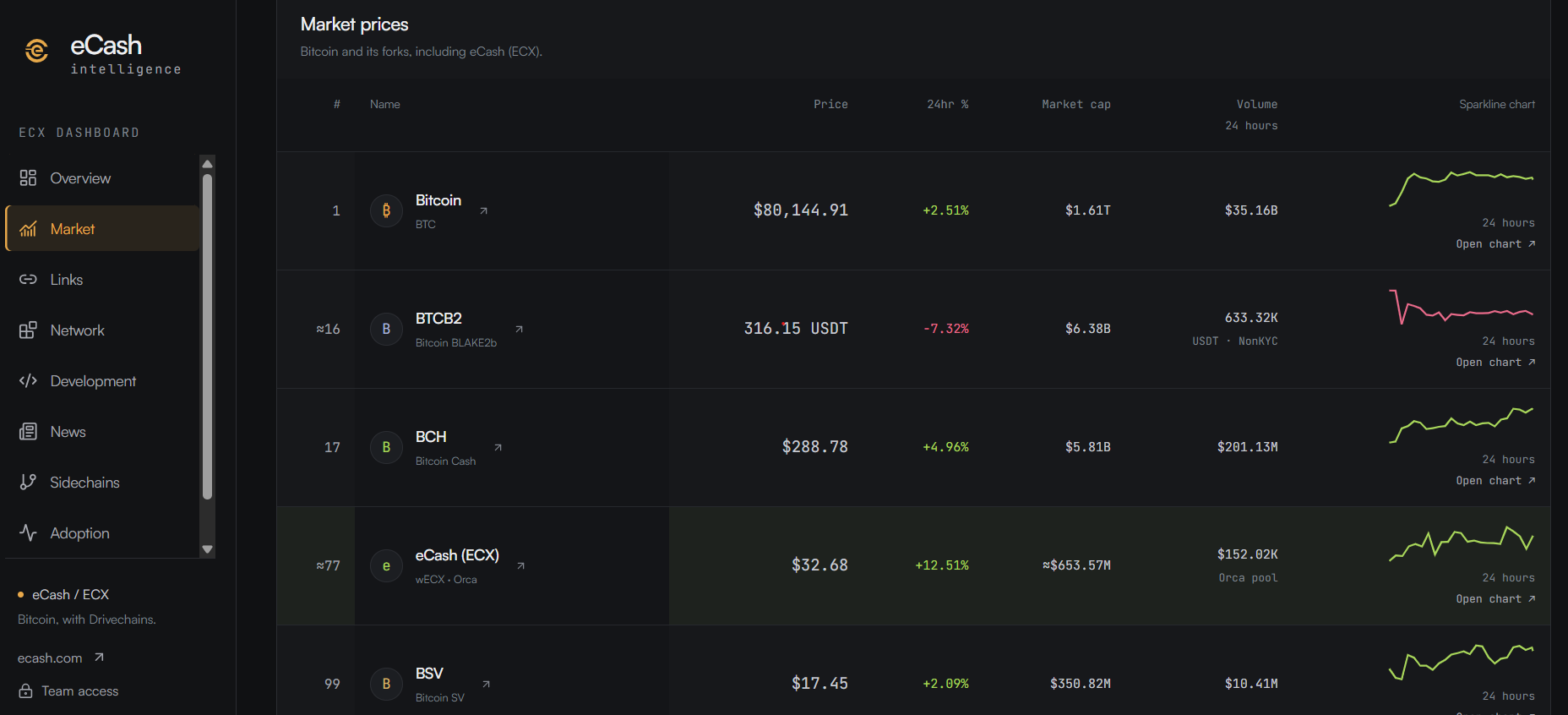
Market data has been inconsistent, reflecting the early stages of the token’s lifecycle. CoinMarketCap reported ECX at $32.63 with approximately $355,000 in 24-hour trading volume as of November 5. In contrast, CoinGecko listed the token as a "preview listing," indicating no available price or tracked exchange markets. Furthermore, prominent crypto market data provider Kaiko stated it did not track ECX, further limiting the availability of independent, comprehensive market analytics. LayerTwo Labs, however, cited early trading fluctuations for ECX between $40 and $50, although it did not provide specific order book depth or trading volume figures to corroborate these claims, instead pointing to Orca’s total value locked as a metric for assessing available liquidity.
Sztorc remains optimistic about ECX’s long-term market potential, drawing parallels to the initial performance of previous Bitcoin forks. "If our fork replicates even a fraction of [Bitcoin Cash] BCH’s initial performance," he remarked, "the liquidity will be staggering." He reassured potential holders that those concerned about low liquidity could simply hold their coins and decide on their strategy later, adding, "We are actively adding new exchanges and trading pairs, so the user experience will only improve. Otherwise, you’re welcome to take your free money and leave."
Broader Implications and Future Outlook
The launch of eCash and its Drivechain architecture presents a compelling, albeit controversial, alternative vision for the evolution of Bitcoin-derived networks. It challenges the prevailing conservative ethos within the Bitcoin core development community, advocating for a more aggressive approach to innovation and feature integration through sidechains. Sztorc firmly believes that the ultimate value of eCash will be determined by its utility—specifically, whether developers choose to build valuable applications on its sidechains and if users are willing to pay for those applications. His primary metrics for success during the first year revolve around "paying customers and transaction fee revenue."
One of the most persistent criticisms leveled against Drivechains, and one Sztorc frequently dismisses, concerns their security model, particularly the theoretical risk of miner coordination to steal funds held on sidechains. Critics argue that the two-way peg mechanism, reliant on miner votes, introduces a potential vector for collusion, where a majority of miners could conspire to censor withdrawals or even outright steal funds from sidechains. Sztorc vehemently refutes this "superstition," arguing that such an act would be economically irrational for miners. "If you genuinely believe miners will torch their own billion-dollar operations for a short-term theft on an L2, then you shouldn’t trust Bitcoin’s L1 either," he contends, highlighting the massive capital investment miners have in the underlying network’s security and reputation.
The eCash project enters a crowded and competitive landscape of Layer-2 solutions and alternative blockchain networks. Its success will be a litmus test for whether a miner-backed sidechain model, championed by Sztorc for so long, can attract a critical mass of developers and users. If eCash can foster a robust ecosystem of innovative applications, it could demonstrate a viable path for Bitcoin-like networks to expand their functionality without compromising the core principles of decentralization and security. Conversely, if it struggles to gain traction, it may reinforce the arguments of those who prefer a more cautious, minimalist approach to Bitcoin’s evolution or who believe other Layer-2 technologies are more suitable.
For now, eCash offers Bitcoin holders a new asset and developers a novel environment for experimentation. The journey ahead for ECX and the eCash network will be closely watched, as its ultimate impact on the broader cryptocurrency landscape hinges on its ability to deliver on its promise of innovation, utility, and widespread adoption. The question remains whether ECX will transcend its initial status as a windfall asset to become a significant player in the ongoing quest for scalable, feature-rich blockchain solutions.