Clara Shinta

Attackers behind a colossal breach of Binance, the world’s largest cryptocurrency exchange, are still in control of billions of dollars in stolen digital assets, despite rapid and coordinated efforts by token issuers to freeze a significant portion of the proceeds. This unprecedented incident, estimated at $6.3 billion, marks the largest cryptocurrency theft in history and has sent ripples through the digital asset ecosystem, raising critical questions about security, centralization, and the persistent threat of state-sponsored cybercrime.
The meticulously executed attack commenced at approximately 8:04 pm UTC on a recent Thursday, with the perpetrators immediately embarking on a sophisticated conversion strategy. Crypto investigators have quickly linked the incident to the same North Korean hacking entities suspected of orchestrating last month’s Bitget hack, indicating a pattern of increasingly audacious and large-scale exploits. These groups are widely believed to be the Lazarus Group, a state-sponsored collective notorious for leveraging cybercrime to fund North Korea’s illicit weapons programs. Their modus operandi typically involves targeting high-value crypto platforms and quickly liquidating stolen assets through a complex web of transactions to obscure their tracks.
The Unprecedented Scale of the Attack and the Attackers’ Strategy
The sheer magnitude of the Binance hack eclipses all previous crypto thefts, dwarfing even notorious incidents such as the $625 million Ronin Bridge hack in March 2022 or the $610 million Poly Network exploit in August 2021. The initial estimate of $6.3 billion sent shockwaves through the industry, underscoring the severe vulnerabilities that can persist even within the most robust platforms.
The attackers’ game plan was clear and executed with alarming speed: convert assets that possess a centralized "off switch," such as stablecoins like Tether (USDT) and USD Coin (USDC), into decentralized cryptocurrencies like Bitcoin (BTC) and Ether (ETH). This strategic move was designed to circumvent the very mechanisms intended to mitigate theft in the stablecoin ecosystem. Within minutes of the breach, blockchain analytics began to trace the illicit movements. CertiK engineer Dickson Wu, for instance, reported tracing $500 million in USDT to a single address, with a staggering $325 million of that amount rapidly sold to market makers for ETH by 8:59 pm UTC – less than an hour after the initial compromise. This rapid conversion highlights the attackers’ understanding of blockchain mechanics and their urgency to secure assets beyond the reach of centralized control.
A Swift Counter-Offensive: Centralized Control Points in Action
In a testament to the ongoing cat-and-mouse game played out on the blockchain, the attackers were racing against some of crypto’s most powerful gatekeepers: the issuers of stablecoins. Giants like Tether and Circle, recognizing the severity of the situation, swiftly initiated measures to blacklist addresses associated with the theft. This proactive response demonstrated the unique capability of centralized stablecoin issuers to intervene in cases of illicit activity, a feature often debated within the crypto community regarding its implications for decentralization but undeniably crucial in crisis management.
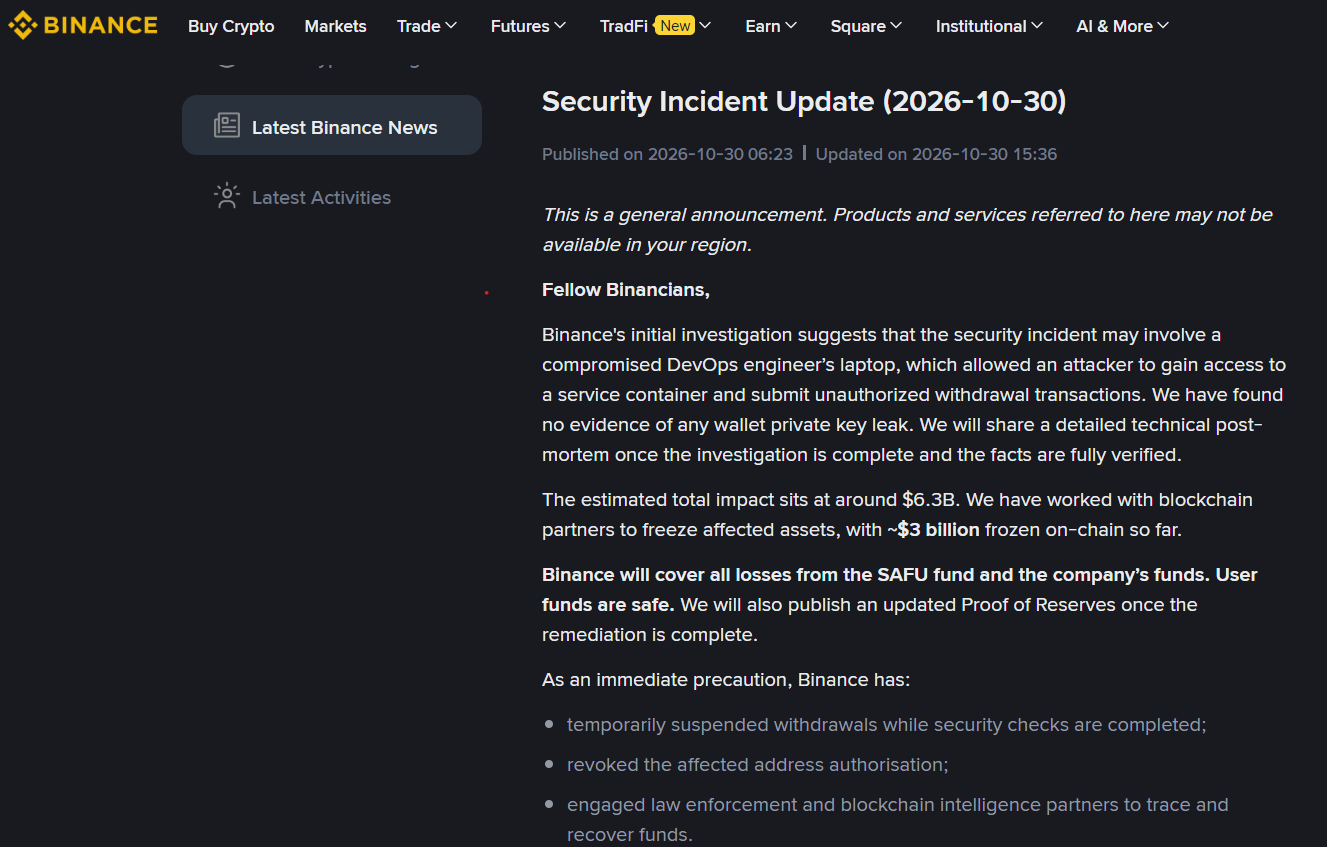
Binance officially stated on Friday that approximately $3 billion of the stolen assets had been successfully frozen on-chain, out of the estimated $6.3 billion total. This immediate immobilization was a direct result of the stablecoin issuers’ rapid response. Binance also affirmed its commitment to working closely with law enforcement agencies, token issuers, and blockchain analytics firms to trace and recover additional funds, emphasizing its dedication to user security and asset recovery.

Crypto with an Off Switch: The Power of Stablecoin Issuers
The ability to freeze tokens is a defining characteristic that differentiates centralized stablecoins from native cryptocurrencies like Bitcoin or Ether. Unlike BTC or ETH, which operate on decentralized networks with no single entity capable of unilaterally halting transactions or freezing funds, stablecoins like USDT and USDC are issued by companies that maintain the power to blacklist specific addresses. This centralized control, often viewed with skepticism by staunch decentralization advocates, proved to be an invaluable tool in containing the damage from the Binance hack.
Tether, the issuer of USDT, acted with remarkable speed, freezing a total of around $1.567 billion in USDT. The first major freeze occurred a mere 37 minutes after the stolen funds arrived in the attacker’s primary Ethereum wallet. Circle, the issuer of USDC, followed suit just three minutes later, immobilizing approximately $823 million in USDC. Other issuers, including Ripple and World Liberty Financial, also joined the coordinated effort, demonstrating a unified front against the cybercriminals.
However, it’s crucial to distinguish between "frozen funds" and "recovered funds." While immobilization prevents the suspected attackers from spending or moving the assets, it does not automatically return them to Binance or the affected users. The frozen assets enter a state of legal and technical limbo, awaiting further action by law enforcement and potentially complex legal processes to facilitate their return.
Decentralized Protocols Join the Fray: The Arbitrum Example
The "off switch" capability is not solely confined to stablecoin issuers. Even some decentralized protocols demonstrated an ability to react to the crisis. Arbitrum, a prominent Layer 2 scaling solution for Ethereum, saw its Security Council take action. They moved approximately $30.5 million in ARB tokens and ETH into an intermediary frozen wallet. These funds can only be moved further after additional action by the council or through a governance vote by the broader Arbitrum DAO, showcasing a form of decentralized governance-led intervention. This incident underscores the evolving landscape of decentralized finance, where community-driven decisions can still play a role in mitigating the impact of security breaches.
The Aave Complication: A Layer of DeFi Complexity
The decentralized lending protocol Aave introduced an additional layer of complexity to the recovery efforts. Between 8:58 pm and 9:01 pm UTC, a wallet linked to the attackers deposited $60 million in USDT into Aave V3 on Ethereum. Immediately thereafter, they borrowed $44.6 million of wrapped Ether (WETH), all occurring approximately 40 minutes before the first freezes began.
LlamaRisk, an Aave risk service provider, later reported that the attacker’s position held around $59.9 million in USDT collateral against $43.8 million in debt. Critically, Aave confirmed that this position remained overcollateralized and did not pose a direct risk to the protocol’s suppliers. Aave Chan Initiative founder Marc Zeller clarified the situation, explaining that while the USDT was deposited into Aave’s lending pool and the position was "criminal," it remained "overcollateralized in the eyes of the protocol." This meant that blacklisting the attacker’s wallet could not automatically retrieve the collateral held within the protocol, as the funds were locked in a smart contract governed by Aave’s rules.
To prevent further exploitation and as a precautionary measure, Aave temporarily froze markets across its V3 and V4 deployments. While existing users could still withdraw funds, repay loans, and liquidate positions, new deposits and borrowing were halted. Aave subsequently lifted this precautionary freeze, confirming that its contracts were unaffected and all positions remained overcollateralized, with Zeller succinctly remarking, "Just another day in crypto." This incident highlights the inherent challenges in recovering funds once they interact with complex, permissionless decentralized finance (DeFi) protocols, even when the underlying assets are technically frozen at the issuer level.
Binance’s Response and Recovery Efforts
In the immediate aftermath, Binance moved swiftly to reassure its user base. Binance CEO Richard Teng provided ongoing updates, affirming that the exchange was actively working with law enforcement, including the FBI, and blockchain forensics experts to trace and recover the stolen assets. Binance reiterated its long-standing commitment to protecting user funds, pledging to cover all losses using its Secure Asset Fund for Users (SAFU) and company funds. The SAFU fund, established in 2018, is designed precisely for such contingencies, holding a percentage of trading fees in a segregated wallet to protect users in extreme circumstances. Teng’s latest updates confirmed that the exchange is already "recovering stolen assets for users," a critical step in restoring confidence.
The Elusive Billions: What Can the Attackers Actually Keep?
Blockchain analytics firm Elliptic estimated that by 7:00 am UTC on Friday, approximately $2.84 billion had been frozen. However, this left roughly $3.33 billion in assets still under the attackers’ control – funds that token issuers could not immobilize. This remaining sum primarily consists of Bitcoin and Ether, which, due to their decentralized nature, lack a central authority to blacklist addresses or unilaterally freeze funds. Once stolen assets are successfully converted into these native cryptocurrencies, restricting their movement becomes significantly more challenging, relying instead on tracing, exchange cooperation, and sophisticated chain analysis to flag and prevent further laundering.
The implications of this unfrozen sum are profound. While law enforcement and blockchain analytics firms can track these assets across the blockchain, preventing their ultimate liquidation into fiat currency or other untraceable forms presents a formidable challenge. The attackers will likely employ a range of sophisticated laundering techniques, including mixing services, privacy coins, and obscure exchanges, to obfuscate the origin of the funds and eventually cash out.
Broader Implications for the Crypto Ecosystem
This historic hack serves as a stark reminder of the persistent security challenges facing the cryptocurrency industry.
- Exchange Security: It underscores the critical need for exchanges to continuously enhance their security protocols, particularly for hot wallets, which are internet-connected and more vulnerable to attack than offline cold storage solutions.
- Centralization vs. Decentralization Debate: The incident reignites the perennial debate within the crypto community regarding the trade-offs between decentralization and practical security measures. While the centralized "off switch" of stablecoins proved effective in mitigating immediate losses, it also highlights a point of control that many in the decentralized movement fundamentally oppose. Conversely, the unfrozen BTC and ETH exemplify the difficulty of recourse when truly decentralized assets are stolen.
- The Threat of State-Sponsored Cybercrime: The strong links to North Korean hacking groups emphasize the growing threat of state-sponsored cybercriminals who view the crypto space as a lucrative avenue for funding their regimes. This trend is likely to intensify, prompting greater collaboration between crypto firms, law enforcement, and national security agencies.
- Regulatory Scrutiny: Such a large-scale theft will undoubtedly draw increased attention from global regulators, potentially accelerating calls for stricter oversight, enhanced AML/KYC (Anti-Money Laundering/Know Your Customer) policies, and more robust cybersecurity standards across the digital asset industry.
- Evolving Recovery Mechanisms: The incident showcases the evolving strategies for asset recovery, involving a complex interplay of on-chain freezing, forensic analysis, and inter-organizational cooperation. The future of crypto security will likely involve more sophisticated predictive analytics and real-time response mechanisms.
The Binance hack is a watershed moment, not just for the exchange itself but for the entire cryptocurrency ecosystem. While a substantial portion of the stolen funds has been immobilized, the ultimate recovery of all assets remains a complex and protracted battle. The ongoing efforts by Binance, law enforcement, and various industry players will be closely watched, as they navigate the intricate landscape of digital asset recovery and strive to uphold trust in a rapidly evolving financial frontier. The incident serves as a powerful testament to the high stakes involved in the world of crypto and the enduring struggle against sophisticated cybercriminals.