Reynand Wu
Gold prices experienced a notable downturn on Friday, failing to sustain earlier gains and struggling to decisively breach the significant $4,200 per ounce milestone. The precious metal, measured by XAU/USD, concluded the trading session approximately 1% lower, settling at $4,138 after reaching an intraday peak of $4,227. This decline was primarily attributed to the persistent upward trajectory of US Treasury yields, which overshadowed a less-than-stellar US employment report that might otherwise have bolstered the appeal of the non-yielding asset. The intricate interplay of these macroeconomic forces painted a complex picture for bullion investors, highlighting the current dominance of interest rate expectations over traditional safe-haven impulses.
A Day of Volatility: Gold’s Struggle at the $4,200 Threshold
The trading day for gold commenced with a promising rally, pushing the yellow metal to an intraday high of $4,227. This brief ascent fueled hopes among bullish traders that gold could finally establish a firm footing above the psychological and technical barrier of $4,200. However, these aspirations proved fleeting. As the session progressed, the momentum waned, and XAU/USD began a steady retreat, ultimately shedding most of its early gains. The inability to consolidate above $4,200, a level that has repeatedly acted as a formidable resistance point in recent trading, signals a persistent bearish sentiment or at least a strong ceiling for immediate upward movements. This resistance is often viewed as a critical juncture; a definitive break above it could signal a sustained rally, while repeated failures reinforce its strength as a barrier.
Treasury Yields Ascendant: A Persistent Headwind for Bullion
A key factor in gold’s Friday decline was the continued rise in US Treasury yields. The benchmark US 10-year Treasury note saw its yield climb by 4 basis points, reaching an elevated 5.9%. This substantial yield, nearing multi-year highs, presents a significant challenge to gold’s appeal. As a non-yielding asset, gold typically struggles in an environment where investors can earn attractive returns from government bonds. The opportunity cost of holding gold increases proportionally with rising bond yields, diverting capital away from the precious metal towards income-generating fixed-income assets.
The current levels of Treasury yields reflect a market grappling with persistent inflation concerns and the Federal Reserve’s hawkish stance. Even with recent signs of economic cooling, the underlying inflationary pressures and the Fed’s commitment to price stability have kept bond yields firm. This environment effectively diminishes gold’s traditional role as a store of value, as the allure of guaranteed, albeit inflation-adjusted, returns from government bonds becomes more compelling. Historically, gold thrives in periods of low real interest rates, where the return on bonds is negligible or negative after accounting for inflation. The current landscape, however, is characterized by relatively high real yields, making it a formidable headwind for bullion.
US Jobs Report: A Mixed Signal Complicated by Participation
Further complicating the market narrative was the release of the US Nonfarm Payrolls (NFP) report for September, which delivered a mixed bag of economic signals. The headline figure came in significantly below expectations, with only 29,000 new jobs added, falling well short of the consensus estimate of 90,000. This figure also represented a substantial deceleration from August’s downwardly revised figure of 133,000, suggesting a tangible slowdown in the US labor market’s hiring pace.
Typically, a weaker-than-expected jobs report might trigger a "dovish" reaction from the market, leading investors to anticipate a more cautious approach from the Federal Reserve regarding interest rate hikes. This would, in turn, often benefit gold, as lower interest rates reduce the opportunity cost of holding the non-yielding asset. However, Friday’s market reaction was nuanced. While the NFP number itself was soft, the unemployment rate edged up from 4.1% to 4.2%. Crucially, this increase was attributed to a rise in the labor force participation rate, indicating more individuals entering or re-entering the job market. A higher participation rate, even if it pushes the unemployment rate slightly higher in the short term, is generally viewed as a positive sign of economic health and confidence, suggesting that underlying labor market strength might be more resilient than the headline NFP number alone suggests. This complexity diluted the dovish implications of the weak NFP, preventing a significant rally in gold.

Federal Reserve’s Nuanced Stance: Dovish Rhetoric Meets Hawkish Reality
Adding another layer to the market’s interpretation were recent comments from key Federal Reserve officials. New York Fed President John Williams and Vice Chair Philip Jefferson both delivered remarks suggesting that the central bank is "not in a rush to raise rates." Such dovish rhetoric from influential Fed members would, under normal circumstances, strongly support gold prices by signaling a potential pause or slowdown in the tightening cycle.
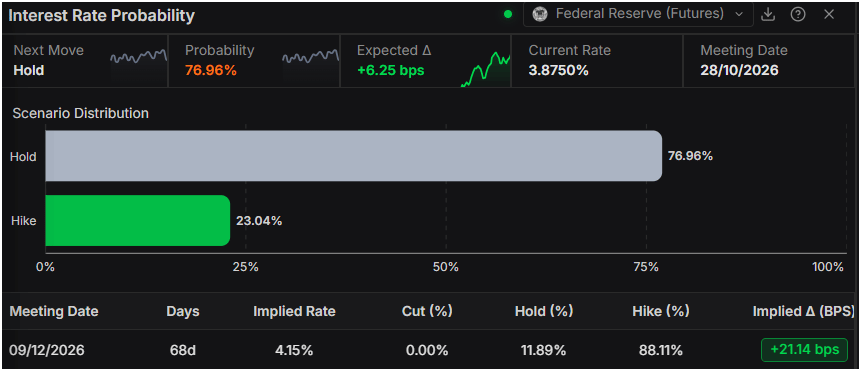
However, the market’s interpretation of these comments, particularly in the context of the elevated Treasury yields, pointed towards a more tactical approach by the Fed rather than a fundamental shift in policy. The prevailing sentiment shifted towards the possibility of an "October skip" – meaning a hold on rate hikes at the upcoming Federal Open Market Committee (FOMC) meeting on October 28 – followed by a likely rate hike in December. According to Prime Terminal data, money markets now assign a nearly 77% probability to a hold in October, but the chances for a December hike are increasing significantly, reaching 88%. This dynamic suggests that while the Fed may choose to exercise patience in the immediate term, the overall trajectory remains one of potential further tightening, keeping the pressure on gold. The market seems to be pricing in a strategic pause to assess incoming data, rather than a definitive end to the hiking cycle, largely driven by the persistence of inflation and resilient aspects of the economy.
The Dollar’s Limited Influence and Geopolitical Undercurrents
Despite gold’s decline, the US Dollar Index (DXY), which measures the dollar’s strength against a basket of six major currencies, was also down by 0.14% at 101.89. Normally, a weaker dollar makes gold more affordable for international buyers, thereby boosting its price. The fact that gold still fell despite a softening dollar underscores the overwhelming influence of rising Treasury yields in the current market environment. The safe-haven appeal of the Greenback appeared to be momentarily diminished, yet this did not translate into a significant advantage for gold, highlighting the current hierarchy of market drivers.
Meanwhile, geopolitical developments, specifically "light news" from the Middle East, also played a role in the broader commodities market, albeit with an indirect impact on gold. Reports suggesting that Europe might consider releasing diesel and crude from its strategic reserves contributed to a decline in energy prices. West Texas Intermediate (WTI), the US crude benchmark, fell by 1.6% to $91.42. While not directly linked to gold, falling energy prices can alleviate inflationary pressures, potentially influencing central bank policy and, by extension, the outlook for interest rates and gold. A reduction in energy-driven inflation could provide the Fed with more flexibility, but the overall impact on gold remains secondary to the direct influence of interest rates and yields.
Gold’s Enduring Role: A Historical Perspective and Modern Drivers
To fully understand gold’s current predicament, it is essential to revisit its fundamental drivers and historical significance. Gold has served as a pivotal store of value and medium of exchange throughout human history, prized for its intrinsic rarity and durability. In modern times, beyond its aesthetic appeal and use in jewelry, gold is predominantly viewed as a safe-haven asset, an investment that tends to retain or increase its value during periods of economic uncertainty, geopolitical instability, or market turmoil. It is also widely regarded as a hedge against inflation and a safeguard against depreciating fiat currencies, as its value is not tied to any single government or issuer.
Central banks globally are the largest holders of gold, meticulously managing their reserves to bolster confidence in their national currencies and economies. Their strategy often involves diversifying reserves to mitigate risks during turbulent times. Data from the World Gold Council reveals that central banks added an unprecedented 1,136 tonnes of gold, valued at approximately $70 billion, to their reserves in 2022 – the highest yearly purchase on record. Emerging economies, notably China, India, and Turkey, have been particularly active in increasing their gold holdings, signaling a broader strategic shift towards diversifying away from traditional reserve currencies and enhancing national financial stability. This consistent institutional demand forms a crucial underlying support for gold prices, even amid short-term market fluctuations.
The inverse correlation between gold, the US Dollar, and US Treasuries is a critical dynamic. When the dollar weakens, gold typically strengthens, as it becomes cheaper for non-dollar holders and its intrinsic value gains prominence. Similarly, higher US Treasury yields, which represent the return on safe-haven government debt, often draw capital away from gold, as investors prioritize yield over non-yielding assets. Conversely, a decline in yields tends to make gold more attractive. Gold also exhibits an inverse correlation with risk assets; a booming stock market often sees capital flowing out of gold into higher-growth opportunities, while market sell-offs in riskier assets frequently drive investors back to the safety of gold.
The price of gold is therefore influenced by a wide array of factors. Geopolitical instability, such as regional conflicts or trade wars, or fears of a deep economic recession can rapidly escalate gold prices due to its safe-haven status. As a yield-less asset, gold tends to perform better when interest rates are low or falling, as the opportunity cost of holding it diminishes. Conversely, a higher cost of money, driven by central bank tightening, usually weighs on the yellow metal. However, the most significant driver of gold prices remains the behavior of the US Dollar, given that gold is primarily priced in dollars (XAU/USD). A strong dollar tends to suppress gold prices, while a weaker dollar is likely to push them higher. In the current environment, the strength of Treasury yields appears to be a dominant factor, overriding even a slightly weaker dollar.
XAU/USD Technical Analysis: Below $4,150, Eyeing Further Downside
From a technical perspective, gold’s failure to decisively clear the $4,200 mark, despite its brief surge to $4,227, is a significant bearish signal that opens the door for further downside. The Relative Strength Index (RSI), a momentum indicator, remains below its 50-neutral level, confirming that sellers currently hold control of the market momentum.
Immediate support for XAU/USD is identified at the $4,100 milestone. Should sellers manage to breach this psychological and technical level, the next likely target for a decline would be the July 29 low of the day (LOD) at $3,996. A break below this level would then bring the July 17 low of $3,959 into focus, suggesting a potential return to price levels not seen in several months.
On the upside, for buyers to regain control and challenge the current bearish trend, they must first reclaim and consolidate above the $4,200 resistance level. A sustained move above this point would then pave the way for a challenge of the 100-day Simple Moving Average (SMA), currently positioned at $4,279. Overcoming the 100-day SMA would be a strong indication of a potential trend reversal or a significant bullish impulse, but the path to such a recovery appears challenging given the current market dynamics.
Looking Ahead: Key Economic Indicators on the Horizon
The coming week promises a busy schedule for the US economic docket, with several key releases that could significantly influence gold prices and the broader market sentiment. Investors will closely watch the ISM Services PMI, which provides crucial insights into the health of the dominant services sector. Further jobs data will also be scrutinized for more clues regarding the labor market’s trajectory and its implications for the Federal Reserve’s policy decisions.
Perhaps most anticipated will be the release of the Federal Open Market Committee (FOMC) Meeting Minutes from its last session. These minutes offer a detailed glimpse into the discussions, concerns, and dissenting opinions among Fed policymakers, providing valuable context for future rate decisions. Additionally, a speech by Fed Governor Bowman will be closely monitored for any shifts in the central bank’s forward guidance. Finally, the University of Michigan Consumer Sentiment report will offer insights into consumer confidence and inflation expectations, which can also play a role in shaping market perceptions of the economy and monetary policy. The cumulative impact of these indicators will be crucial in determining whether gold can find a new catalyst for recovery or if the current pressures will persist.
In conclusion, gold’s performance on Friday underscored a market currently dominated by the allure of higher US Treasury yields, which effectively neutralized any potential upside from a weaker-than-expected jobs report or dovish Fed rhetoric. While the underlying demand from central banks and gold’s historical role as a safe haven remain intact, short-term price action will likely continue to be dictated by the complex interplay of interest rate expectations, inflation concerns, and the US dollar’s relative strength. The $4,200 level remains a critical battleground for bulls and bears, with the path of least resistance currently appearing to be to the downside.