Lina Wu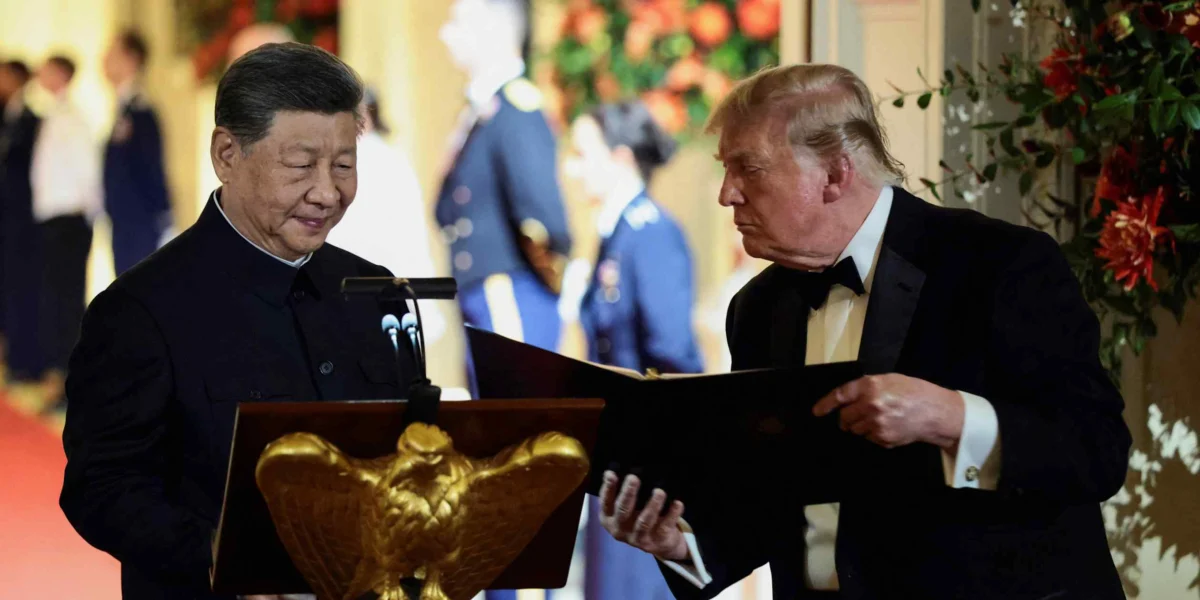
WASHINGTON/NEW YORK/TOKYO — Chinese President Xi Jinping and U.S. President Donald Trump convened for their second summit of the year, a critical dialogue unfolding against a backdrop of escalating trade tensions, complex geopolitical challenges, and profound technological competition. The White House rolled out the red carpet for the Chinese leader, culminating in an elaborate state dinner, as both nations grappled with the delicate balance of their intertwined, yet increasingly contentious, relationship.
The summit, hosted this time in Washington D.C. after Trump’s reciprocal visit to Beijing in May, began with a significant announcement: the extension of the trade truce between the two economic giants. This agreement, initially set to expire on November 10th, will now hold until January 10th, offering a temporary reprieve from further tariff escalations. However, this extension was tempered by cautious optimism, a reflection of the limited tangible outcomes from their previous encounter, which many observers deemed to be more symbolic than substantive. The ever-sensitive issue of Taiwan, a territory claimed by Beijing but defended by democratic institutions, loomed large, particularly given Trump’s prior characterization of arms sales to the island as a potent "negotiating chip."
A Carefully Orchestrated Welcome and Early Discussions
The diplomatic choreography commenced on Wednesday, September 23rd, 2026, with Xi Jinping’s arrival at Joint Base Andrews in the late afternoon. President Trump, breaking with diplomatic convention, personally greeted his counterpart planeside, a gesture signaling the high importance of this engagement. Accompanying Xi were his wife, Peng Liyuan, alongside key officials including Cai Qi, a top aide, and Foreign Minister Wang Yi. The U.S. delegation, led by President Trump and First Lady Melania Trump, ensured a meticulously planned arrival ceremony, complete with a 100-foot red carpet, a salute battery, honor cordon, color guards, a U.S. Air Force band, and flyovers by B1 bombers.
This elaborate welcome underscored the administration’s efforts to project an image of diplomatic engagement, even as internal tensions with the press persisted. Major U.S. media outlets, citing ongoing disputes with the Trump administration, largely opted out of broadcasting the ceremony live. This media standoff, exacerbated by previous attempts to ban certain news organizations from the White House, contrasted sharply with the more open press environment of Xi’s 2015 visit under President Obama.
Key Agreements and Contentious Issues
The early hours of Thursday, September 24th, saw the leaders engage in initial discussions, setting the stage for the day’s more intensive bilateral meetings. President Trump, in his welcoming remarks, spoke of "tremendous strides" and emphasized forthcoming discussions on security, technology, and "super intelligence" – his term for artificial intelligence. He also highlighted efforts to rebalance trade, including securing "new market access" for American farmers, a critical constituency for his administration.
President Xi, addressing the White House for the first time since 2015, stressed the indispensability of partnership between the world’s two largest economies, advocating for mutual respect, trust, and enhanced cooperation. "Without our cooperation between the U.S. and China, it’d be hard to solve many of the world’s problems," he stated, echoing a sentiment of global responsibility.
A significant development emerged from these initial talks: the agreement to extend the trade truce until January 10th, 2027. Treasury Secretary Scott Bessent, who had engaged in prior discussions with Chinese Vice Premier He Lifeng, confirmed the extension, a move welcomed by the European Chamber of Commerce in China as a vital measure to prevent the crippling impact of potential export controls on rare earth materials. However, the chamber also flagged ongoing uncertainties regarding export license applications and a perceived lack of coordination among Chinese authorities.
On the contentious issue of artificial intelligence, President Xi called for the technology to remain under human control, advocating for a "human-centered and benevolent approach." He acknowledged the competitive landscape but also the potential for cooperation, urging both nations to leverage their strengths rather than adopt defensive postures. This discussion on AI guardrails, even amidst broader technological rivalry, signaled a shared concern about the ethical and societal implications of advanced AI development.
The sensitive topic of Taiwan was also addressed. According to a readout from China’s state-run Xinhua News Agency, Xi urged the U.S. to uphold its "correct position" of opposing Taiwan’s independence and to handle the issue with prudence, laying a solid foundation for strategic cooperation. This statement directly reflected concerns within Beijing regarding ongoing U.S. arms sales to the island. Taiwan’s cabinet spokesperson, Michelle Lee, expressed gratitude for U.S. support and affirmed Taipei’s positive view of efforts to stabilize the regional situation, while maintaining close contact with Washington.
In a notable gesture of goodwill, Xi announced that China would send two giant pandas to Zoo Atlanta, a move intended to mend relations after the recall of four pandas in 2024 amid escalating U.S.-China tensions. This "envoy of friendship" underscored the enduring cultural significance of these animals in bilateral diplomacy.
Deep Dive into Economic and Geopolitical Issues
The summit agenda also included discussions on broader geopolitical issues, such as the Middle East, Ukraine, and the Korean Peninsula. China’s stance on Iran, as articulated by Xi, supported a return to dialogue and negotiations, with a hope for a comprehensive agreement, including on the nuclear issue. This position aligned with Beijing’s general advocacy for de-escalation and respect for national sovereignty.
The economic underpinnings of the bilateral relationship were a central focus. Data indicated a significant decline in U.S. soybean exports to China, falling from nearly $18 billion in 2022 to an estimated $3 billion in 2025, a direct consequence of pre-summit tariffs. This shift had benefited Brazil and Argentina, which had gained substantial market share in China. American Soybean Association Vice President Dave Walton expressed hope for the removal of tariffs, describing Xi as a "friend to American agriculture."
The Spectacle of a State Dinner
As evening descended on September 24th, the White House hosted a lavish state dinner, an occasion designed to foster a sense of camaraderie and historic connection. President Trump, speaking off-the-cuff, praised the enduring ties between the two nations and even offered Xi a tour of the newly constructed White House ballroom. He presented Xi with a statue of a bald eagle, a U.S. national symbol, which he claimed was designed by himself and the First Lady.
The guest list for the dinner included prominent figures from the tech industry, such as Elon Musk of Tesla, Jensen Huang of Nvidia, Lisa Su of AMD, and Tim Cook of Apple, signaling the critical role of technology in the U.S.-China dialogue. The menu itself was a carefully curated blend of American and Chinese culinary traditions, featuring dishes like yellow squash veloute and sesame-crusted sea bass, complemented by Schramsberg sparkling wine, a nod to the historic 1972 "Toast to Peace" between President Nixon and Premier Zhou Enlai. The musical accompaniment, provided by opera singer Christopher Macchio, offered a distinct contrast to the popular music that had entertained Xi’s wife during a previous visit.
Underlying Tensions and Broader Global Context
While the summit presented a carefully managed facade of diplomatic progress, underlying tensions remained palpable. Concerns about China’s industrial overcapacity were resonating globally, with Germany’s auto industry association, VDA, explicitly endorsing new tariffs on Chinese goods for the first time. This sentiment was echoed by European leaders and companies operating in China, who urged Beijing to address these imbalances.
The summit also unfolded against a backdrop of shifting global perceptions. Reports indicated a generational shift in American attitudes towards China, with younger and Democratic-leaning individuals showing a greater inclination towards engagement rather than decoupling. Conversely, studies from Gallup and Pew Research Center suggested an improvement in China’s global image relative to the U.S., particularly in regions where Beijing has deepened its trade ties. However, the Pew survey also highlighted that the U.S. government still ranked higher than Beijing in terms of respect for personal freedom.
The economic landscape was characterized by a robust U.S. stock market, largely fueled by AI investments, yet juxtaposed with rising living costs for many American households. In China, while the nation solidified its manufacturing dominance, it grappled with a property market slump and a concerning youth unemployment rate, exacerbated by the rapid adoption of AI.
Human Rights and Activist Concerns
The summit did not escape the spotlight of human rights activism. Protests against Beijing’s policies in Tibet, the detention of Uyghurs, and the suppression of freedoms in Hong Kong were organized in Washington D.C. These demonstrations highlighted the stark contrast between the diplomatic engagements at the highest levels and the lived realities of those facing repression in China. The death of Chinese human rights activist Shi Tingfu in a Xinjiang prison shortly before the summit further underscored the administration’s challenge in balancing economic and strategic interests with human rights advocacy. Activist groups called on President Trump to press Xi on these issues, particularly concerning the fate of detained Americans.
Strategic Implications and Future Outlook
The summit’s outcomes, while offering a temporary de-escalation in trade tensions, left many of the thorniest issues—including technological rivalry, transshipment practices, and the unresolved status of Taiwan—unaddressed. Analysts from Oxford Economics characterized the trip as a sign of increasing predictability in the U.S.-China relationship, but cautioned that both sides were essentially "buying time." China aimed to preserve export access while reducing technological dependence, while the U.S. sought to minimize supply chain disruptions and bolster domestic manufacturing. The long-term implications hinge on whether this period allows for the development of credible substitutes and a more sustainable economic and geopolitical equilibrium.
The summit concluded with a sense of cautious optimism for some, and continued apprehension for others. The extension of the trade truce provided a much-needed pause, but the fundamental disagreements and strategic competition between the U.S. and China remain potent forces shaping the global landscape. The coming months will reveal the true impact of these high-level discussions on the trajectory of bilateral relations and the broader international order.