Lina Wu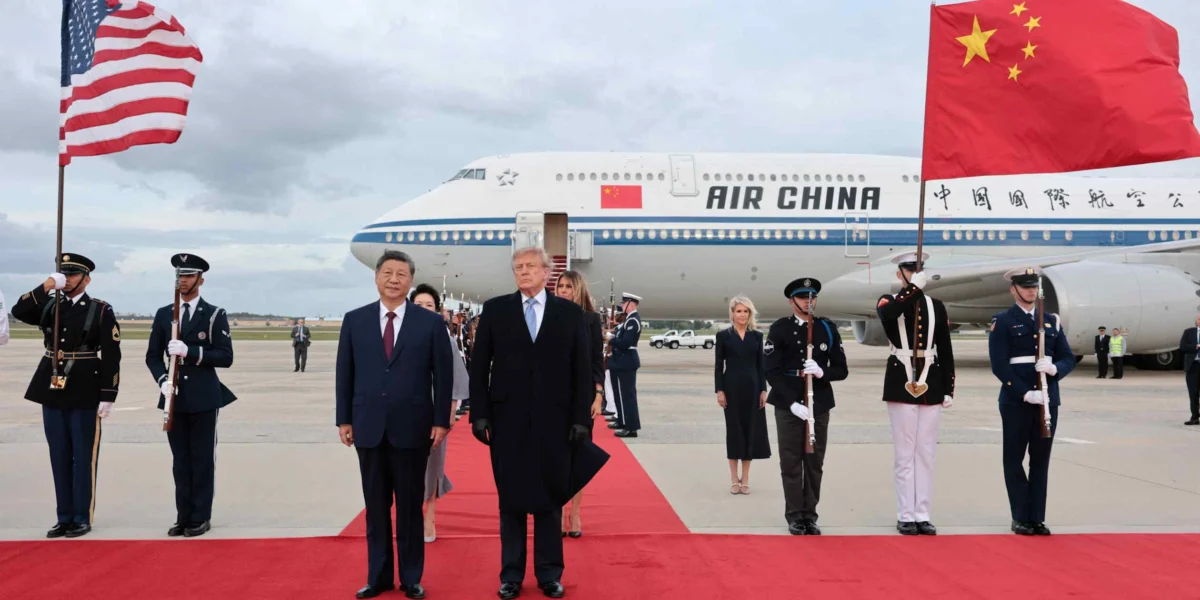
WASHINGTON/NEW YORK/TOKYO — Chinese President Xi Jinping and U.S. President Donald Trump convened for their second summit of the year, a high-stakes meeting shadowed by persistent disputes over tariffs, access to critical rare earth materials, the accelerating race in artificial intelligence, and a host of other complex bilateral issues. The summit, hosted in Washington following President Trump’s earlier visit to Beijing in May, was marked by an elaborate welcome ceremony at the White House, including a state dinner, underscoring the significant, albeit fraught, relationship between the two global superpowers.
A key development announced at the outset of the summit was the agreement to extend the trade truce between the United States and China. This truce, initially slated to expire on November 10, has been prolonged until January 10, providing a temporary reprieve from escalating trade disputes. This extension, while welcomed by some sectors, comes against a backdrop of muted expectations for broader, tangible breakthroughs, especially after their previous meeting was characterized by many experts as emphasizing symbolism over substantive outcomes. The delicate issue of Taiwan, which China claims as its own territory, is expected to be a focal point of discussions. President Trump has previously referred to U.S. arms sales to the democratically governed island as a "very good negotiating chip," a stance that invariably raises concerns in Beijing.
The Delicate Dance of Diplomacy: A Chronology of Events
The summit’s proceedings unfolded over a period of intense diplomatic activity, beginning with the arrival of President Xi Jinping.
Wednesday, September 23, 2026
-
4:30 p.m. (Washington Time): The economic impact of trade disputes became starkly evident as data revealed a significant decline in U.S. soybean exports to China. Prior to the imposition of tariffs by the Trump administration, China was a voracious market, purchasing approximately half of all U.S. soybean exports. By 2025, these shipments had plummeted from nearly $18 billion in 2022 to a mere $3 billion, according to U.S. Department of Agriculture figures. This downturn has significantly benefited agricultural powerhouses like Brazil and Argentina, with Brazil reporting a record 108.7 million metric tons of soybean exports in 2025, roughly 80% of which were destined for China. Dave Walton, vice president of the American Soybean Association and an Iowa farmer, lamented the situation, stating, "No one can replace the Chinese market," and expressing hope for the removal of U.S. tariffs, viewing President Xi as a "friend to American agriculture."
-
3:30 p.m.: Secretary of State Marco Rubio, speaking on the sidelines of the United Nations General Assembly, emphasized the imperative for the U.S. and China to engage at the highest levels. He described regular contact between the world’s two largest economies as "responsible statecraft," asserting that abstaining from such high-level interaction would be "irresponsible" and "outrageous." His remarks preceded President Trump’s planned tarmac welcome for President Xi at Joint Base Andrews.
-
2:00 p.m.: Security measures in Washington D.C. were significantly heightened in anticipation of the summit. Road closures around the White House were implemented, and the U.S. Secret Service, responsible for the security of visiting heads of state, was on high alert. Chinese, Hong Kong, Tibetan, and Uyghur activist groups announced plans for large-scale demonstrations, expecting several thousand participants to protest President Xi’s visit. Joey Siu, a Hong Kong human rights activist, articulated the sentiment of many: "We’re all protesting for a simple reason… because our people who used to say these things, who used to organize these demonstrations back at home, are now locked up behind bars in prisons, in concentration camps and are stripped away from their political freedom and rights." Past demonstrations during Xi’s visits, such as the one in San Francisco in 2023, had seen clashes between activist groups and Chinese government supporters. The Secret Service stated its commitment to ensuring freedom of assembly and speech while maintaining safety.
-
1:05 p.m.: U.S. Treasury Secretary Scott Bessent reported engaging in "substantive discussions" with Chinese Vice Premier He Lifeng regarding the bilateral economic relationship, a prelude to the high-level summit.
-
11:30 a.m.: Treasury Secretary Scott Bessent met for a second time with Chinese Vice Premier He Lifeng, just hours before President Xi’s arrival. Bessent indicated that the meeting was to address "unfinished business" from earlier discussions, emphasizing the need for "strategic stability" based on "reciprocity and fairness." These closed-door negotiations, held on Sunday at JPMorgan headquarters in Manhattan, had previously yielded an agreement to exclude "nonsensitive" goods from future tariff actions.
-
7:40 a.m.: Emerging data suggested a generational shift in American perceptions of China. Studies indicated that younger and more Democratic-leaning Americans were increasingly open to closer ties with China, rather than pursuing a complete decoupling. A survey by the Chicago Council on Global Affairs revealed that 57% of American respondents favored engagement with China, the highest figure since 2020. The same poll also highlighted a perceived decline in global respect for the U.S. over the past decade, with a majority of respondents believing respect for China remained stable or had increased. Conversely, the Ronald Reagan Institute Summer Survey indicated a significant generational divide on concerns about Chinese espionage, with 93% of Americans aged 65 and above expressing worry, compared to 62% of those aged 18 to 29. Younger demographics were also less concerned about potential military conflict over Taiwan, Chinese land acquisitions, and China’s role in fentanyl flows.
-
7:00 a.m.: President Xi Jinping’s visit coincided with an apparent improvement in China’s global image relative to the United States. A Gallup report from April indicated that China had surpassed the U.S. in global approval ratings in 2025, with a median of 36% approving of Chinese leadership versus 31% for the U.S. This widening gap was attributed to both Xi’s efforts to project Beijing as a responsible global actor and a decline in American ratings during Trump’s second term. A more recent Pew Research Center survey across 37 economies found a median of 51% holding a favorable view of China, with particularly warm sentiments in Southeast Asia, Africa, and Latin America, regions where China has deepened its trade ties. While confidence in both leaders was generally low, Xi was viewed more favorably than Trump in 22 countries. However, the Pew survey noted that the U.S. government still ranked higher than Beijing in terms of respect for personal freedom.
-
6:30 a.m.: The summit marked President Xi’s first official state visit to the U.S. since 2015 and his first time on American soil since the APEC forum in 2023. The intervening decade had seen significant shifts in both nations. In the U.S., a robust stock market, fueled by AI investments, had amplified wealth for high-income households. However, middle- and low-income families faced escalating living costs, exacerbated by elevated energy prices resulting from the Trump administration’s stance on Iran. Moody’s Analytics chief economist Mark Zandi noted that the wealthiest 20% of Americans now accounted for 60% of personal spending. Polling suggested that affordability issues had eroded Trump’s popularity, with a Reuters/Ipsos poll showing only 32% approval of his job performance, a career low, and a mere 17% approving his handling of living costs. Public polling on Xi’s performance was unavailable, but signs of discontent were emerging due to labor market challenges, with youth unemployment reaching a record 18.9% in August amidst the widespread adoption of AI. China had solidified its manufacturing dominance with a record trade surplus exceeding $1 trillion, despite U.S. tariffs. However, the country faced a bifurcated economy, with a prolonged property slump impacting household wealth and retail spending, while official growth rates continued a downward trend.
-
6:00 a.m.: Experts at a forum in Sydney offered cautionary perspectives on the geopolitical landscape. Retired commander of the U.S. Indo-Pacific Command, John Aquilino, described China’s military buildup as the largest since World War II, with an industrial base operating on a "wartime footing" to "change the current world order in ways that benefit China at the expense of all of us." He stressed the need for U.S. allies to focus on economic alternatives and deterrence. Regarding the summit, he expressed deep concern about discussions on Taiwan, noting that Xi was likely to press Trump to halt new arms sales to Taipei. Kurt Campbell, former U.S. deputy secretary of state, echoed these concerns, suggesting Xi’s strategy was to "reduce the confidence in Taiwan in the United States" by framing discussions around Taiwan and resisting arms sales. Lai I-Chung, president of the Prospect Foundation think tank, indicated that Taiwan would be closely observing the summit but emphasized that the island’s fate would not be solely determined by negotiations between the two powers.
-
5:45 a.m.: Tesla CEO Elon Musk, reportedly slated to attend the state dinner, praised Xi as a "great leader" in an interview with Chinese state broadcaster CCTV, noting China’s "immense prosperity" under his tenure. Musk has recently lauded China while denying rumors of a potential scaling back of Tesla’s operations there.
-
5:15 a.m.: A commentary in the Communist Party’s People’s Daily framed the summit as a guiding star for the "most important and complex bilateral relationship in the world," emphasizing "constructive strategic stability." China’s ambassador to the U.S., Xie Feng, articulated Beijing’s non-negotiable "red lines," including Taiwan, democracy and human rights, development paths and systems, and development rights.
-
5:05 a.m.: Chinese state news agency Xinhua confirmed President Xi’s departure for Washington, accompanied by his wife Peng Liyuan and key aides Cai Qi and Foreign Minister Wang Yi. Oxford Economics predicted "narrow" and "reversible" outcomes from the trip, such as limited tariff relief, increased purchases of farm goods and aircraft, and cooperation on AI safety and Iran. However, thornier issues like tech rivalry, transshipments, and Taiwan were expected to remain unresolved, as both sides are essentially "buying time" to build credible substitutes for economic interdependence.
Thursday, September 24, 2026
-
2:00 a.m.: Major U.S. media outlets reportedly refrained from broadcasting President Trump’s elaborate welcome for President Xi, amidst an ongoing feud between the Trump administration and the press. Trump’s administration had previously attempted to ban CNN, MS NOW, and Politico from White House reporting, accusing them of disseminating "lies." Fox News, generally perceived as friendly to Trump, also omitted coverage of the ceremony. A federal judge subsequently ordered Trump to reinstate White House press access for the three outlets, deeming the ban likely unconstitutional.
-
1:30 a.m.: Taiwan’s cabinet spokesperson, Michelle Lee, expressed "gratitude" for long-standing U.S. support and positive views on efforts to stabilize the regional situation and manage risks posed by authoritarian expansion. She indicated Taiwan maintained close contact with the U.S. to stay informed of relevant developments.
-
12:35 a.m.: Minoru Kihara, Japan’s chief cabinet secretary, stated that Japan would "continue to monitor the situation" at the summit "closely with keen interest," given its own tensions with Beijing. He highlighted the significance of earlier talks between Japanese Prime Minister Sanae Takaichi and President Trump at the UN General Assembly, where they exchanged views on China-related issues, including economic security, and agreed to continue close cooperation.
-
11:45 p.m. (Wednesday): The European Chamber of Commerce in China lauded the extension of the trade truce, warning that its absence would have had a "crippling impact on industry" due to planned export controls on rare earths. However, the chamber raised concerns about the uncertainty beyond January 10 and a perceived lack of clarity and coordination in China’s export licensing procedures for rare earths.
-
11:00 p.m. (Wednesday): The death of Chinese human rights activist Shi Tingfu in a Xinjiang prison on Tuesday cast a somber shadow over the summit. Shi, an advocate for freedom and democracy and a supporter of the 1989 Tiananmen protests, was detained in January 2024 and sentenced to three years for "picking quarrels and provoking trouble." His death, at age 67, underscored questions about whether President Trump would press President Xi on human rights issues, beyond potentially raising the cases of two Americans held by Beijing. Shi’s conviction stemmed from his dissemination of information to overseas media about fruit farmers’ grievances against a state-run paramilitary organization. While the Network of Chinese Human Rights Defenders could not definitively confirm the cause of death, his family reported him to be in good condition recently, raising concerns about the circumstances of his sudden demise. Simultaneously, the Tibet Action Institute reported a "complete information blackout across Tibet" following catastrophic landslides and floods, calling on President Trump to urge Xi to allow access and end the "relentless repression" of Tibetans.
-
10:30 p.m. (Wednesday): The White House released a short video clip documenting President Trump’s welcome for President Xi.
-
10:00 p.m. (Wednesday): In a gesture aimed at fostering goodwill, President Xi had penned a reply to nearly 100 students from 10 U.S. universities who had participated in an exchange program in China, urging them to promote bilateral ties. However, academic and people-to-people exchanges between the two nations remained severely chilled. The pipeline for American scholars to study in China had dwindled, and the number of U.S. students in China had dropped significantly. Conversely, Chinese students were increasingly hesitant to attend American universities due to tighter visa restrictions and heightened immigration scrutiny.
-
8:30 p.m. (Wednesday): The elaborate welcome ceremony for President Xi included a 100-foot red carpet, a salute battery, an honor cordon, color teams with U.S. and Chinese flags, a U.S. Air Force band, military platoons, B-1 flyovers, and flower presenters.
-
6:20 p.m. (Wednesday): Treasury Secretary Scott Bessent confirmed to Fox News that he and Chinese Vice Premier He Lifeng had agreed to extend the trade truce through January 10, two months beyond its original November 10 expiration.
-
5:41 p.m. (Wednesday): Chinese President Xi Jinping arrived in Washington, receiving a rare tarmac welcome from President Donald Trump, who greeted his counterpart planeside. President Trump and First Lady Melania Trump were to participate in an arrival ceremony for Xi and his wife, Peng Liyuan, marking the commencement of a three-day state visit.
Broader Implications and Global Perspectives
The summit between Xi Jinping and Donald Trump carries profound implications not only for the bilateral relationship between the U.S. and China but also for the global geopolitical and economic order. The extension of the trade truce, while offering a temporary respite, does little to resolve the underlying structural issues fueling the trade war. Concerns about China’s industrial policies, intellectual property rights, and market access for foreign companies remain significant points of contention.
The delicate issue of Taiwan is likely to be a central focus, with potential U.S. arms sales to the island serving as a significant leverage point. Beijing’s unwavering stance on Taiwan, coupled with its increasing military assertiveness in the region, presents a persistent flashpoint that could easily escalate tensions.
Furthermore, the accelerating competition in artificial intelligence and critical technologies, such as semiconductors and rare earth minerals, underscores the strategic rivalry between the two nations. The summit’s discussions on these fronts will be closely watched for any indications of potential guardrails or further escalation.
International reactions to the summit reflect a complex global landscape. Allies of the United States are keenly observing the outcomes, seeking clarity on the future trajectory of U.S.-China relations and its impact on regional stability and global trade. Japan, for instance, expressed its intent to monitor the summit closely, given its own complex relationship with Beijing.
The summit also occurs against a backdrop of shifting global perceptions. Data suggests that China’s international image has improved relative to the United States in recent years, particularly in developing economies. This shift underscores the complex interplay of economic influence, diplomatic engagement, and national narratives in shaping global opinion.
The emphasis on "constructive strategic stability," a term that emerged from previous high-level discussions, suggests an attempt by both sides to manage their competition to avoid outright conflict. However, the practical implementation of this concept remains a significant challenge, given the deep-seated mistrust and divergent strategic interests.
Ultimately, the summit between President Xi and President Trump represents a critical juncture in a relationship that defines much of the 21st-century global order. While the immediate outcomes may be incremental, the long-term implications of their discussions on trade, technology, security, and geopolitical alignment will continue to shape the international landscape for years to come. The delicate balance between competition and cooperation will remain the defining characteristic of this pivotal bilateral relationship.