Clara Shinta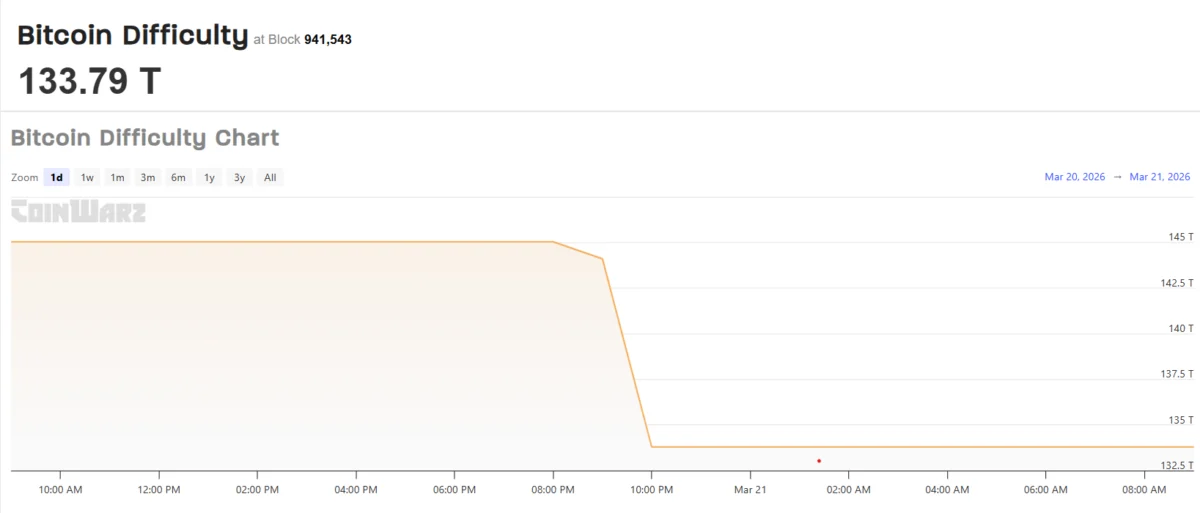
Bitcoin’s mining difficulty experienced a significant downward adjustment of approximately 7.7% on March 20, recalibrating to 133.79 trillion at block 941,472. This marked the sharpest drop since a similar event in February, according to data compiled by CoinWarz, signaling a notable shift in the computational landscape underpinning the world’s leading cryptocurrency. This latest recalibration represents a continued decrease from difficulty levels of around 145 trillion observed in mid-March and roughly 148 trillion at the commencement of the year, reflecting an ongoing trend of fluctuating hashrate on the network.
The immediate implication of a lower difficulty setting is a reduction in the computational work required for miners to successfully find a valid block hash and earn the associated block reward. This directly translates to an improvement in revenue per unit of hashrate for mining operations that remain online and active. For an industry perennially challenged by razor-thin margins and intense competition, such an adjustment offers a crucial, albeit temporary, reprieve, enhancing the profitability of existing infrastructure and potentially extending the operational lifespan of less efficient mining rigs.
Understanding Bitcoin’s Adaptive Difficulty Mechanism
At the core of Bitcoin’s resilient and self-regulating monetary policy lies its difficulty adjustment algorithm. This critical mechanism ensures the network’s stability, security, and predictable issuance schedule. Bitcoin is designed to produce a new block, on average, every 10 minutes. Each block contains a set of validated transactions and, once added to the blockchain, rewards the successful miner with a fixed amount of newly minted Bitcoin, alongside transaction fees.
The network’s hashrate—the total computational power dedicated to mining—is constantly in flux. As more miners join the network, the hashrate increases, making it easier to find blocks more quickly than the 10-minute target. Conversely, if miners leave or reduce their activity, the hashrate declines, causing block production to slow down. To counteract these fluctuations and maintain the consistent 10-minute block time, the Bitcoin protocol automatically adjusts the mining difficulty every 2,016 blocks. This epoch typically spans approximately two weeks, assuming blocks are found precisely every 10 minutes.
The calculation for the adjustment is straightforward: if the previous 2,016 blocks were found faster than 10 minutes each (i.e., less than 14 days total), the difficulty increases. If they were found slower (more than 14 days total), the difficulty decreases. The magnitude of the adjustment is proportional to the deviation from the target block time. This ingenious design ensures that, regardless of how many miners are competing, the rate of new Bitcoin creation remains largely predictable, adhering to its pre-programmed monetary policy and reinforcing its scarcity.
The Drivers Behind the Recent Hashrate Contraction
The recent 7.7% difficulty drop was a direct consequence of slower-than-target block production over the preceding 2,016 blocks. Data from CloverPool indicated that the average block time during this period stretched to approximately 12 minutes and 36 seconds, significantly exceeding Bitcoin’s 10-minute target. This persistent deviation signaled a reduction in the aggregate hashrate dedicated to the network, compelling the protocol to recalibrate to a lower difficulty level to restore the target block interval.
Several factors are likely contributing to this observed hashrate decline, painting a complex picture of economic pressures and strategic shifts within the mining industry:
- Soaring Energy Costs: Electricity remains the single largest operational expense for Bitcoin miners. In various regions globally, energy prices have been volatile, and in many cases, on an upward trajectory. Miners, especially those operating older, less energy-efficient hardware, find their profit margins squeezed considerably when power costs rise. This economic pressure forces some to power down their rigs, either temporarily or permanently, making their operations unsustainable.
- Intensifying Competition and Diminishing Returns: Even with relatively stable energy prices, the sheer volume of hashrate that has joined the network over recent years has driven down per-unit profitability. As difficulty increases, the rewards for the same computational effort diminish. This creates an "arms race" for the most efficient hardware and access to the cheapest power, pushing out less competitive players.
- Anticipation of the Bitcoin Halving Event: The Bitcoin network is rapidly approaching its fourth halving event, expected in April 2024. This programmed event will reduce the block reward from 6.25 BTC to 3.125 BTC per block. Miners typically prepare for this significant reduction in revenue by optimizing operations, upgrading to more efficient Application-Specific Integrated Circuit (ASIC) miners, or strategically shutting down older, unprofitable machines. The current hashrate contraction could be an early manifestation of miners decommissioning less efficient hardware in anticipation of the halving’s impact on their bottom line.
- Strategic Diversification: As highlighted in the broader market trends, many large-scale mining operations are actively exploring or pivoting towards other high-performance computing (HPC) applications, most notably Artificial Intelligence (AI) workloads. This diversification strategy can lead to a reallocation of power capacity and data center resources away from pure Bitcoin mining, contributing to a reduced hashrate.
The February Precedent: A Snapshot of Volatility and Resilience
The recent difficulty drop is not an isolated event but echoes a similar, albeit distinct, episode in February. During that period, Bitcoin’s difficulty also experienced a sharp decline, primarily attributed to severe weather-related disruptions across parts of the United States. Winter storms and extreme cold temperatures temporarily knocked a significant portion of American mining facilities offline, particularly in regions like Texas, which hosts a substantial concentration of large-scale mining operations.
The temporary loss of this considerable hashrate prompted the network to adjust its difficulty downwards to compensate for the reduced computational power. However, as power conditions normalized and affected facilities came back online, the hashrate quickly returned to the network. This rapid recovery led to a robust rebound in difficulty, increasing by approximately 15% in the subsequent adjustment cycle.
The February event served as a powerful demonstration of both the fragility of localized mining infrastructure in the face of extreme weather and, crucially, the inherent resilience and adaptive nature of the Bitcoin network itself. The protocol functioned exactly as designed, adjusting to exogenous shocks and swiftly returning to its intended block production schedule once conditions stabilized. While the immediate cause of the February drop was external and temporary, the current drop appears to be driven by more systemic economic and strategic shifts within the mining industry, suggesting a potentially different long-term trajectory for hashrate distribution.

The Broader Trend: Miners Pivoting to AI and HPC
One of the most compelling narratives emerging from the Bitcoin mining sector is the accelerating pivot by several listed mining companies towards Artificial Intelligence (AI) and high-performance computing (HPC) infrastructure. This strategic diversification is driven by a quest for steadier and potentially higher returns on their substantial investments in power and data center capacity, especially as the profitability of pure Bitcoin mining faces increasing pressure from rising energy costs and impending halving events.
The competition for electricity resources between Bitcoin mining and AI data centers has become a salient topic of discussion among industry experts. Crypto trader Ran Neuner famously argued that "AI has killed Bitcoin forever," suggesting that AI has become Bitcoin mining’s biggest competitor in the race for cheap, reliable energy. While such a hyperbolic statement should be viewed with a critical lens, it underscores a legitimate and growing tension. Both industries are voracious consumers of electricity, and the specialized infrastructure developed for Bitcoin mining—large data centers, robust power connections, and efficient cooling systems—is highly adaptable for AI workloads, which also demand immense computational power.
Several prominent Bitcoin miners have already made tangible moves in this direction:
- Core Scientific, a leading publicly traded Bitcoin mining company, has secured significant credit facilities, including up to $1 billion from Morgan Stanley, explicitly for data center development. This move indicates a strategic intent to expand its infrastructure beyond solely Bitcoin mining, likely to accommodate HPC and AI clients.
- MARA Holdings (Marathon Digital Holdings), another industry giant, has openly discussed exploring opportunities in HPC and AI. While their primary focus remains Bitcoin mining, they recognize the potential synergies and the ability to leverage their existing infrastructure for diverse revenue streams.
- Hut 8, a well-established North American miner, has made one of the most significant pivots, reporting a substantial $248 million loss while simultaneously announcing a $7 billion AI data center lease. This dramatic financial outcome alongside a massive investment in AI infrastructure clearly illustrates their commitment to diversifying away from a sole reliance on Bitcoin mining revenue.
- Cipher Mining has also been actively acquiring sites and developing data centers with a broader scope than just Bitcoin mining, positioning themselves to capitalize on the growing demand for HPC services.
This strategic shift is not merely about expanding operations; it’s about optimizing resource allocation. As profitability tightens in Bitcoin mining, especially for less efficient operations, miners are re-evaluating where they can generate the most sustainable returns. Some operators are reducing their hashrate dedicated to Bitcoin, while others are entirely shutting down less efficient rigs to free up power capacity for more lucrative AI contracts.
A stark example of this recalibration is Bitdeer. On February 21, the company liquidated 943 BTC from its reserves and sold newly mined coins, effectively cutting its corporate Bitcoin holdings to zero. In its latest weekly update on March 21, Bitdeer confirmed that its BTC holdings remained at zero. This aggressive move suggests a profound re-evaluation of its balance sheet strategy, potentially to fund its pivot into other ventures or to de-risk its exposure to Bitcoin’s price volatility, instead focusing on providing infrastructure services.
Implications for the Bitcoin Network and Mining Industry
The recent difficulty adjustment and the broader trend of miner diversification carry significant implications for the Bitcoin network and the mining industry as a whole.
For Network Security: While a decrease in hashrate theoretically reduces the computational barrier to executing a 51% attack (where a malicious entity controls more than half of the network’s processing power), Bitcoin’s hashrate remains astronomically high, making such an attack economically unfeasible for any known entity. The difficulty adjustment mechanism itself acts as a safeguard, ensuring that even with fluctuating hashrate, the network continues to operate as intended, producing blocks consistently and maintaining its security guarantees. The distributed nature of mining also contributes to its resilience, as no single entity or region typically controls a dominant share of the hashrate for extended periods.
For Miner Profitability and Industry Structure: In the short term, the difficulty reset offers a welcome boost to profitability for remaining miners, allowing them to earn more Bitcoin for the same computational effort. This can provide crucial breathing room for operations struggling with high energy costs or preparing for hardware upgrades. However, in the long term, the pressures remain. The industry is likely to see further consolidation, with less efficient or poorly capitalized miners being forced out. The "race to the bottom" for the cheapest electricity will intensify, driving innovation in energy procurement and data center efficiency. The pivot to AI/HPC also suggests a future where mining companies might evolve into diversified data infrastructure providers, with Bitcoin mining being just one, albeit significant, component of their revenue streams.
Geographic Shifts: The pursuit of the lowest energy costs will continue to drive geographic shifts in mining operations. Regions with abundant, cheap, and preferably renewable energy sources will become increasingly attractive. This could lead to a more decentralized distribution of hashrate globally, reducing concentration risks in any single jurisdiction.
Future Outlook and the Halving: The next difficulty adjustment is currently estimated for April 3, though this projection is dynamic and changes with each new block found. More critically, the impending Bitcoin halving in April 2024 looms large. Historically, halvings have led to a temporary dip in hashrate as less efficient miners become unprofitable and shut down, followed by a recovery as new, more efficient hardware comes online and the Bitcoin price potentially appreciates. The current hashrate contraction and difficulty drop could be an early indicator of this pre-halving "shake-out," where miners are strategically optimizing their operations in anticipation of the reduced block rewards. The combination of rising energy costs, intense competition, and the halving will undoubtedly accelerate the trend towards greater efficiency, diversification, and potentially further consolidation within the Bitcoin mining industry.
In conclusion, the recent 7.7% drop in Bitcoin’s mining difficulty is more than just a technical adjustment; it’s a barometer reflecting a dynamic and evolving industry landscape. Driven by economic pressures, strategic diversification into AI, and the looming halving event, the Bitcoin mining sector is undergoing a profound transformation, positioning itself for a future where efficiency, adaptability, and multi-faceted revenue streams will be paramount for survival and success.