Clara Shinta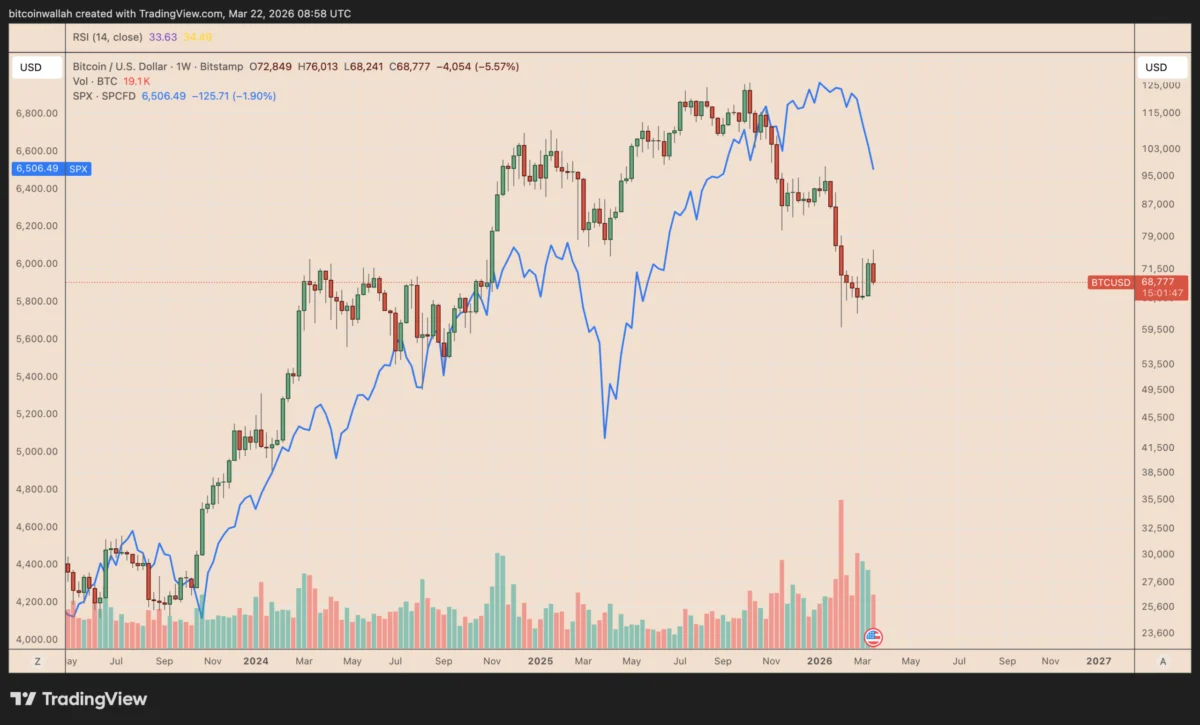
Bitcoin (BTC) has recently relinquished a significant portion of the gains it accumulated amidst heightened geopolitical tensions between the United States and Iran, reverting to a synchronized pattern with the broader downtrend observed across global risk assets, most notably US equities. This shift marks a critical juncture for the cryptocurrency, as a resurgence in its correlation with traditional stock markets has historically preceded substantial price corrections, prompting analysts to issue cautionary warnings about potential further declines.
Immediate Market Reactions and The Fading Safe-Haven Narrative
As of the close of trading on Sunday, Bitcoin’s value had depreciated by 5.65% week-to-date, settling at approximately $68,700. This downturn mirrored, albeit in an amplified fashion, the performance of the S&P 500 (SPX), the benchmark index for US equities, which concluded the week down 1.90%. The initial period of geopolitical instability, particularly following drone attacks and retaliatory strikes in the Middle East, saw Bitcoin briefly perceived by some market participants as a "digital safe haven." This narrative suggested that in times of global uncertainty, investors might flock to decentralized, non-sovereign assets like Bitcoin, much like they traditionally would to gold. However, this perception proved ephemeral, as Bitcoin’s price movements quickly decoupled from this safe-haven thesis and re-established its strong linkage to risk assets.
The fleeting safe-haven status underscored a recurring debate within the financial community regarding Bitcoin’s true nature. While proponents argue for its independence from traditional financial systems, its price action, especially in times of broader market stress, often aligns with more speculative investments. This recent episode suggests that for many institutional and retail investors, Bitcoin is still largely viewed as a high-beta asset, sensitive to changes in global risk appetite rather than a primary store of value during crises. The initial upward momentum, likely driven by a subset of investors seeking uncorrelated assets, quickly gave way to broader market forces prioritizing liquidity and de-risking in response to macro uncertainties.
Deep Dive into the BTC-SPX Correlation: A Bearish Indicator
The renewed correlation between Bitcoin and the S&P 500 is now signaling a heightened risk of further downside in the cryptocurrency market. A key metric underpinning this bearish outlook is the 20-week rolling correlation coefficient between BTC and SPX. As of Saturday, this metric had risen significantly to 0.13, a notable recovery from its recent nadir of around -0.5.
To contextualize this, a correlation coefficient ranges from -1 to +1. A value of +1 indicates a perfect positive correlation, meaning the assets move in the same direction, while -1 signifies a perfect inverse correlation. A value close to zero suggests no linear relationship. The shift from a negative correlation, where Bitcoin might have moved somewhat independently or even inversely to stocks, to a positive correlation indicates that Bitcoin is increasingly behaving in sync with the broader equity market. Historically, negative correlations were sometimes cited by Bitcoin maximalists as proof of its diversification benefits. However, the current trend suggests a convergence of investor sentiment and capital flows across both asset classes.

Since 2018, such sharp recoveries in the BTC-SPX correlation have consistently preceded broader Bitcoin market declines, with an average depreciation of approximately 50%. This historical pattern provides a compelling, albeit not deterministic, warning for current investors. Analyst Tony Severino, commenting on this trend, stated unequivocally, "It is a warning sign that the stock market is going to collapse and take BTC with it."
If this historical pattern were to repeat, a 50% drop from Bitcoin’s current price of around $68,700 would imply a downside target of roughly $34,350. This projection aligns with the forecasts of several other analysts who have previously suggested Bitcoin could decline to the $30,000-$40,000 range in the coming months or throughout 2026, depending on the severity and duration of the macroeconomic downturn.
Historical Precedents: The Echoes of 2020 and 2022
The current market dynamics bear a striking resemblance to previous periods of significant Bitcoin corrections. In both 2020 and 2022, Bitcoin’s substantial declines were observed to lag by several months, often unfolding after what market observers termed "bull traps." These bull traps typically involved Bitcoin rallying alongside a rising SPX correlation, giving investors a false sense of security or a belief that the rally was sustainable, only for the price to reverse sharply and erase those gains.
- The 2020 Scenario: Following the initial shock of the COVID-19 pandemic and the subsequent market crash in March 2020, central banks globally, led by the Federal Reserve, unleashed unprecedented monetary stimulus. This liquidity surge buoyed both traditional equities and Bitcoin. As the SPX began its recovery, Bitcoin, initially battered, also found its footing, and their correlation strengthened. However, as the initial euphoria subsided and the long-term economic uncertainties remained, Bitcoin experienced significant volatility, with several sharp pullbacks, though it ultimately recovered strongly into 2021. The "trap" here was the assumption of a continuous upward trajectory despite underlying economic fragilities.
- The 2022 Bear Market: This period offers a more direct parallel. As the Federal Reserve began its aggressive interest rate hiking cycle to combat soaring inflation, risk assets across the board suffered. Bitcoin, which had reached an all-time high in late 2021, entered a prolonged bear market. Throughout 2022, there were intermittent rallies, often coinciding with temporary improvements in market sentiment or short-term equity bounces. These rallies, occurring alongside a strong BTC-SPX correlation, frequently proved to be bull traps, as the overarching macroeconomic pressures continued to push prices lower, leading to significant capitulation events. The correlation served as a leading indicator of synchronized downside rather than a sign of a shared, robust recovery.
These historical episodes underscore the importance of discerning between temporary bounces and sustainable uptrends, particularly when Bitcoin’s movements are closely tied to the broader equity market. The implication is that investors should exercise extreme caution, as the current environment, characterized by a strengthening correlation, might be setting the stage for a similar pattern of deceptive rallies followed by steeper declines.
Macroeconomic Headwinds: A Confluence of Pressures
Beyond the technical correlation, a constellation of macroeconomic factors lends substantial weight to the bearish outlook for both Bitcoin and equities in the coming months. These include elevated oil prices, persistent inflation, and a diminished probability of the Federal Reserve implementing interest rate cuts in the near term.
- Elevated Oil Prices: Global oil prices have remained stubbornly high, influenced by a combination of geopolitical instability (including the Middle East tensions), production cuts by OPEC+ nations, and robust demand. High oil prices act as a significant inflationary pressure, increasing costs across supply chains and for consumers, thereby eroding purchasing power and potentially slowing economic growth. For investors, this translates to higher operational costs for companies and reduced consumer spending, impacting corporate earnings and stock valuations.
- Persistent Inflation: Despite aggressive monetary tightening by central banks, inflation rates in many major economies, including the US, have proven more resilient than initially anticipated. Core inflation, which excludes volatile food and energy prices, remains above central bank targets. Sustained inflation erodes the real returns on investments and typically prompts central banks to maintain restrictive monetary policies for longer, dampening enthusiasm for risk assets like growth stocks and cryptocurrencies.
- Federal Reserve Policy and Interest Rates: The Federal Reserve’s stance has become a dominant force shaping market sentiment. Recent economic data, particularly concerning inflation and the robustness of the labor market, has led to a significant recalibration of market expectations regarding future interest rate cuts. What was once anticipated as multiple rate cuts in 2024 has now largely diminished, with some analysts even speculating about potential rate hikes if inflation re-accelerates. "Higher for longer" interest rates increase the cost of capital, make borrowing more expensive for businesses and consumers, and diminish the attractiveness of speculative assets by offering competitive risk-free returns from bonds. This environment typically favors conservative investments over high-growth, high-risk ventures.
The interplay of these factors creates a challenging environment for risk assets. Geopolitical tensions add a layer of uncertainty, potentially disrupting supply chains and exacerbating inflationary pressures. Central banks, caught between managing inflation and avoiding a recession, face complex policy decisions that directly impact market liquidity and investor confidence. For Bitcoin, which thrives on liquidity and speculative capital, this confluence of macroeconomic headwinds presents a formidable obstacle to sustainable growth.

Institutional Caution: MicroStrategy’s Pause Signals Broader Hesitation
Adding another layer to the cautious outlook is the noticeable pause in corporate accumulation of Bitcoin, particularly from prominent institutional players. MicroStrategy (MSTR), a publicly traded business intelligence firm and one of the largest corporate holders of Bitcoin globally, notably did not purchase BTC via the sales of its STRC preferred stock this week, according to data resource STRC.LIVE.
MicroStrategy, under the leadership of its staunch Bitcoin advocate CEO Michael Saylor, has adopted a corporate strategy centered on accumulating Bitcoin, viewing it as a superior treasury reserve asset. The company has frequently leveraged various financial instruments, including convertible notes and preferred stock offerings, to fund these substantial BTC acquisitions. Its buying sprees have often served as a significant catalyst for Bitcoin price rallies, demonstrating strong institutional conviction and absorbing considerable supply from the market.
The company’s last announced acquisition on March 16 was substantial, adding 22,337 BTC worth $1.57 billion to its holdings, bringing its total to an impressive 761,068 BTC. Bitcoin rallied by approximately 10.50% in the same period, outperforming US stocks. MicroStrategy’s STRC-fueled buying during the initial phases of the US-Iran war tensions was instrumental in supporting Bitcoin’s price and potentially contributed to its brief safe-haven appearance.
Therefore, the current absence of fresh purchases from MicroStrategy, even if temporary, carries symbolic weight. It suggests a potential shift in strategy, perhaps a wait-and-see approach amid heightened market volatility and macroeconomic uncertainty, or a more tactical pause in their continuous accumulation. This pause removes a significant source of consistent institutional demand that has historically helped underpin Bitcoin’s price, leaving the cryptocurrency more exposed to potential sell-offs in the traditional stock market.
Furthermore, while the article’s related links mention "Bitcoin options signal fear even as BTC ETF outflows remain relatively low," the overall picture suggests a broader cooling of institutional fervor. While spot Bitcoin ETFs have seen historic inflows since their launch in January, recent weeks have seen a slowdown, and even net outflows on certain days, indicating that the initial wave of institutional adoption might be moderating. The combination of MicroStrategy’s pause and potentially decelerating ETF inflows could collectively contribute to a more challenging demand environment for Bitcoin.
Broader Implications for the Cryptocurrency Ecosystem
Should Bitcoin experience a significant downturn as projected by the historical correlation patterns and macroeconomic indicators, the implications would ripple throughout the broader cryptocurrency ecosystem. Altcoins, which typically exhibit higher beta relative to Bitcoin, meaning they tend to amplify BTC’s movements, would likely suffer even more severe corrections. This could lead to widespread deleveraging across the crypto market, impacting decentralized finance (DeFi) protocols, non-fungible token (NFT) markets, and the valuations of numerous blockchain projects.

A sustained period of Bitcoin price weakness, particularly if driven by a collapse in traditional equity markets, could also challenge the narrative of crypto as a distinct and uncorrelated asset class. It would further cement its perception as a risk-on asset, highly susceptible to global liquidity conditions and investor sentiment towards speculative investments. This might prompt a reassessment of investment strategies within the digital asset space, emphasizing projects with clearer utility and robust fundamentals over purely speculative ventures.
Conclusion: Navigating a Complex and Uncertain Landscape
The current landscape for Bitcoin is characterized by a complex interplay of geopolitical risk, macroeconomic pressures, and renewed correlation with traditional financial markets. The erasure of war-driven gains and the strengthening link to US equities, particularly against a backdrop of historical precedents suggesting significant downside, present a formidable challenge for Bitcoin investors. The cautious stance adopted by institutional players like MicroStrategy further underscores the prevailing uncertainty.
Investors are urged to conduct thorough due diligence and exercise extreme caution. The confluence of elevated oil prices, persistent inflation, and the Federal Reserve’s "higher for longer" interest rate policy creates a difficult environment for risk assets. While Bitcoin’s long-term potential as a transformative technology and a hedge against fiat debasement remains a subject of ongoing debate, its short-to-medium-term price trajectory appears increasingly tied to the fate of traditional markets and the global macroeconomic climate. The coming months will be crucial in determining whether Bitcoin can once again decouple from these traditional influences or if it will follow the path laid out by historical correlations, potentially reaching price levels not seen since earlier phases of the bull market.
This article does not contain investment advice or recommendations. Every investment and trading move involves risk, and readers should conduct their own research when making a decision. While we strive to provide accurate and timely information, this publication does not guarantee the accuracy, completeness, or reliability of any information in this article. This article may contain forward-looking statements that are subject to risks and uncertainties. This publication will not be liable for any loss or damage arising from your reliance on this information.