
 Clara Shinta
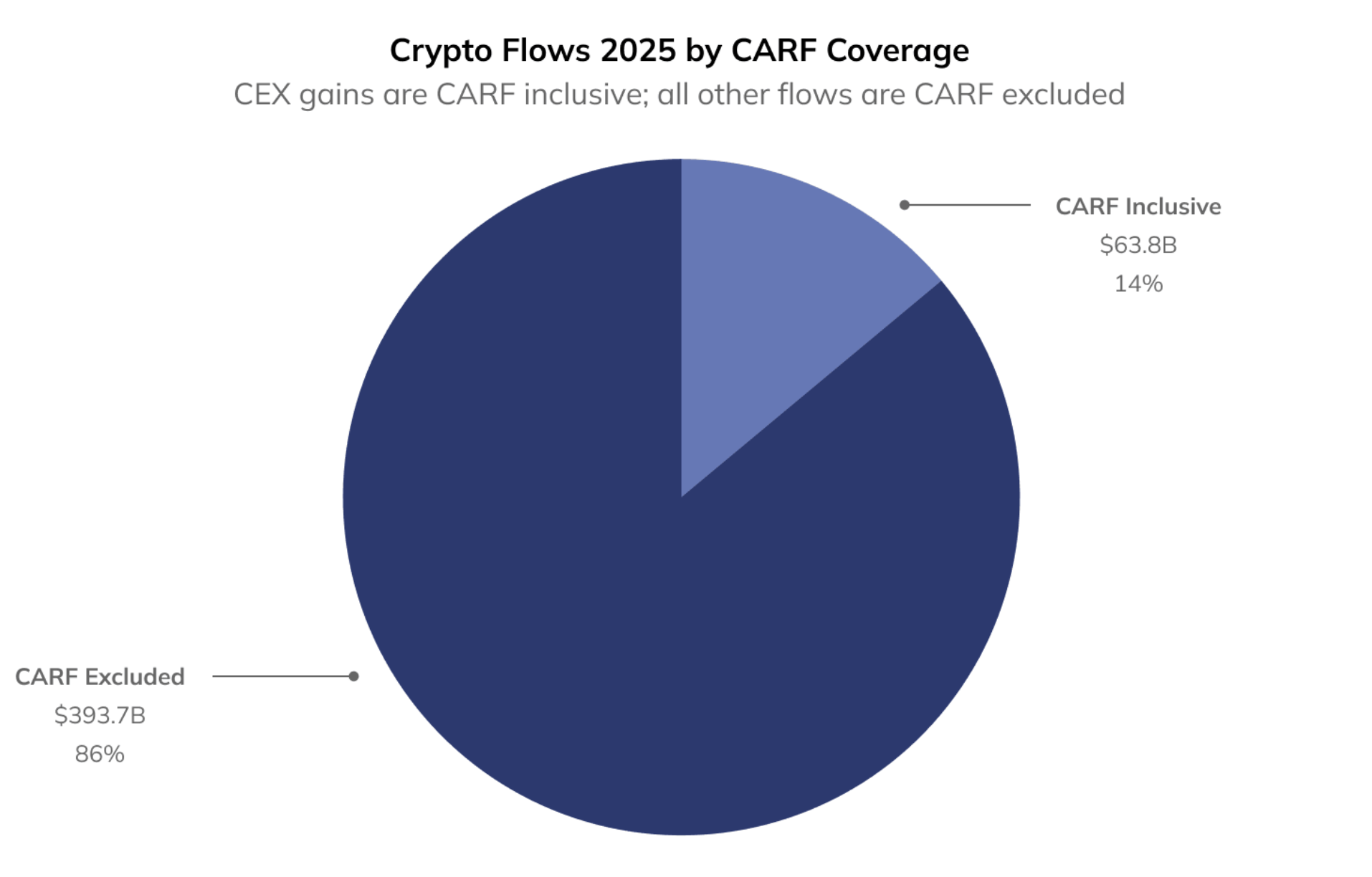
A groundbreaking report from blockchain analytics firm Chainalysis indicates that potentially taxable onchain crypto activity reached an staggering $457 billion globally in 2025. Alarmingly, the report suggests that existing international reporting rules, spearheaded by the OECD’s Crypto-Asset Reporting Framework (CARF), are poised to capture only a fraction – approximately 14% – of this massive sum, leaving an estimated 86% largely untracked by tax authorities. This substantial oversight highlights a significant and growing challenge for governments worldwide striving to ensure fair taxation and prevent illicit financial flows in the rapidly evolving digital asset landscape.
The United States alone accounted for an estimated $112.6 billion of this global total, underscoring the considerable domestic implications. Regionally, North America led all continents with $134.6 billion in potentially taxable onchain activity, closely followed by the European Union at $125.1 billion. These figures paint a vivid picture of the sheer volume of economic activity occurring within the decentralized corners of the crypto ecosystem, much of which currently operates beyond the reach of conventional tax reporting mechanisms.
The Scale of Untapped Revenue: A Deep Dive into Chainalysis Findings
The Chainalysis report, a comprehensive analysis of onchain transactions, carefully delineates the types of activities contributing to the $457 billion figure. These estimates encompass realized gains from crypto asset appreciation, income derived from various blockchain-native activities such as mining, staking, and lending, and crypto-denominated payments conducted across six major blockchains. Crucially, the methodology explicitly excludes trading and other activities conducted within centralized exchanges (CEXs). This exclusion is significant because CEXs are typically the primary target of existing and developing regulatory frameworks, including CARF, making the $457 billion figure even more impactful as it represents the less-regulated, onchain segment.
The decision to exclude CEX activity from this particular calculation was deliberate, aiming to highlight the segment of the market that poses the greatest challenge for current tax reporting standards. Centralized exchanges, by their very nature, act as intermediaries, collecting Know Your Customer (KYC) data and maintaining transaction records that can, in principle, be shared with tax authorities. The vast sum identified by Chainalysis, therefore, represents the truly decentralized and peer-to-peer activities that occur directly on blockchain networks, often without a readily identifiable central counterparty to facilitate reporting.
Understanding the Crypto-Asset Reporting Framework (CARF)
The Crypto-Asset Reporting Framework (CARF) was developed by the Organisation for Economic Co-operation and Development (OECD) in 2022 as a landmark initiative to enhance international tax transparency for crypto assets. Building on the success of earlier frameworks like the Common Reporting Standard (CRS) for traditional financial assets, CARF aims to provide a standardized global framework for the automatic exchange of information on crypto transactions. Its primary objective is to combat tax evasion and ensure that crypto assets are subject to the same level of tax scrutiny as traditional financial products.
Under CARF, in-scope crypto service providers are mandated to collect customer and tax residency information, along with detailed transaction data, and report this to their domestic tax authorities. These authorities can then exchange this information with other participating jurisdictions, creating a multilateral network for cross-border data sharing. The framework applies to a wide range of crypto assets, including cryptocurrencies, stablecoins, and certain non-fungible tokens (NFTs), as well as various transactions like exchanges between crypto assets and fiat currency, transfers of crypto assets, and retail payments.
The implementation of CARF commenced with data collection on January 1, 2026, across 48 jurisdictions worldwide. This includes major economic blocs such as the United Kingdom and the entire European Union, signifying a concerted global effort to bring crypto assets into the fold of international tax compliance. For crypto users within these jurisdictions, this means that their transactions conducted through regulated platforms are now subject to enhanced scrutiny and reporting. Exchanges and other covered service providers are now required to collect additional customer and tax residency information to fulfill their reporting obligations, a significant shift from the earlier, less regulated environment.
The Chasm: Why CARF Misses Most Onchain Activity
Despite its ambitious scope and widespread adoption, the Chainalysis report starkly reveals CARF’s inherent limitations, particularly concerning the vast majority of onchain activity. The framework, by design, focuses heavily on crypto intermediaries – centralized entities that facilitate crypto transactions as a business. This intermediary-centric approach is precisely why CARF accounts for only 14% of the identified onchain taxable activity. The remaining 86% encompasses activities like transactions on decentralized exchanges (DEXs), peer-to-peer (P2P) transfers, various onchain income streams (beyond those facilitated by a clear intermediary), and direct crypto payments.
As Colby Mangels, a former OECD adviser instrumental in CARF’s development, previously noted, the framework was constructed around the premise of identifiable service providers. This model works effectively for centralized exchanges, custodial wallet providers, and certain crypto payment processors that operate similarly to traditional financial institutions. However, much of the decentralized finance (DeFi) ecosystem, by its very nature, operates without such centralized operators or custodial relationships.
DeFi protocols are often governed by smart contracts and decentralized autonomous organizations (DAOs), where no single entity holds the keys or acts as a clear intermediary in the traditional sense. This absence of a centralized reporting entity poses a fundamental challenge for CARF. When users interact directly with smart contracts on a DEX, lend assets to a liquidity pool, or engage in a P2P transfer, there isn’t a "service provider" in the CARF definition to collect and report their transaction data. The pseudonymous nature of blockchain addresses further complicates efforts to link onchain activity to real-world identities without an intermediary.
The technical complexity of tracking and attributing these decentralized transactions to specific individuals for tax purposes is immense. Unlike a bank statement or a centralized exchange’s transaction history, direct onchain activity requires sophisticated blockchain analytics to trace flows, identify transaction types, and, critically, connect pseudonymous addresses to verifiable identities. This is where firms like Chainalysis play a crucial role, but their analytical capabilities are not yet universally integrated into national tax reporting systems for direct compliance.
Implications for Global Tax Authorities and the Crypto Ecosystem
The vast gap between potentially taxable onchain activity and CARF’s current reporting capabilities carries profound implications for governments, the integrity of the tax system, and the future development of the crypto industry.
Lost Revenue and Fiscal Strain: The $457 billion in untracked activity represents a significant potential loss of tax revenue for national treasuries. In an era where governments face increasing fiscal pressures and seek new revenue streams, this untapped resource is substantial. While it’s challenging to precisely quantify the exact tax revenue loss without knowing individual tax rates and net gains, the sheer volume of economic activity suggests billions in potentially uncollected taxes globally. This could exacerbate existing budget deficits and lead to calls for more aggressive enforcement measures.
Regulatory Arbitrage and Market Integrity: The existence of such a large reporting gap creates opportunities for regulatory arbitrage. Individuals and entities seeking to avoid tax obligations may be incentivized to move their activities from centralized, CARF-compliant platforms to decentralized, untracked protocols. This not only undermines the fairness of the tax system but also poses risks to market integrity. A segment of the market operating outside regulatory oversight can be more susceptible to illicit activities, money laundering, and fraud, potentially eroding public trust in the broader crypto ecosystem.
Challenges for Compliant Users: Even crypto users who are committed to tax compliance face significant hurdles. The complexity of tracking every onchain transaction, calculating basis costs, realized gains, and income from diverse DeFi protocols can be overwhelming. Without clear guidance, standardized tools, and accessible reporting mechanisms for direct onchain activity, even well-intentioned individuals may inadvertently fall into non-compliance. This highlights the need for user-friendly solutions and clearer regulatory frameworks that cater to the unique characteristics of decentralized finance.
The Road Ahead: Evolving Regulatory Responses
The Chainalysis report serves as a wake-up call, emphasizing the urgent need for regulators to bridge the gap between traditional tax frameworks and the innovative, decentralized nature of blockchain technology. The evolution of regulatory responses is likely to proceed on several fronts:
Watching AML Developments: Regulators are keenly observing developments in anti-money laundering (AML) regulations, particularly those spearheaded by the Financial Action Task Force (FATF). FATF’s guidance on Virtual Asset Service Providers (VASPs) and the "travel rule" – which requires financial institutions and VASPs to share originator and beneficiary information for transactions above a certain threshold – are crucial. As regulators grapple with defining when DeFi platforms or their operators should be treated as regulated crypto service providers, AML frameworks often provide the initial legal and conceptual groundwork. If a DeFi protocol or DAO can be deemed to have sufficient control or a centralizing element, it might eventually fall under reporting obligations similar to CEXs.
Future of DeFi Regulation: The debate around regulating decentralized platforms is intensifying. Legislative efforts, such as the Markets in Crypto-Assets (MiCA) regulation in the European Union, are beginning to address aspects of DeFi, albeit cautiously. Future iterations of such regulations may seek to impose reporting requirements on specific roles within DeFi ecosystems, such as front-end developers, liquidity providers, or even governance token holders, if they are deemed to exert significant control. However, this approach raises complex questions about the nature of decentralization, liability, and the practical enforcement of rules in a global, permissionless environment.
Calls for Comprehensive Frameworks: There is a growing consensus that future tax reporting frameworks for crypto will need to be more adaptable and technologically sophisticated than CARF’s initial iteration. This might involve exploring onchain analytics solutions directly integrated with tax authorities, developing mechanisms for users to self-report complex DeFi activity more easily, or even exploring novel approaches that leverage blockchain technology itself for compliance. The challenge lies in designing systems that respect the principles of decentralization and privacy while ensuring fiscal responsibility.
Industry and Government Collaboration: Bridging this tax gap will necessitate unprecedented collaboration between blockchain analytics firms, crypto industry stakeholders, and governmental bodies. Industry expertise is vital for understanding the nuances of onchain activity and developing practical, enforceable solutions. Governments, in turn, must be willing to engage with the technology and adapt their regulatory paradigms rather than simply trying to fit new tech into old boxes.
In conclusion, the Chainalysis report highlights a critical juncture for global tax policy in the age of digital assets. While the OECD’s CARF represents a significant step forward in international tax transparency, its current design is proving insufficient to capture the vast majority of potentially taxable activity occurring directly on blockchain networks. The estimated $457 billion in untracked onchain activity in 2025 underscores the urgency for regulators to develop more comprehensive, adaptable, and technologically informed frameworks. The imperative now is to balance the need for fiscal integrity and market stability with the innovative potential of decentralized finance, ensuring that the burgeoning digital economy contributes fairly to public treasuries without stifling technological advancement.








