Clara Shinta
A groundbreaking working paper from the Federal Reserve Bank of Cleveland has offered a compelling new perspective on the unique behavior of cryptocurrency markets, positing that the distinct dynamics of digital assets are not primarily driven by the demographics or inherent risk appetites of their investors, but rather by fundamentally divergent beliefs regarding their future returns. This provocative finding challenges conventional wisdom in financial economics and provides a crucial framework for understanding both crypto’s notorious volatility and its capacity to attract new participants during market rallies, potentially fueling self-reinforcing feedback loops.
The research, conducted by Michael Weber, Bernardo Candia, Olivier Coibion, and Yuriy Gorodnichenko, utilized extensive, repeated surveys of up to 25,000 U.S. households per wave. Their comprehensive analysis revealed that expectations about future crypto returns were a more potent predictor of cryptocurrency ownership than a wide array of demographic characteristics, including age, income, and gender. This insight suggests a market where psychological factors and subjective future outlooks play a disproportionately larger role than in traditional financial markets. The paper, aptly titled “Do You Even Crypto, Bro? Cryptocurrencies in Household Finance,” underscores the cultural and behavioral dimensions intertwined with the economic phenomena of digital assets.
The Unconventional Nature of Crypto Valuation
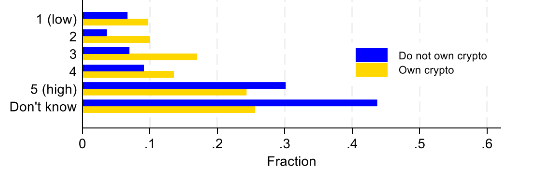
The core of the Cleveland Fed’s findings lies in the stark contrast between the beliefs of crypto owners and non-owners. For individuals willing to project future returns, the disparity was immense. Crypto owners anticipated an average return of 22% over the subsequent year, a figure dramatically higher than the 7% expected by non-owners. This chasm in expectations is a critical differentiator, highlighting a fundamental disagreement about the asset class’s intrinsic value and growth potential. Furthermore, crypto owners tended to perceive digital assets as less risky than their non-owning counterparts, suggesting a self-selection bias where optimistic return expectations are coupled with a lower perceived risk profile.
This divergence is particularly striking given the relatively nascent and often opaque nature of the cryptocurrency market. The 2021 survey data, integral to the study, revealed that a significant majority of non-crypto owners (87%) admitted to having no clear expectation of future returns. Even among existing crypto owners, a substantial 54% shared this uncertainty, indicating a broad lack of consensus or deep understanding regarding the asset class’s underlying economics. This environment of informational asymmetry and varied interpretations creates fertile ground for speculative behavior and exaggerated price movements, as market participants operate with vastly different mental models of future outcomes.
The researchers quantified the explanatory power of these beliefs: a one-percentage-point increase in an individual’s expected crypto return was associated with a 0.8-percentage-point increase in the probability of owning cryptocurrency. This strong correlation far outstripped the influence of traditional observable characteristics. For comparison, in markets for stocks, bonds, or gold, demographic and financial attributes typically hold significantly more explanatory power over ownership patterns than individual differences in expected returns. This reversal of explanatory power firmly positions cryptocurrency as an outlier in the landscape of household finance.
Methodology: Unpacking the Cleveland Fed’s Approach
The Federal Reserve Bank of Cleveland, one of the twelve regional Federal Reserve Banks, plays a crucial role in monetary policy, banking supervision, and economic research. Its foray into understanding cryptocurrency is indicative of the growing recognition among central banks and financial institutions that digital assets are no longer a fringe phenomenon but a significant, albeit volatile, component of the global financial ecosystem. The institution’s commitment to rigorous academic research, exemplified by this working paper, aims to provide data-driven insights to policymakers, regulators, and the public, helping to navigate the complexities of emerging financial technologies.
The robust methodology employed by Weber, Candia, Coibion, and Gorodnichenko leverages large-scale survey data, a powerful tool for capturing nuanced household financial behavior that might be missed by aggregated market data. The repeated waves of surveys, encompassing thousands of U.S. households, allow for granular analysis of how individual beliefs, risk perceptions, and responses to information influence investment decisions. This approach moves beyond simple correlation, attempting to uncover causal mechanisms through carefully designed experiments. The researchers’ choice to delve into the psychological underpinnings rather than solely relying on economic fundamentals reflects a growing trend in behavioral finance to understand irrationalities and biases that drive market actions.
The Information Effect: A Catalyst for Adoption
Perhaps one of the most consequential findings for understanding crypto market dynamics emerged from a randomized information experiment embedded within the survey. In an experiment conducted as part of the research (likely in 2021 or 2022, given the paper’s publication in 2026), households were randomly assigned to receive specific information about various asset classes, including Bitcoin (BTC), traditional stocks, GameStop (a symbol of meme stock phenomena), or general inflation trends. Participants who were shown Bitcoin’s performance over the preceding 12 months demonstrated a marked change in their investment intentions.
Specifically, these individuals increased their desired crypto portfolio allocation by approximately 2 percentage points. This represented a substantial 47% increase relative to the control group, which had an average desired allocation of 4.3%. More importantly, this shift in intent translated into real-world action: actual subsequent crypto purchases among this group rose by about 2.5 percentage points. The authors succinctly describe this outcome as “providing information about recent Bitcoin returns induces some households to start buying cryptocurrency.”

Ignorance and Influence: How Past Performance Shapes Future Action
This "information effect" was not uniform across all participants. It was predominantly concentrated among those who previously cited a lack of sufficient information as their primary reason for not owning crypto. Conversely, individuals who already held a negative view of cryptocurrency as a bad investment were largely unresponsive to the information treatment. This suggests a critical vulnerability in the market: a segment of the population, unburdened by preconceived negative notions but lacking knowledge, can be swayed by readily available, positive historical performance data. This mechanism aligns with the concept of "recency bias," where recent events disproportionately influence future expectations, and "herding behavior," where individuals follow the actions of a larger group, especially in ambiguous situations.
The implications of this finding are profound for understanding the cyclical nature of crypto rallies. Positive price movements, when communicated effectively, can act as a powerful magnet, drawing in new retail investors who are swayed by the prospect of quick gains. This influx of capital further pushes prices higher, creating a self-perpetuating feedback loop that can accelerate market booms and contribute to the formation of speculative bubbles. This dynamic underscores why periods of rapid appreciation in assets like Bitcoin or other altcoins often coincide with a surge in new investor accounts and increased trading volume.
Crypto’s Distinctive Investor Profile
While the study emphasized that beliefs about returns overshadow traditional demographics in explaining crypto ownership, it did not dismiss the demographic profile of investors entirely. The research confirmed several well-documented trends: individuals under 40 were 13 percentage points more likely to own cryptocurrency than those over 60, even after controlling for other characteristics. Men were approximately 4 percentage points more likely than women to own crypto, and higher-income and wealthier households also showed a greater propensity for participation.
These demographic characteristics paint a picture of early adopters who tend to be younger, more tech-savvy, predominantly male, and possess the financial capacity to engage in higher-risk, speculative investments. This aligns with broader trends observed in other regions; for instance, a survey from the Ontario Securities Commission indicated that Canadian crypto ownership increased to 25%, with similar demographic leanings. However, the Cleveland Fed paper argues that even within these demographic cohorts, the beliefs about future returns, rather than the demographic traits themselves, are the primary drivers of who ultimately invests.
Beyond Demographics: A Shift in Explanatory Power
The unique aspect is that for traditional assets, such as diversified stock portfolios or investment-grade bonds, an individual’s age, income, and financial sophistication typically explain a much larger portion of their investment choices. This is because traditional assets have longer track records, more established valuation models, and are often integrated into long-term financial planning based on life stage and risk tolerance. Crypto, by contrast, operates in a different paradigm where the perceived potential for outsized returns, often fueled by social media narratives and rapid price surges, overrides conventional investment rationale for a significant segment of the market. This highlights a fundamental divergence in how investment decisions are made across different asset classes.
The "Gambling Income" Phenomenon: Consumption Patterns and Perceived Wealth
Another intriguing finding from the paper relates to how crypto wealth influences household consumption. The study found that a doubling in Bitcoin’s price made a household whose entire financial portfolio was held in crypto 1.4 percentage points more likely to purchase a durable good. This translates to roughly a 7% increase relative to the unconditional probability of such a purchase. However, this effect did not extend to ordinary, day-to-day spending.
Transient Gains: Crypto Wealth and Consumer Behavior
This selective impact on consumption led the researchers to a stark comparison: crypto gains appear to be treated more like "gambling income" or lottery winnings than a permanent increase in wealth. When individuals experience a windfall from gambling or a lottery, they often splurge on one-time purchases, like a new car or home improvement, but do not fundamentally alter their long-term spending habits or perceive themselves as having permanently increased their wealth. In contrast, gains from traditional assets, such as a rise in stock portfolio value or real estate appreciation, are more commonly integrated into a household’s perceived permanent wealth, leading to more sustained changes in consumption patterns or reinvestment.
This behavioral pattern suggests that even among crypto owners, there might be an underlying skepticism or uncertainty about the long-term stability of their digital asset gains. This "transient wealth effect" has broader implications for economic modeling and understanding consumer behavior in a rapidly digitizing financial landscape. If a significant portion of newly acquired wealth is treated as ephemeral, it could lead to different macroeconomic outcomes compared to wealth creation through traditional channels.
Implications for Market Dynamics and Volatility
The Cleveland Fed paper’s findings coalesce into a powerful explanation for cryptocurrency’s persistent volatility. The absence of common information and a shared understanding of crypto’s fundamental value among investors creates an environment ripe for "disagreement and learning." In such a market, new information, particularly about past price performance, can dramatically alter individual expectations and subsequent behavior. This feedback loop, where positive returns attract new participants whose purchases further drive up prices, is a classic characteristic of speculative bubbles.
This dynamic, the authors argue, suggests that "price volatility will continue to be one of the most defining characteristics of this new asset for the foreseeable future." The market is not merely reacting to objective economic fundamentals but is heavily influenced by subjective beliefs, emotional responses, and the contagious power of positive past performance. This makes crypto markets inherently more susceptible to rapid swings, sudden corrections, and periods of irrational exuberance.
Regulatory Scrutiny and the Path Forward
The insights from this research carry significant implications for financial regulators and policymakers globally. The finding that investors can be easily influenced by information about past returns, especially when they lack foundational knowledge, highlights potential vulnerabilities for market manipulation and consumer protection. Regulators like the Securities and Exchange Commission (SEC) in the U.S. and financial authorities in other jurisdictions have grappled with classifying and overseeing cryptocurrencies, often citing concerns about investor protection, market integrity, and financial stability.
Navigating the Regulatory Landscape: A Call for Clarity
This study provides further ammunition for those advocating for clearer regulations, enhanced investor education, and stringent disclosure requirements in the crypto space. It suggests that merely warning investors about risks might not be sufficient if a large segment of the market lacks basic information or is unduly influenced by past performance narratives. Policymakers might consider initiatives aimed at improving financial literacy specifically related to digital assets, ensuring that potential investors understand the underlying technology, market mechanics, and inherent risks beyond just historical price charts. Furthermore, the paper implicitly supports the need for robust mechanisms to counter misinformation and prevent pump-and-dump schemes that prey on uninformed investors.
Central banks, concerned with systemic risk, will likely continue to monitor the growth and integration of crypto assets into the broader financial system. The "gambling income" phenomenon, while perhaps limiting widespread systemic risk from everyday spending, could still contribute to localized economic instability if large numbers of households experience sudden and significant wealth erosion from crypto downturns.
Conclusion: Understanding the Digital Frontier
The Federal Reserve Bank of Cleveland’s working paper offers a pivotal contribution to our understanding of cryptocurrency markets, shifting the focus from purely economic factors to the powerful role of human psychology and information dynamics. By demonstrating that disparate beliefs about future returns, rather than just demographics, primarily drive crypto ownership, and that simple information about past performance can significantly alter investment behavior, the research illuminates the fundamental drivers of crypto’s unique volatility.
The uncomfortable conclusion for crypto markets is that the next wave of retail demand may not solely hinge on Bitcoin’s intrinsic value or macroeconomic factors, but critically on what investors are told, and choose to believe, about its past price trajectory. As digital assets continue to evolve and integrate into the mainstream financial landscape, these behavioral insights will be indispensable for investors, financial advisors, regulators, and policymakers alike in navigating the complexities and harnessing the potential of this digital frontier while mitigating its inherent risks. Understanding the human element, the study emphatically states, is key to comprehending the future trajectory of cryptocurrencies.