Clara Shinta
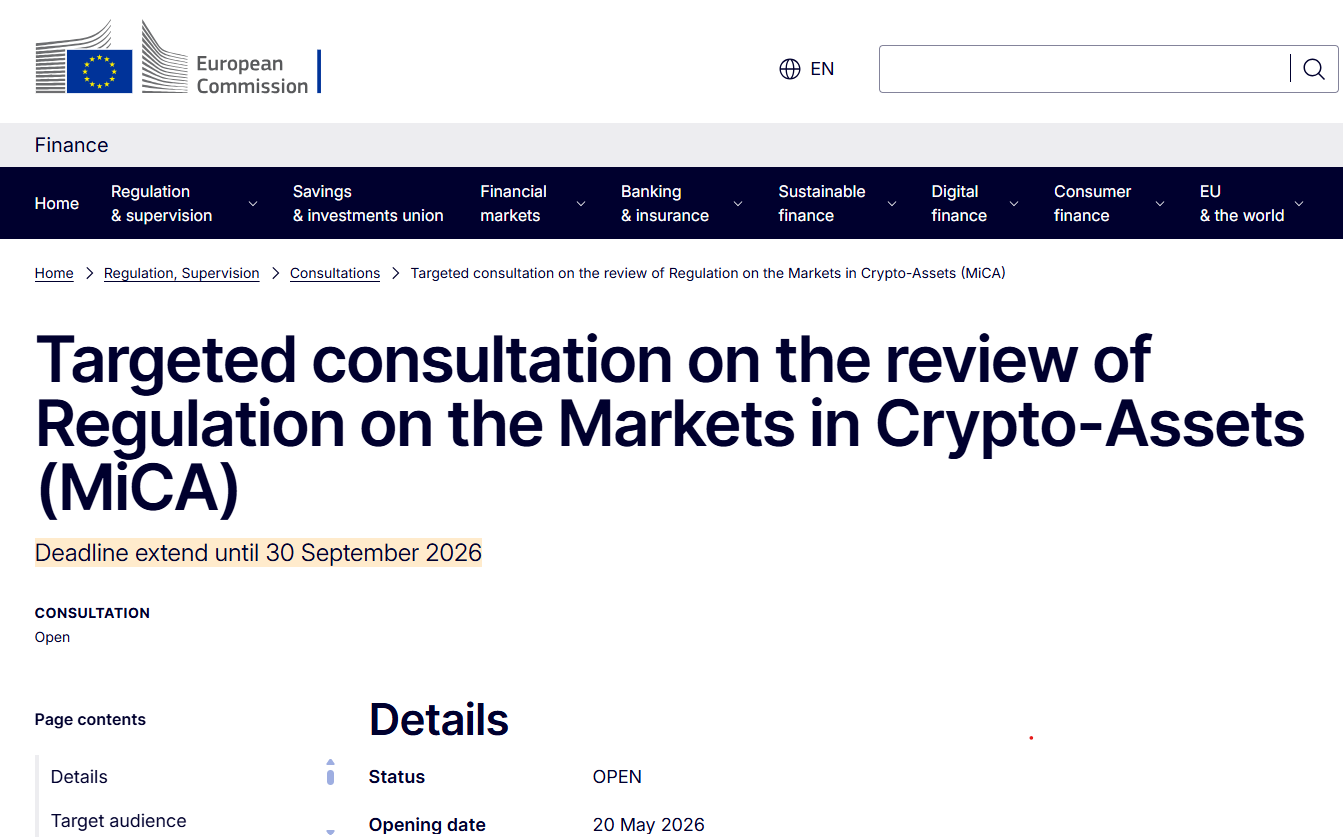
The European Union is re-evaluating the scope of its landmark Markets in Crypto-Assets (MiCA) regulation, specifically considering whether to extend its reach to cover crypto lending and borrowing, areas initially excluded from the comprehensive framework. This move, initiated by the European Commission’s targeted consultation launched on May 20, 2026, aims to address the rapidly evolving landscape of decentralized finance (DeFi) and the innovative financial instruments that have emerged within it, particularly "lending vaults." The potential expansion of MiCA’s regulatory perimeter has ignited a crucial debate within the crypto industry and among legal experts, focusing on the complexities of defining and overseeing activities that often defy traditional financial categorization.
MiCA’s Genesis and the Evolving Regulatory Landscape
MiCA, formally Regulation (EU) 2023/1114, represents the European Union’s pioneering effort to establish a harmonized regulatory framework for crypto-assets and crypto-asset service providers (CASPs) across its 27 member states. Proposed by the European Commission in September 2020 as part of its broader Digital Finance Strategy, MiCA’s primary objectives were to foster innovation, ensure financial stability, and protect consumers and investors within the nascent crypto market. After extensive negotiations, the regulation was finally agreed upon in June 2022, officially entered into force in June 2023, and is set to become fully applicable in phases, with rules for stablecoins (Asset-Referenced Tokens and E-money Tokens) taking effect in June 2024, and the broader framework for other crypto-assets and CASPs by December 2024 and June 2025, respectively.
However, during its formative stages, certain complex areas, particularly those characterized by a high degree of decentralization, were deliberately left outside MiCA’s initial scope. Crypto lending and borrowing, often facilitated through smart contracts and decentralized protocols, fell into this category. The rationale was largely pragmatic: regulators recognized the difficulty of applying traditional financial rules to systems that might lack a clear central entity or identifiable service provider. The rapidly changing nature of DeFi also meant that a more nuanced approach, potentially through subsequent reviews, would be necessary.
Now, with MiCA’s implementation on the horizon, the Commission is initiating the promised review. The consultation, which will close on September 30, 2026, specifically seeks stakeholder input on "issues around decentralized finance (DeFi) and crypto lending and borrowing." This proactive step underscores the EU’s commitment to maintaining regulatory oversight over a sector that has grown significantly since MiCA’s initial drafting, with billions of dollars in assets often locked in these protocols.
The Ambiguity of Lending Vaults: A Regulatory Blind Spot
At the heart of the current regulatory challenge are "lending vaults." These sophisticated on-chain mechanisms aggregate capital from multiple users and channel it into various crypto lending markets, often leveraging smart contracts to automate processes like interest accumulation, collateral management, and liquidations. Unlike traditional banks or financial institutions, which operate with clear legal entities, regulatory licenses, and defined responsibilities, lending vaults often operate in a legal gray area. Their legal status currently hinges on non-binding interpretations that suggest they fall outside the existing MiCA framework and conventional EU fund rules.

Yuriy Brisov, an EU digital assets lawyer and partner at Digital & Analogue Partners, highlights this definitional challenge. "EU law has no category called a ‘vault,’" Brisov told Magazine, emphasizing the functional nature of legal interpretation. "A lawyer therefore defines it the way a regulator would qualify it: by function, not by label." This distinction is critical because vaults can perform the economic functions of lending, effectively acting as intermediaries, but they do so by distributing functions across smart contracts and numerous participants, rather than consolidating them within a single corporate entity. This dispersal of responsibility makes it exceedingly difficult to identify a "service provider" in the traditional sense, which is a cornerstone of most financial regulations.
The stakes are considerable. The decentralized lending market has witnessed substantial growth, with total value locked (TVL) in DeFi protocols fluctuating but often reaching tens of billions of dollars globally. While specific figures for EU-based lending vaults are hard to isolate, the potential for significant capital flows and systemic risk cannot be overlooked by regulators. The absence of clear rules raises concerns about investor protection, market integrity, and the potential for illicit finance, mirroring some of the motivations behind MiCA’s initial creation.
Morpho: A Case Study in Decentralized Complexity
To illustrate the practical intricacies, the decentralized lending protocol Morpho offers a compelling example. Morpho’s Vault V2 architecture explicitly divides responsibilities among an "owner," "curator," "allocator," and "sentinel." The "curator" is tasked with configuring strategy and risk parameters, the "allocator" executes capital allocations, and the "sentinel" possesses powers designed to mitigate risk. This multi-party, multi-role structure exemplifies why identifying a single, accountable "provider" for regulatory purposes is far more complex than with conventional lending models.
While none of these roles, in isolation, might automatically qualify as providing a regulated lending service under MiCA’s current definitions, their collective function undeniably facilitates lending. This distributed responsibility model challenges regulators to move beyond entity-based regulation towards a more activity-based or function-based approach, without stifling the very innovation that DeFi promises.
Jonathan Galea, a partner at Cahill Gordon & Reindel, has extensively explored the regulatory implications of lending vaults in the EU context, noting how these structures can intersect with MiCA, stablecoin rules, and broader European fund law. Galea cautions policymakers against a blanket approach, stressing that "lending vaults solve more practical problems than they create." He argues that vaults often help aggregate fragmented liquidity, making lending markets more efficient. He further highlights that not all "vaults" are equal; some merely facilitate lending, while others might engage in active trading or asset management, necessitating different regulatory treatments. "Bring ‘DeFi lending’ into the perimeter as a single label, and structures that deserve opposite answers risk ending up captured together," Galea warns, underscoring the need for granular distinctions.
The Decentralization Dilemma: Who to Regulate?
MiCA currently provides an exemption for crypto-asset services "provided in a fully decentralized manner." However, it also clarifies that the regulation can apply if only a part of an activity is performed in a decentralized way. This creates a critical grey area and a definitional tightrope for regulators. The challenge lies in objectively defining "fully decentralized" in a spectrum where many protocols still rely on some degree of human input, governance, or upgradeability.
Galea points out a significant drawback of using decentralization as the primary dividing line for regulation. "Decentralization is a spectrum and a function of time: a test built on it would penalize newer, more novel protocols while entrenching mature incumbents that have had years to distribute control," he argues. This would create an uneven playing field, potentially stifling innovation from emerging projects that require a period of semi-centralized development before achieving full decentralization.
Brisov offers an alternative perspective, suggesting that the focus should be on the structural characteristics of the vault and the actual control exercised by individuals or entities. He advocates for "safer ground" where "there is no undertaking, no appointed manager, the holder has a direct coded claim on the pool, and the user can exit before any parameter change takes effect." This structural approach aims to identify whether a traditional "undertaking" or "service provider" exists, irrespective of the "decentralized" label. If Brussels decides to regulate lending and borrowing, Brisov suggests these activities should be explicitly added to the list of regulated crypto-asset services, rather than broadly redefining what constitutes a crypto-asset service provider. This targeted approach could offer greater clarity and avoid unintended consequences.
Industry Calls for a Tailored Framework
The industry’s reaction to the potential expansion of MiCA is a mixture of apprehension and a call for thoughtful, tailored regulation. Michael Egorov, founder of Curve Finance, a prominent DeFi protocol, emphasizes the fundamental differences between decentralized and conventional finance. "If DeFi lending is ever brought into the scope of regulation, it should be treated completely differently," Egorov states. He highlights that DeFi’s inherent transparency, immutability of smart contracts, and often over-collateralized nature can offer safeguards not present in traditional lending, while simultaneously presenting unique risks that require distinct approaches.
Egorov urges a "really careful" approach to regulation, suggesting that a dedicated framework could enhance safety and attract new users to DeFi lending without imposing rules that are incompatible with the decentralized architecture of many protocols. This sentiment is echoed by many in the crypto community, who fear that applying conventional financial regulations wholesale to DeFi could inadvertently stifle innovation, drive activity offshore, or even render certain protocols inoperable due to compliance burdens. The goal, they argue, should be to mitigate risks without sacrificing the core tenets of decentralization, transparency, and permissionless access that define DeFi.
Broader Implications and the Road Ahead
The European Commission’s consultation is not merely a technical exercise; it represents a pivotal moment for the future of DeFi within the EU and potentially globally. The decision on whether and how to regulate crypto lending and borrowing will have far-reaching implications:
- Innovation vs. Regulation: A heavy-handed approach could deter innovation within the EU, pushing developers and projects to more lenient jurisdictions. Conversely, a clear, tailored framework could provide legal certainty, attracting institutional capital and fostering responsible growth.
- Investor Protection: Bringing these activities under regulation aims to enhance consumer protection by introducing requirements for disclosure, risk management, and operational resilience, similar to those imposed on traditional financial services.
- Market Integrity: Regulation could help mitigate risks such as market manipulation, liquidity crises, and the use of DeFi for illicit activities, contributing to overall financial stability.
- EU’s Global Stance: As a first-mover in comprehensive crypto regulation with MiCA, the EU’s approach to DeFi lending will be closely watched by other jurisdictions. Its framework could set a precedent for global standards, influencing how other major economies choose to address these evolving financial instruments.
- Regulatory Arbitrage: Without clear and harmonized rules, there is a risk of regulatory arbitrage, where entities choose to operate in jurisdictions with less stringent oversight, potentially undermining the effectiveness of EU regulation.
The consultation period, which concludes on September 30, will gather diverse perspectives from industry participants, legal experts, consumer protection groups, and national regulators. The challenge for Brussels will be to synthesize this input into a coherent and effective policy. This will involve not only deciding whether to regulate DeFi lending but also, critically, how to craft rules that can meaningfully distinguish between the myriad forms of on-chain lending, accurately identify the individuals or entities (if any) that exercise control, and ensure that the regulatory burden is proportionate to the risks involved. The outcome will undoubtedly shape the trajectory of decentralized finance in Europe for years to come.