Clara Shinta
A significant shift in investment strategy is emerging among Generation Z traders utilizing the Binance platform, as a new analysis by Binance Research indicates a growing allocation of their equity activity towards Exchange-Traded Funds (ETFs). This trend, observed in early August, saw ETFs accounting for a substantial 25% of the cohort’s overall trading volume. This marks a notable increase from previous months, with ETFs capturing 21.9% of Gen Z’s net equity inflows in July, an uptick from 18.5% in June. Concurrently, the share of inflows directed towards individual stocks experienced a slight decline, moving from 77% to 74.2% over the same period. This evolving preference suggests a maturing approach to investment among younger demographics within the digital asset ecosystem, prioritizing diversification and potentially lower risk profiles offered by ETFs.
Gen Z’s Evolving Investment Landscape: A Deep Dive into Binance Research Findings
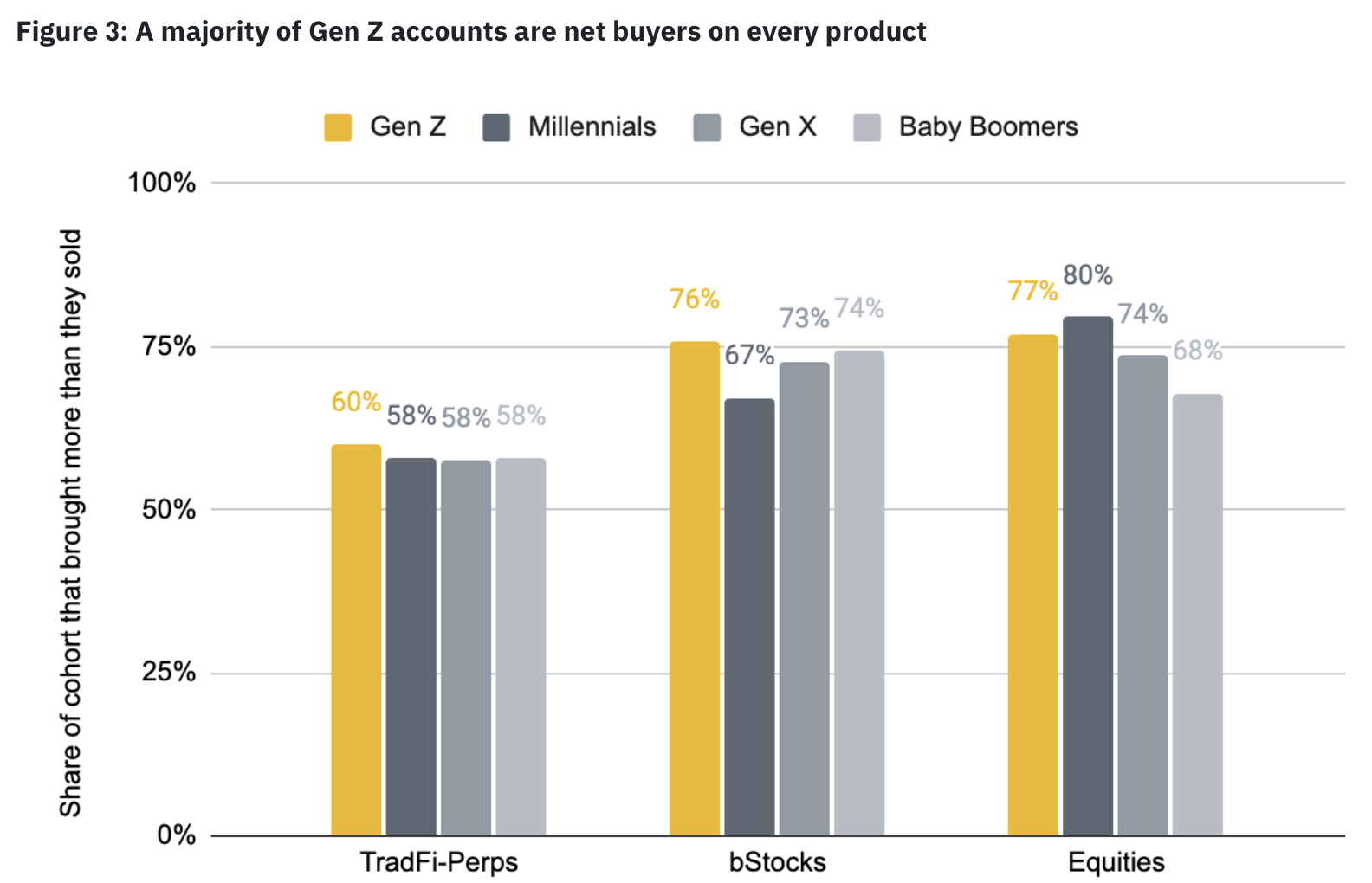
Binance Research’s comprehensive analysis meticulously examined trading activities across various product categories, including direct equities, tokenized stocks, and traditional finance (TradFi) perpetuals. The study provided a comparative look at investment behaviors across different generations—Gen Z, Millennials, Gen X, and Baby Boomers—evaluating metrics such as trading frequency, net capital flows, and the utilization of leverage. The findings underscore a distinct investment philosophy among Gen Z, particularly their burgeoning interest in ETFs.
Exchange-Traded Funds, a popular investment vehicle in traditional financial markets, offer investors a diversified portfolio of assets—be it stocks, bonds, commodities, or a mix—that trade like individual stocks on an exchange. Their appeal often lies in their diversification benefits, lower expense ratios compared to actively managed mutual funds, and ease of trading. For Gen Z investors, many of whom are digital natives and accustomed to instant access and streamlined interfaces, the accessibility of ETFs on platforms like Binance may contribute significantly to their growing adoption. This shift could reflect a broader market trend where investors, especially those new to equity markets, seek ways to mitigate risk through diversification while still participating in market growth.
Despite their increasing engagement with financial products, Gen Z traders demonstrated a generally lower trading frequency compared to their older counterparts. Across all three product categories analyzed—direct equities, tokenized stocks, and TradFi perpetuals—the younger cohort engaged in fewer monthly trades. For instance, Gen Z averaged 13 monthly trades in TradFi perpetuals, a figure noticeably lower than the 17 trades observed for Millennials and 16.5 for Gen X. This lower frequency could indicate a preference for a more long-term, ‘buy-and-hold’ investment strategy rather than active, short-term trading. It might also suggest a more considered approach to market participation, potentially influenced by market volatility or a desire to avoid speculative risks.
Further supporting this hypothesis of a more cautious or long-term approach is the prevalence of "buy-only" accounts among Gen Z. The research revealed that 22% of Gen Z direct-equity accounts had never executed a sell order. While Millennials topped this metric with 30% buy-only accounts, Gen Z’s figure was higher than Gen X (19%) and significantly higher than Baby Boomers (9%). This phenomenon could be attributed to several factors, including a strong belief in the long-term growth potential of chosen assets, a lack of experience in managing profit-taking or loss-cutting strategies, or simply a preference for accumulating assets over time. Among these Gen Z buy-only accounts, the top assets by cumulative purchases included tech giants like Broadcom and Tesla, alongside the Schwab US Dividend Equity ETF. This mix suggests an interest in both high-growth companies and income-generating, diversified funds, further solidifying the idea of a balanced, albeit accumulating, investment strategy.

Another key finding from the Binance Research report was Gen Z’s relatively low appetite for higher-risk investment products, specifically leveraged and inverse ETFs. A significant 88.2% of Gen Z TradFi perpetual accounts recorded no activity in these products. This contrasts with Millennials, where 84.5% showed no activity, and Gen X, with 85.9%. Leveraged and inverse ETFs are designed to amplify returns or bet against market movements, respectively, and typically carry higher risks. Gen Z’s avoidance of these instruments, despite being digital natives often stereotyped as risk-takers in other digital domains, suggests a pragmatic and risk-averse stance when it comes to their financial investments. This could be a reflection of observing past market downturns or a generational learning from economic uncertainties.
It is important to note, as cautioned by Binance, that its direct-equities product only achieved meaningful scale in June. This relatively short data window means that while the observed trends are significant, they represent initial insights rather than fully established, long-term patterns. Nevertheless, these early findings offer a valuable glimpse into the evolving investment behaviors of a crucial demographic group that will increasingly shape financial markets.
The Dynamic Rise of Tokenized Stocks and Fierce Platform Competition
Beyond traditional financial instruments, the digital asset space continues to innovate, with tokenized stocks emerging as a notable trend. Binance’s own tokenized stock offering, "bStocks," has rapidly made its mark on the market, briefly surpassing Kraken’s "xStocks" to become the second-largest tokenized stock issuer within less than two months of its launch. This rapid ascent highlights the growing demand for real-world asset (RWA) tokenization and the intense competition among leading crypto platforms to capture this nascent but expanding market segment.
On a specific Tuesday, bStocks reached a significant milestone, holding $610.6 million in tokenized stock value, eclipsing xStocks’ $601.2 million, according to data from Token Terminal. This momentary leadership underscored Binance’s aggressive entry and rapid market penetration in the tokenized assets space. Tokenized stocks offer a bridge between traditional equity markets and blockchain technology, allowing investors to gain exposure to fractional shares of publicly traded companies through digital tokens. This innovation lowers entry barriers, enhances liquidity, and provides a new avenue for global investment, appealing to a diverse range of investors, including Gen Z.
However, the competitive landscape in tokenized stocks is highly dynamic. By Friday of the same week, the positions had reversed, with Token Terminal data showing xStocks reclaiming its lead at $610.7 million, while bStocks adjusted to $579.6 million. This fluctuation represents 22.3% and 21.2% of the roughly $2.7 billion tokenized stock market, respectively. This back-and-forth demonstrates the volatile yet exciting nature of this emerging market, where market share can shift rapidly based on liquidity, platform offerings, and investor sentiment.
Despite these competitive shifts, the broader tokenized stock market continues its trajectory of expansion. RWA.xyz, a prominent tracker for real-world assets on-chain, reported approximately $2.43 billion in distributed value as of Friday, marking a robust 5% growth over the preceding 30 days. This consistent growth underscores the increasing acceptance and utility of tokenized assets within the digital economy. Leading the pack remains Ondo Finance, which held a dominant position as the largest issuer with $971.8 million in tokenized stock value, reflecting its early mover advantage and established presence in the RWA tokenization sector. The overall growth of tokenized stocks is a testament to the broader movement towards integrating traditional finance with blockchain technology, creating new investment opportunities and improving market efficiencies.
Broader Market Implications and Expert Commentary
The observed trends in Gen Z’s investment behavior and the burgeoning tokenized stock market collectively point towards a significant convergence of traditional and digital finance. The increasing preference for ETFs among younger investors on a crypto-native platform like Binance signals a maturation of the digital asset investment landscape. It suggests that as cryptocurrency platforms expand their offerings beyond pure digital assets to include tokenized versions of traditional securities and TradFi perpetuals, they are attracting a more diverse investor base with varied risk appetites and investment goals.
Financial analysts widely interpret the shift towards ETFs among Gen Z as a positive indicator of growing financial literacy and a preference for diversified, less volatile investment vehicles. "The data from Binance Research suggests that Gen Z, while digitally savvy, is demonstrating a pragmatic approach to wealth building," remarked a crypto market analyst, speaking on background. "Their gravitation towards ETFs, coupled with lower trading frequency and aversion to highly leveraged products, indicates a desire for sustainable growth rather than speculative gains. This is a healthy sign for the long-term stability of digital asset platforms seeking to onboard mainstream investors."
The rapid rise and intense competition within the tokenized stock market further emphasize the transformative potential of real-world asset tokenization. This innovation is not merely about replicating traditional assets on a blockchain; it’s about enhancing their accessibility, liquidity, and potentially offering fractional ownership to a global audience. The competitive dynamics between platforms like Binance and Kraken are indicative of a fierce race to establish dominance in what is projected to be a multi-trillion-dollar market. Industry experts believe that as regulatory frameworks evolve to accommodate these new financial instruments, tokenized stocks will play a pivotal role in democratizing access to global capital markets.
Moreover, the engagement of Gen Z with these diversified and tokenized offerings highlights their growing influence as a demographic force in finance. As the first generation to grow up entirely in the digital age, their comfort with technology translates directly into their investment habits. They seek platforms that offer seamless user experiences, transparent data, and a wide array of options that cater to their specific financial goals, which often include both growth and stability. The fact that top assets for buy-only Gen Z accounts include both high-growth tech stocks and dividend-paying ETFs underscores a nuanced understanding of market dynamics and a desire for balanced portfolio construction.
In conclusion, the latest insights from Binance Research paint a compelling picture of an evolving investment landscape. Gen Z traders are increasingly adopting traditional financial strategies, such as ETF investing, within the digital asset ecosystem, signaling a preference for diversification and a more conservative approach to risk. Simultaneously, the tokenized stock market is experiencing robust growth and dynamic competition, demonstrating the profound impact of real-world asset tokenization. These trends collectively underscore a significant convergence between traditional finance and the digital asset world, driven by technological innovation and the distinct investment preferences of a new generation of investors. As platforms continue to innovate and offerings diversify, the bridge between these two financial realms is only expected to strengthen, paving the way for a more integrated and accessible global financial system.