Clara Shinta
Strategy, recognized globally as the largest corporate holder of Bitcoin, has successfully augmented its capital reserves by $263.5 million through the sale of its Class A common stock, all while steadfastly preserving its considerable Bitcoin portfolio. This strategic financial maneuver, executed through the company’s at-the-market (ATM) program, underscores Strategy’s ongoing commitment to its unique digital asset treasury strategy, which has become a defining characteristic of the enterprise.
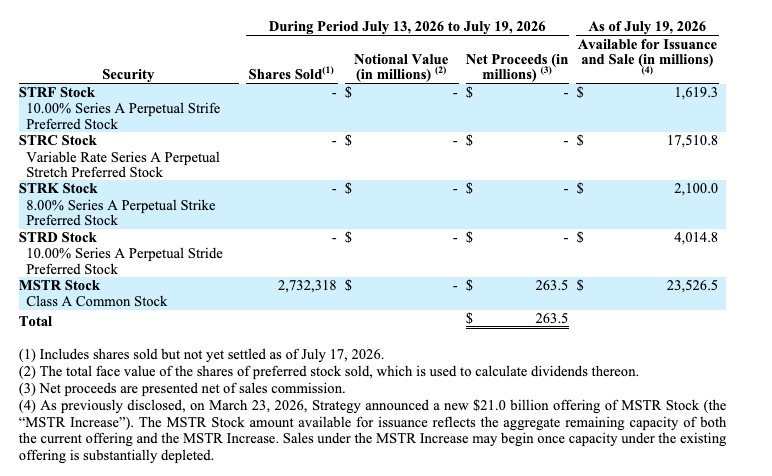
Between July 13 and July 19, Strategy divested 2.73 million shares of its MSTR common stock under its ATM program, according to a Form 8-K filing submitted to the US Securities and Exchange Commission (SEC) on Monday. This capital injection brought the company’s US dollar reserve to an impressive $3.225 billion, marking a 7.5% increase from the $3 billion reported just a week prior. This reserve is critically important for funding dividend payments on the company’s preferred stock and covering interest obligations on its outstanding debt, demonstrating a meticulous approach to financial liquidity and obligation management.
Unwavering Commitment to Bitcoin Holdings
Despite the active capital-raising initiatives, Strategy made no alterations to its Bitcoin holdings during the reporting period. The company’s digital asset treasury remains unchanged at 843,775 BTC. These holdings were acquired for a cumulative purchase price of $63.69 billion, resulting in an average acquisition cost of approximately $75,476 per Bitcoin, as detailed on Strategy’s official website. At the time of the filing, Bitcoin was trading at roughly $64,657, indicating a paper loss relative to Strategy’s average acquisition cost but reinforcing the company’s long-term conviction in the cryptocurrency’s value proposition.
This consistent stance on Bitcoin accumulation, even in periods of market volatility or when the asset trades below its average cost basis, highlights the unwavering belief of Strategy’s leadership in Bitcoin as a store of value and a strategic reserve asset. The company’s strategy posits that Bitcoin offers a superior long-term inflation hedge and growth opportunity compared to traditional treasury assets.
Chronology of Recent Capital-Raising Activities
The latest $263.5 million common stock sale follows closely on the heels of another significant capital raise. Just the previous week, Strategy reported no Bitcoin purchases while simultaneously raising a substantial $466.7 million through its MSTR ATM program. Combined, these two recent common stock sales have injected over $720 million into the company’s coffers within a short timeframe. It is noteworthy that during both reporting periods, Strategy did not utilize any of its preferred stock ATM programs, focusing solely on common stock issuance to raise capital.
The use of an ATM program offers companies significant flexibility, allowing them to sell shares into the open market over a period, rather than through a single large offering. This method can minimize market disruption and allow the company to capitalize on favorable market conditions. Strategy still possesses considerable financial maneuverability, with approximately $23.5 billion of remaining capacity under its common stock ATM program. This substantial unused capacity provides the company with significant flexibility to raise additional capital should market conditions or its strategic needs dictate.
The Evolution of Strategy’s Funding Mechanisms

Strategy’s journey into Bitcoin began in August 2020, marking a pivotal shift in its corporate strategy. Under the guidance of its executive chairman, the company embarked on an ambitious program to accumulate Bitcoin, positioning the cryptocurrency as its primary treasury reserve asset. This pioneering move distinguished Strategy from virtually all other publicly traded companies and quickly established it as a proxy for Bitcoin exposure in the equity markets.
Initially, the company funded its Bitcoin acquisitions primarily through excess cash flows and common stock sales. However, as its Bitcoin holdings expanded and its appetite for further accumulation grew, Strategy diversified its funding mechanisms. It began to issue convertible senior notes, a form of debt that can be converted into equity under certain conditions, and later introduced preferred stock offerings. These preferred stock offerings, specifically the STRC series, have provided another avenue for capital generation, appealing to a different segment of the investor base interested in fixed income-like returns with a potential upside tied to Strategy’s overall performance and, by extension, Bitcoin’s appreciation.
This multi-faceted funding approach allows Strategy to maintain its Bitcoin acquisition strategy while balancing shareholder dilution and leveraging different capital markets instruments. The decision to predominantly use common stock sales in the most recent periods suggests a strategic assessment of current market appetite and the cost of capital across its various funding options.
Deep Dive into the STRC Valuation Debate
The increasing utilization of preferred stock, particularly Strategy’s STRC series, has sparked considerable debate among investors and analysts regarding its true valuation. On Friday, STRC preferred stock closed at $85.29, while MSTR common shares ended the session at $94.85, according to Yahoo Finance data. This divergence in valuation metrics often reflects different investor expectations and risk perceptions.
Credit investor Khing Oei recently articulated his view on the potential undervaluation of STRC preferred stock in an X post on Sunday. Oei argued that the market might be simplistic in its assessment, treating STRC merely as a "14% yield" product rather than valuing its long-term future cash flows. He emphasized that valuing such a stream by simply dividing the current year’s coupon by today’s price is a flawed methodology. Instead, Oei suggested that STRC should be appraised more akin to a bond, considering its fixed dividend payments and the underlying financial strength of Strategy.
Oei’s model posited that the preferred stock could be worth around $96, even under a scenario where Bitcoin experiences no further price appreciation. This valuation is predicated on Strategy’s robust capacity to sustain dividend payments for decades, supported by its substantial financial reserves and ongoing operational revenues. The key driver, according to Oei, is leverage. He argued that if Bitcoin’s value ascends, it would significantly bolster Strategy’s balance sheet, which in turn would likely push STRC closer to its $100 par value. This perspective highlights the intricate relationship between Strategy’s Bitcoin-centric balance sheet, its capital structure, and the perception of risk and return for its different classes of securities.
Broader Market Impact and Implications
Strategy’s distinctive corporate strategy has made it a focal point in both the traditional equity markets and the burgeoning digital asset space. Its stock, MSTR, often trades with a significant premium to its underlying Bitcoin holdings, a phenomenon known as the "Saylor premium," reflecting investor enthusiasm for its Bitcoin exposure and the management’s perceived expertise in navigating the cryptocurrency market. This premium, however, is subject to market sentiment and can fluctuate wildly.
The company’s continuous capital raises, whether through common stock, preferred stock, or debt, illustrate a bold and aggressive strategy to accumulate more Bitcoin. This approach carries inherent risks, primarily centered around the volatility of Bitcoin’s price. A significant downturn in Bitcoin’s value could put pressure on Strategy’s balance sheet, potentially impacting its ability to service debt and preferred dividends, although the company has consistently maintained ample cash reserves to mitigate immediate risks.
Conversely, a sustained upward trend in Bitcoin’s price could dramatically enhance Strategy’s equity value, validating its unconventional treasury management strategy. The ongoing debate surrounding the valuation of its preferred stock, STRC, further exemplifies the complexity and unique challenges investors face when assessing a company so deeply intertwined with a nascent and volatile asset class.
Risks and Opportunities in a Bitcoin-Centric Strategy
Strategy’s high-conviction Bitcoin strategy presents a unique risk-reward profile. The primary opportunity lies in the potential for significant appreciation of Bitcoin, which would directly increase the company’s net asset value and, theoretically, its share price. Furthermore, by being the largest corporate holder, Strategy offers institutional and retail investors indirect exposure to Bitcoin through a publicly traded equity, potentially bypassing some of the complexities of direct cryptocurrency ownership.
However, the risks are equally pronounced. Bitcoin’s price volatility remains a significant concern. While Strategy has shown resilience through past market corrections, a prolonged bear market could lead to sustained paper losses on its holdings, potentially impacting investor confidence and its ability to raise capital on favorable terms. The company’s reliance on leverage through debt and preferred stock also amplifies both potential gains and losses. A substantial decline in Bitcoin could trigger margin calls or necessitate further capital raises under less favorable conditions.
Despite these challenges, Strategy has consistently demonstrated a commitment to its long-term vision. The ongoing capital raises, coupled with the steadfast preservation of its Bitcoin treasury, signal a clear intent to continue executing its strategy. The company’s robust US dollar reserve, now exceeding $3.2 billion, provides a crucial buffer against short-term market fluctuations and ensures the servicing of its financial obligations.
Future Outlook and Capital Flexibility
With $23.5 billion in remaining capacity under its common stock ATM program, Strategy possesses substantial financial flexibility for future capital-raising endeavors. This capacity allows the company to opportunistically raise funds without the need for traditional, more cumbersome public offerings, enabling it to react swiftly to market conditions or strategic opportunities. This agility is a key component of its overall strategy to maintain and potentially expand its Bitcoin holdings.
The company’s continued use of common stock sales, rather than preferred stock sales in these recent periods, may reflect a strategic preference to tap into broader equity market demand, potentially minimizing the cost of capital or managing its preferred share outstanding balance. As the digital asset landscape evolves and Bitcoin continues to mature as an asset class, Strategy’s unique position as a leading corporate adopter will likely keep it at the forefront of financial innovation and market discourse.
In conclusion, Strategy’s latest financial report highlights a concerted effort to fortify its balance sheet through strategic common stock sales, reinforcing its operational liquidity while unequivocally maintaining its substantial Bitcoin treasury. The company’s innovative financing approaches and its unwavering commitment to its Bitcoin-centric strategy continue to shape its market identity, drawing both fervent support and critical scrutiny from investors who are closely watching the interplay between traditional corporate finance and the volatile world of digital assets.