Reynand Wu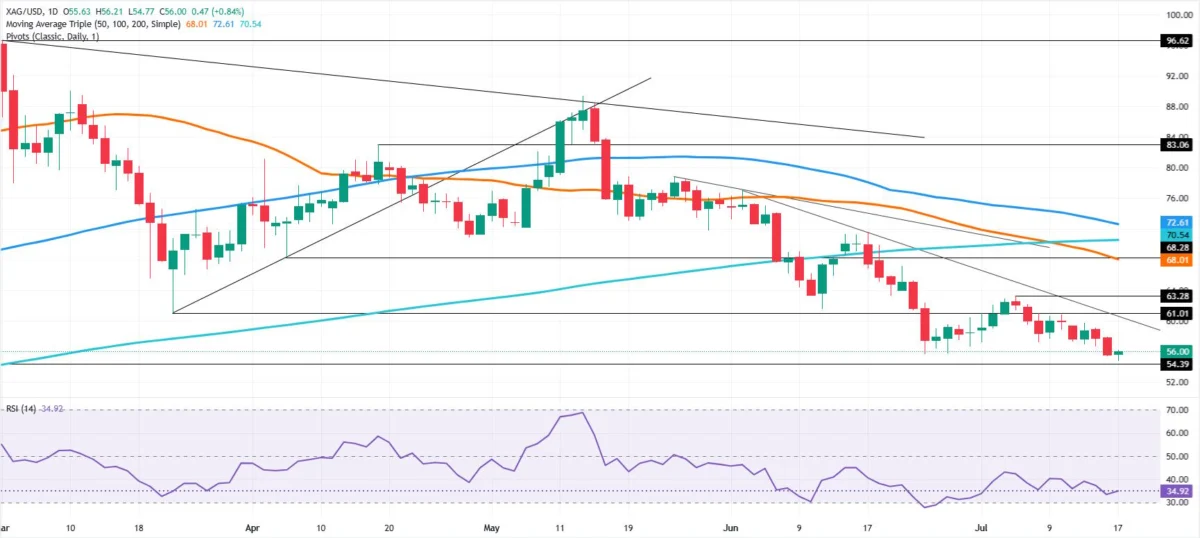
The global precious metals market observed a challenging week for silver, as the commodity registered a significant weekly loss exceeding 6.50%, even after a slight rebound of 0.84% on Friday. Trading at $56.00 per troy ounce at the close of the week, XAG/USD had earlier plummeted to a new year-to-date (YTD) low of $54.77, signaling a persistent bearish sentiment among investors. This downturn underscores the complex interplay of macroeconomic factors, industrial demand, and technical indicators currently influencing the white metal’s valuation.
A Week Defined by Downward Pressure and Missed Opportunities
The week commenced with silver under considerable pressure, extending a broader trend of weakness that has characterized its performance in recent periods. Despite attempts by bulls to mount a recovery, the crucial psychological barrier of $60.00 proved insurmountable. This level, which analysts and traders closely monitor, represented a key resistance point that, if reclaimed, could have potentially paved the way for a more substantial recovery, possibly challenging the July 6 high of $63.28. However, the failure to breach this threshold reinforced the prevailing downward market structure.
As the week progressed, selling pressure intensified, pushing XAG/USD through several minor support levels. The culmination of this bearish momentum saw the price touch $54.77, establishing a new low for the year. This event served as a stark reminder of the market’s current disposition towards silver, reflecting concerns ranging from global economic slowdowns to the impact of tighter monetary policies. The modest recovery on Friday, while providing a glimmer of hope, did little to offset the substantial losses accumulated over the preceding days, leaving the metal vulnerable to further declines in the short to medium term.
Technical Outlook: A Path of Least Resistance to the Downside
From a technical perspective, the landscape for silver appears decidedly bearish. The price action over the past week has solidified a downward market structure, with lower highs and lower lows indicating that sellers remain firmly in control. The failure to reclaim the $60.00 mark is a critical technical signal, suggesting that the path of least resistance for XAG/USD continues to be to the downside.
Momentum indicators corroborate this bearish view. The Relative Strength Index (RSI), a popular oscillator used to measure the speed and change of price movements, remains downward-biased. A reading below 50 on the RSI typically suggests that bearish momentum is stronger than bullish momentum, and the current positioning indicates that selling pressure is dominant. For traders and technical analysts, this implies that further declines are more probable than a significant upward reversal in the immediate future.
Key support levels are now in focus as the market anticipates silver’s next moves. The immediate support lies around $55.00, a psychological level that could offer some temporary respite. Should this level be breached, the next significant support is identified at $54.39, a historical daily high that has now transitioned into a crucial support level, previously observed around November 13. A break below this could expose silver to further declines, with the next major target being the historical swing low of $48.64, a level last seen around November 21. These historical points of interest, while numerically referencing past market behaviors, serve as critical benchmarks for current price projections.
Conversely, for silver to reverse its current trajectory, it would need to convincingly reclaim the $60.00 psychological barrier. A sustained move above this level could ignite a fresh wave of buying interest, potentially leading the price towards the July 6 swing high of $63.28. Beyond this, additional resistance levels include $65.00, followed by the 50-day Simple Moving Average (SMA) at $68.01. The 50-day SMA is a dynamic resistance level often watched by traders, as a break above it can signal a shift in the short-term trend from bearish to bullish. However, given the current market structure and momentum, these upside targets appear distant and would require a significant shift in market sentiment or a catalyst from broader economic developments.
The Dual Nature of Silver: Industrial Demand Meets Safe-Haven Appeal
Silver’s unique position in the global economy stems from its dual role as both an industrial commodity and a precious metal. This dual identity means its price is influenced by a diverse set of factors, making it a complex asset to analyze.
As an industrial metal, silver boasts the highest electrical conductivity of all metals, surpassing even copper and gold. This property makes it indispensable in a wide array of technological applications, particularly in the electronics sector (e.g., switches, circuits, conductors) and the burgeoning solar energy industry (photovoltaic cells). Medical applications and automotive components also rely heavily on silver. Consequently, the health of the global manufacturing sector and economic growth rates in major industrial powerhouses like the United States and China directly impact industrial demand for silver. A robust industrial sector typically translates to higher demand and, potentially, higher prices for silver. Conversely, fears of a global recession or a slowdown in manufacturing activity, as currently observed in some economies, can depress industrial demand, putting downward pressure on prices. India’s demand, while also having an industrial component, is significantly influenced by its vast jewelry market and cultural affinity for the metal.
Simultaneously, silver shares gold’s status as a precious metal and a potential safe-haven asset. In times of geopolitical instability, economic uncertainty, or high inflation, investors often flock to precious metals as a store of value to protect their wealth. While silver’s safe-haven appeal is generally considered secondary to gold’s, it still benefits from such flight-to-safety movements. Its intrinsic value, historical use as currency, and finite supply contribute to this perception. However, its industrial demand component can sometimes temper its safe-haven performance; if industrial demand plummets during a recession, it can counteract the safe-haven buying interest, leading to more volatile price swings compared to gold.
Macroeconomic Headwinds: Interest Rates, Inflation, and the US Dollar
The current macroeconomic environment presents significant headwinds for silver. Central bank policies, particularly interest rate decisions, play a pivotal role. As a yieldless asset—meaning it does not pay interest or dividends—silver tends to perform poorly in an environment of rising interest rates. Higher interest rates increase the opportunity cost of holding non-yielding assets like silver, as investors can earn better returns from interest-bearing alternatives such as bonds or savings accounts. The expectation of continued monetary tightening by central banks, aiming to curb persistent inflation, has therefore been a significant drag on silver prices.
Inflation, while often cited as a catalyst for precious metals, presents a nuanced picture for silver. While it can act as a hedge against inflation by preserving purchasing power, its effectiveness is often contingent on other factors, notably interest rate policy. If central banks aggressively raise rates to combat inflation, the negative impact of higher rates on silver’s appeal can overshadow its inflation-hedge benefits. Investors weigh the perceived safety of holding silver against the guaranteed returns offered by rising bond yields.
Perhaps one of the most consistent influences on XAG/USD is the strength of the US Dollar. As silver is priced in dollars on international markets, a stronger dollar makes the metal more expensive for buyers holding other currencies. This inverse relationship means that when the US Dollar Index (DXY) rises, XAG/USD typically falls, and vice-versa. Recent periods of dollar strength, driven by robust US economic data relative to other major economies and the Federal Reserve’s hawkish stance, have therefore contributed significantly to silver’s depreciation. A weakening dollar, conversely, tends to propel silver prices upwards by making it more affordable globally.
Supply and Demand Dynamics: A Complex Equation
Beyond macroeconomic forces, the fundamental dynamics of supply and demand are crucial determinants of silver prices. On the supply side, silver is significantly more abundant than gold, which contributes to its generally lower price point. Mining output, a primary source of new supply, can fluctuate based on new discoveries, operational costs, and geopolitical factors affecting mining regions. Unlike gold, a substantial portion of silver supply comes as a byproduct of mining other metals, such such as copper, lead, and zinc, meaning its supply can be less directly responsive to its own price changes. Recycling rates also contribute to the overall supply, with industrial and jewelry scrap returning to the market.
Demand for silver is multifaceted. Investment demand, often channeled through physical purchases (coins, bars) or Exchange Traded Funds (ETFs) that track silver’s price, can surge during periods of economic uncertainty or when investors seek portfolio diversification. Industrial demand, as previously discussed, is driven by the electronics, solar, and automotive sectors. Consumer demand, particularly for jewelry and silverware, especially prominent in markets like India, also plays a significant role. The balance between these various demand components and the total supply dictates the underlying fundamental value of silver.
The Gold-Silver Ratio: A Key Market Indicator
The Gold/Silver ratio, which expresses how many ounces of silver are needed to buy one ounce of gold, is a widely followed indicator in the precious metals market. This ratio provides insights into the relative valuation of the two metals and can sometimes signal potential opportunities. A high ratio, for instance, might suggest that silver is undervalued relative to gold, or that gold is overvalued. Conversely, a low ratio could indicate that gold is undervalued compared to silver.
Historically, the ratio fluctuates significantly, reflecting shifts in market sentiment towards industrial metals versus pure safe havens. When silver prices fall more sharply than gold, as has been the case recently, the ratio tends to rise, suggesting that the market is currently favoring gold’s perceived stability over silver’s more volatile industrial and investment characteristics. Analysts often use this ratio to identify potential arbitrage opportunities or to inform asset allocation decisions within precious metals portfolios. A rising ratio, particularly when both metals are falling, underscores silver’s heightened sensitivity to economic downturns and dollar strength.
Analyst Perspectives and Market Sentiment
The prevailing sentiment among market analysts concerning silver remains cautiously bearish in the short term, largely due to the failure to hold key psychological levels and the continued strength of the US dollar. The technical breakdown below the $60.00 mark and the establishment of a new YTD low are strong signals that further downside exploration is probable. Analysts are closely watching for any signs of a turnaround in global economic data, particularly manufacturing PMIs and inflation figures, which could alter the outlook for industrial demand and central bank policy.
A sustained breach above $60.00 would be a critical first step for any significant recovery, indicating a shift in investor confidence. However, until such a move occurs, the market appears poised to test lower support levels, with the $54.39 and $48.64 historical marks serving as key downside targets. Geopolitical developments and any unexpected shifts in the Federal Reserve’s monetary policy could also act as powerful catalysts, either exacerbating the current trend or potentially sparking a reversal.
Implications for Investors and Industry
For investors, the current weakness in silver presents both challenges and potential opportunities. Those holding silver may face continued pressure on their portfolios, necessitating a review of risk management strategies. Conversely, long-term investors or those with a contrarian view might see the current depressed prices as an attractive entry point, particularly if they believe in a future rebound driven by increasing industrial demand (e.g., from the green energy transition) or a eventual weakening of the US dollar. The dual nature of silver means its long-term prospects are tied to both technological advancement and global financial stability.
For industries reliant on silver, such as electronics and solar manufacturing, lower prices translate to reduced input costs. This can be beneficial for profit margins, especially in competitive sectors. However, a sustained period of low silver prices might also signal broader economic weakness, which could ultimately impact demand for their end products.
In conclusion, silver finds itself at a critical juncture. While Friday’s modest recovery offered a brief respite, the overwhelming weekly loss and the establishment of a new year-to-date low underscore the formidable challenges facing the white metal. The interplay of technical indicators pointing to a bearish bias, persistent macroeconomic headwinds from rising interest rates and a strong US dollar, and the nuanced dynamics of industrial and investment demand will continue to dictate silver’s trajectory in the coming weeks and months. The market remains vigilant, awaiting clear signals that could either confirm further declines or herald a much-anticipated rebound.