Clara Shinta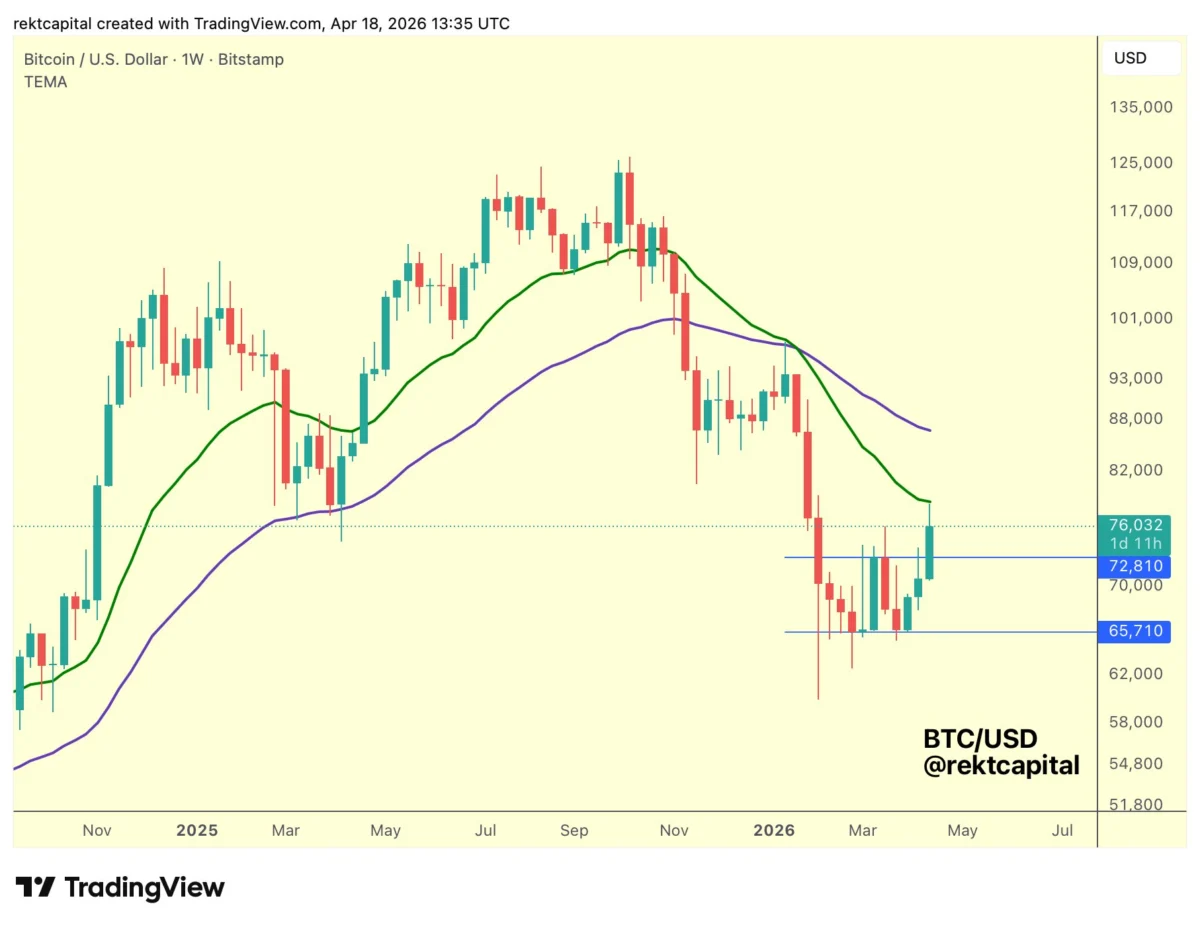
Bitcoin (BTC) faced significant downward pressure, struggling to maintain the $75,000 support level heading into Sunday’s weekly close, as renewed geopolitical uncertainties surrounding the United States and Iran cast a shadow over global markets. This price retraction followed a recent surge that saw the cryptocurrency reach ten-week highs, underscoring its increasing sensitivity to macroeconomic and geopolitical developments.
Detailed Price Movement and Market Reaction
Data sourced from TradingView revealed that BTC’s price, after briefly touching an impressive $78,400 on Friday—a level not seen in over two months—began to re-enter a phase of pressure. This retreat from multi-week highs highlights the inherent volatility of the cryptocurrency market, particularly when confronted with sudden shifts in the global political landscape. The initial optimism that propelled Bitcoin to these levels was quickly overshadowed by the resurgence of geopolitical risks, leading to a scramble by investors to assess and recalibrate their positions. The $75,000 threshold became a critical psychological and technical battleground for bulls attempting to defend against further declines, with the weekly close serving as a key indicator for short-term market direction.
The broader cryptocurrency market mirrored Bitcoin’s cautious sentiment. As BTC/USD circled these local highs and then retreated, market participants exhibited palpable caution. The sudden shift from a period of relative calm and upward momentum to one dominated by geopolitical fears prompted a rapid reassessment of risk. This immediate reaction underscored the interconnectedness of the crypto market with traditional financial systems and global events, challenging the narrative of Bitcoin as an entirely uncorrelated asset.

Geopolitical Catalyst: US-Iran Tensions Resurface
The primary catalyst for this market unease was a series of mixed signals emanating from US and Iranian sources over the weekend. What had initially been perceived as a diplomatic breakthrough, potentially an assumed ceasefire and mutual agreements between the two sides, rapidly unraveled. This diplomatic ambiguity created a vacuum of certainty, leading to speculation and heightened anxiety across financial markets.
Among the most significant developments was the repeat closure of the Strait of Hormuz, a critical maritime chokepoint. This action immediately refocused market attention on oil futures, specifically impacting West Texas Intermediate (WTI) crude. Earlier news of a potential ceasefire had temporarily sent WTI crude prices below $80 per barrel for the first time since March 10, signaling a potential de-escalation of regional tensions and a corresponding relief in energy markets. However, the subsequent closure of the Strait reversed this sentiment, demonstrating the fragility of the perceived stability. Trading resource The Kobeissi Letter succinctly captured the prevailing sentiment in ongoing analysis on X, summarizing, "We expect an eventful Sunday ahead." This statement encapsulated the market’s anticipation of continued volatility and uncertainty as the situation evolved.
Broader Economic and Geopolitical Context
The Strait of Hormuz is not merely a regional waterway; it is a globally indispensable artery for oil transit. Located between the Persian Gulf and the Gulf of Oman, it is the world’s most important oil transit chokepoint, with approximately one-fifth of global oil consumption passing through it daily. Any disruption, such as a closure, has immediate and profound implications for global energy prices, supply chains, and economic stability. Past instances of tension in the Strait have consistently led to spikes in crude oil prices, reflecting the market’s deep reliance on its unimpeded flow. The historical friction between the United States and Iran, marked by periods of sanctions, naval confrontations, and proxy conflicts, means that any escalation in this region is met with extreme caution by international observers and financial markets alike. The recurring nature of these tensions has ingrained a sense of unpredictability, making rapid market reactions to such news a common occurrence.

Beyond oil, renewed geopolitical instability often triggers a flight to safety in traditional financial markets. Investors typically reallocate capital from riskier assets into perceived safe havens like the U.S. dollar, government bonds, and gold. While Bitcoin has, at times, been championed as "digital gold," its behavior during these specific geopolitical crises often aligns more closely with risk-on assets, exhibiting sharp pullbacks as global sentiment sours. This nuanced reaction underscores the evolving perception of Bitcoin within the broader financial ecosystem.
Market Sentiment and Investor Behavior
The sentiment within the cryptocurrency market, while overwhelmingly bullish in the preceding days, proved to be remarkably fragile. Trading resource Material Indicators warned of this precarious balance, noting, "Sentiment is overwhelmingly bullish at the moment, but that could change with one Tweet in the coming days. Know your invalidations." This observation underscores the hypersensitivity of crypto markets to news, rumors, and even social media narratives, particularly from influential figures or official channels. The rapid dissemination of information, often unfiltered, can trigger swift and significant price movements, leading to periods of heightened volatility and emotional trading.
The impact of this sudden shift in sentiment was immediately visible in liquidation data. CoinGlass reported total crypto liquidations reaching $260 million over the past 24 hours, with long positions bearing the brunt of the retracement. Liquidations occur when an investor’s leveraged position is automatically closed by an exchange due to a sudden price movement against their trade, leading to a loss of the initial margin. This cascade of forced selling can amplify downward price pressure, creating a feedback loop that further exacerbates market declines. The substantial volume of liquidations indicated that many traders were caught off guard by the abrupt change in market direction, having positioned themselves for continued upward momentum based on earlier price action. This phenomenon highlights the risks associated with leveraged trading, especially in volatile markets susceptible to external shocks.
Technical Analysis Perspectives

Adding another layer of analysis, trader Daan Crypto Trades pointed to a potential gap opening in CME Group’s Bitcoin futures market as a direct consequence of the weekend’s comedown. CME (Chicago Mercantile Exchange) Bitcoin futures gaps occur when the market opens at a different price than where it closed, typically after a weekend break. Historically, these gaps often act as "price magnets," with Bitcoin’s spot price tending to move to "fill" these gaps in the subsequent trading sessions. As Cointelegraph has previously reported, such gaps frequently serve as short-term targets for price action once the new week commences. Daan Crypto Trades emphasized the importance of monitoring this development, stating, "It’s going to be interesting to see the futures open today and how $OIL will react to the recent headlines regarding the strait." This dual focus on both Bitcoin futures and crude oil underscores the interconnectedness of these seemingly disparate markets under the influence of geopolitical events.
Further technical scrutiny came from trader and analyst Rekt Capital, who highlighted the critical role of Bitcoin’s 21-week exponential moving average (EMA) near $78,900. Analyzing the weekly chart, Rekt Capital observed, "Bitcoin is rejecting from the 21-week EMA (green)." The 21-week EMA is a widely watched technical indicator that often acts as a dynamic support or resistance level for Bitcoin’s macro trends. A clear rejection from this level is typically interpreted as a bearish signal, suggesting that the upward momentum has stalled or reversed. Rekt Capital elaborated on the implications, stating, "It is this rejection that could force a post-breakout retest of the top of the Double Bottom (~$73k) next week, provided Bitcoin Weekly Closes just like this." A "Double Bottom" pattern is a bullish reversal pattern, and a retest of its neckline or peak ($73,000 in this context) would test the strength of the previous breakout. If this level fails to hold as support, it could signal a deeper correction.
These technical perspectives provide critical frameworks for traders and investors to navigate the current market uncertainty. The interplay between fundamental geopolitical news and these technical levels often dictates short-to-medium term price action, with key support and resistance zones becoming battlegrounds for bulls and bears.
Interplay of Geopolitics and Crypto Markets
The recent price action serves as a stark reminder of Bitcoin’s evolving relationship with global macroeconomic and geopolitical forces. While initially hailed by some as a decentralized, uncorrelated asset, immune to the vagaries of traditional finance and state-level conflicts, its increasing integration into the mainstream financial system has made it more susceptible to external shocks. Large institutional investors, now significant players in the crypto space, often manage their portfolios based on broader risk assessments, leading to capital reallocation during periods of global instability.

During such events, traditional safe-haven assets like gold and the U.S. dollar often see inflows. Bitcoin’s occasional failure to act as a definitive safe haven, particularly when geopolitical tensions escalate, complicates its "digital gold" narrative. Instead, it often behaves more like a growth stock or a risk-on technology asset, experiencing sell-offs alongside equity markets when global risk appetite diminishes. This dynamic highlights the ongoing debate within the crypto community about Bitcoin’s true utility and its ultimate role in a diversified investment portfolio. The current episode underscores that while Bitcoin offers decentralization and censorship resistance, its market valuation is not immune to the collective human response to fear and uncertainty on a global scale.
Outlook and Forward-Looking Statements
As the market moves into a new trading week, analysts and investors will be closely monitoring several key factors. Foremost among these are the ongoing developments in the US-Iran situation, with any official statements or actions from either side having the potential to trigger immediate market responses. The price of WTI crude oil will serve as a bellwether for the perceived stability of global energy markets and, by extension, broader economic sentiment.
Technically, the market will be watching the weekly close of Bitcoin’s price in relation to the $75,000 level, as well as the potential CME futures gap and the resilience of the $73,000 Double Bottom retest zone. The ability of Bitcoin to either reclaim critical resistance levels or hold key support will be crucial in determining its trajectory for the coming days and weeks. The inherent volatility and unpredictability of cryptocurrency markets, especially when influenced by external shocks, necessitate a cautious approach. While the long-term bullish outlook for Bitcoin remains a prevalent sentiment among many proponents, short-term price movements will continue to be dictated by the complex interplay of technical indicators, market sentiment, and, increasingly, geopolitical realities.
This article is produced in accordance with Cointelegraph’s Editorial Policy and is intended for informational purposes only. It does not constitute investment advice or recommendations. All investments and trades carry risk; readers are encouraged to conduct independent research before making any decisions. Cointelegraph makes no guarantees regarding the accuracy or completeness of the information presented, including forward-looking statements, and will not be liable for any loss or damage arising from reliance on this content.