Reynand Wu

The Australian Dollar (AUD) recorded a marginal 0.12% gain against the U.S. Dollar (USD) as Thursday’s trading session concluded, with the pair stabilizing around familiar levels below the 0.6700 threshold. This modest upward movement occurred amidst a backdrop of escalating geopolitical tensions in the Middle East and the closure of U.S. markets for the Thanksgiving holiday, which significantly thinned trading volumes and constrained broader price action. The subtle appreciation of the Aussie dollar reflects a complex interplay of resilient global equity markets, a hawkish U.S. Federal Reserve (Fed) outlook, and an increasingly dovish tilt from the Reserve Bank of Australia (RBA), creating a nuanced environment for currency traders.
U.S. Economic Resilience Bolsters Fed’s Tightening Stance
The United States economy continues to demonstrate remarkable resilience, a factor that has significantly underpinned the U.S. Dollar and solidified expectations for further monetary tightening by the Federal Reserve. Despite the Thanksgiving holiday hiatus, market participants remained focused on a series of robust economic indicators released earlier in the week, which collectively painted a picture of sustained growth and persistent inflationary pressures. These data points have reinforced the market’s conviction that the Fed is poised to continue its fight against inflation, even if it means maintaining higher interest rates for an extended period.
The latest Federal Reserve Beige Book, a qualitative assessment of economic conditions across the twelve Fed districts, provided a generally positive outlook. It reported that eight districts experienced growth, while four observed no significant change, indicating a broad-based, albeit moderate, expansion across various sectors. The report also highlighted a slight improvement in the jobs market, suggesting continued tightness, while prices were noted to have increased moderately. This composite view from regional Fed banks offers valuable insight into the grassroots economic activity and serves as a crucial input for the Federal Open Market Committee (FOMC) in its policy deliberations.
Further supporting the narrative of a robust U.S. economy, the Personal Consumption Expenditures (PCE) price index, the Fed’s preferred inflation gauge, rose by 3.8% in October. This figure, while showing some moderation from earlier peaks, remains considerably above the Fed’s long-term 2% inflation target, underscoring the ongoing challenge of bringing price pressures under control. The PCE index is particularly favored by the Fed because it captures a broader range of goods and services consumed by households and is less volatile than the Consumer Price Index (CPI), providing a more accurate reflection of underlying inflation trends.
Adding to the strong economic data, the U.S. Gross Domestic Product (GDP) report for the third quarter "crushed estimates," registering an impressive growth rate exceeding 4.3%. This robust expansion signifies strong consumer spending and business investment, showcasing the economy’s underlying strength despite aggressive interest rate hikes over the past year and a half. A surging GDP typically reduces the urgency for central banks to ease monetary policy, as it suggests the economy can withstand higher borrowing costs.
The labor market also exhibited strength, with initial jobless claims dipping from 200,000 to 189,000. This decline to historically low levels is a clear indication of a tight labor market, where employers are retaining workers and layoffs are minimal. A strong jobs market, characterized by low unemployment and potentially rising wages, can contribute to inflationary pressures, prompting the central bank to remain vigilant.
Collectively, these compelling economic figures—growth across districts, elevated inflation, strong GDP, and a tight labor market—have solidified market expectations for the Federal Reserve. According to the CME FedWatch Tool, money markets are currently pricing in a high probability, specifically a 97% chance, that the Fed will implement another 25 basis point rate hike at its upcoming December 8-9 meeting. This anticipated move underscores the Fed’s commitment to prioritizing price stability and tackling elevated inflation, even at the risk of potentially slowing economic momentum. The expectation of further tightening by the Fed has provided a strong tailwind for the U.S. Dollar, limiting the upside potential for risk-sensitive currencies like the Australian Dollar.
RBA’s Dovish Pivot and Domestic Pressures
In stark contrast to the hawkish stance of the U.S. Federal Reserve, the Reserve Bank of Australia (RBA) appears to be navigating a more complex and increasingly dovish path. While Australia also grapples with elevated inflation, recent economic data, particularly from the labor market, suggests that the RBA may be nearing the end of its tightening cycle, with some market participants even anticipating future rate cuts. This divergence in monetary policy expectations between two major economies is a primary driver of the AUD/USD exchange rate.
Australia’s Consumer Price Index (CPI) report for October indeed registered as "hot," exerting significant pressure on the RBA to address persistent inflation. Similar to many developed nations, Australia has seen inflation driven by a combination of global supply chain disruptions, strong domestic demand, and rising energy costs. The RBA’s mandate includes maintaining price stability, typically targeting an inflation range of 2-3%. When inflation consistently exceeds this target, the central bank is usually compelled to raise interest rates to cool the economy.

However, despite the inflationary pressures, the RBA has recently signaled a potential pause in its policy tightening, a stance that has been further complicated by "dismal back-to-back jobs reports." These weak employment figures indicate a softening in the Australian labor market, which could undermine economic growth and, eventually, curb inflationary pressures organically. For a central bank, a weakening labor market often provides a strong argument against further rate hikes, as such moves could exacerbate unemployment and slow the economy unnecessarily. The RBA, like the Fed, also considers employment in its mandate.
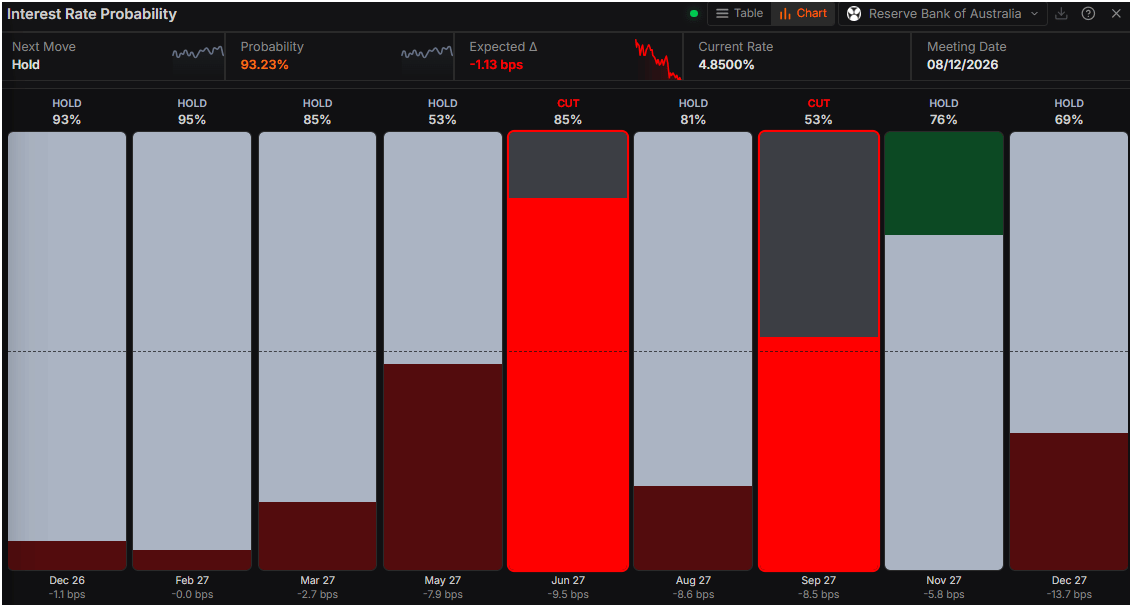
The confluence of a hot CPI and weakening jobs data presents a policy dilemma for the RBA. While inflation suggests a need for tighter policy, a deteriorating labor market argues for a more cautious approach, or even a pause. The market’s interpretation of this dilemma leans towards a less aggressive RBA. In a significant shift in expectations, Prime Terminal data indicates an 85% chance that the RBA will cut rates by 25 basis points at its June 2027 meeting. This long-term expectation of a rate cut stands in stark contrast to the Fed’s current trajectory of potential hikes, highlighting the differing economic landscapes and policy responses.
This anticipated dovish pivot from the RBA, driven by a weakening domestic economy and an effort to avoid an excessive economic downturn, places downward pressure on the Australian Dollar. The prospect of lower interest rates in Australia compared to the U.S. makes the AUD less attractive to yield-seeking investors, contributing to the overall bearish sentiment surrounding the currency despite its modest daily gain.
Global Risk Sentiment and Market Dynamics
Beyond the immediate central bank narratives, broader global market dynamics and geopolitical factors played a role in shaping the AUD/USD pair’s performance. The positive close for global equities on Thursday, despite the backdrop of ongoing Middle East tensions, provided a modest tailwind for risk-sensitive currencies like the Australian Dollar.
Global equity markets have shown remarkable resilience, often shrugging off concerns about inflation and interest rate hikes, buoyed by factors such as robust corporate earnings, technological advancements (e.g., AI), and an underlying belief that central banks might successfully engineer a "soft landing" for their economies. When equities perform well, investor confidence generally improves, leading to an increased appetite for riskier assets, including currencies of commodity-exporting nations like Australia. This "risk-on" sentiment can temporarily override other bearish factors.
However, the escalating tensions in the Middle East continue to cast a shadow of uncertainty over global markets. Geopolitical instability typically triggers a flight to safety, with investors moving capital into traditional safe-haven assets such as the U.S. Dollar, Japanese Yen, and gold. While the AUD’s modest gain suggests that the immediate impact of these tensions on risk appetite was tempered by other factors on Thursday, the underlying geopolitical risks remain a significant consideration for currency traders.
The closure of U.S. markets for the Thanksgiving holiday also contributed to the "narrow price action" observed for the AUD/USD pair. With a major global financial center offline, trading volumes are typically lower, and liquidity is reduced. This often leads to reduced volatility and smaller price movements, as there are fewer participants to drive significant directional shifts. The lack of major news flow during the U.S. session further reinforced this subdued trading environment, allowing the AUD to register a minor gain without facing substantial resistance from a fully engaged U.S. trading desk.
Chronology of Key Events and Data Releases
The recent movements in the AUD/USD pair are best understood within a chronological framework of economic data and central bank communications:
- Wednesday:
- Federal Reserve Beige Book Release: Provided a qualitative assessment of U.S. economic conditions, noting growth in 8 of 12 districts, slight job market improvement, and moderate price increases. This report generally supported a positive, though not overheating, economic picture.
- U.S. PCE Inflation Data: The Fed’s preferred inflation gauge rose 3.8% in October, reinforcing concerns about persistent inflation above target.
- U.S. GDP Report: Q3 GDP exceeded expectations, growing over 4.3%, signaling strong economic momentum.
- U.S. Jobless Claims: Dipped to 189,000, indicating a tight labor market.
- CME FedWatch Update: Money markets priced in a 97% chance of a 25 basis point Fed rate hike in December, solidifying hawkish expectations.
- Australian CPI Report (October): Revealed "hot" inflation, putting pressure on the RBA.
- Australian Jobs Reports (Back-to-back): Showed dismal figures, suggesting a weakening labor market and complicating the RBA’s policy stance.
- Thursday:
- U.S. Thanksgiving Holiday: U.S. markets closed, leading to thinner liquidity and subdued trading volumes.
- Global Equities End Positive: Supported risk-sensitive currencies, including the AUD, despite geopolitical tensions.
- AUD/USD Modest Gain: The pair registered a 0.12% gain, remaining below 0.6700, influenced by the mix of global risk-on sentiment and divergent central bank expectations.
Upcoming Economic Calendar and Potential Impacts
Looking ahead, both the Australian and U.S. economic calendars feature events that could influence the AUD/USD pair:
- Australia:
- November 30: Building Permits: This data provides insight into the health of the housing sector and future construction activity. A stronger-than-expected figure could offer some support for the AUD by indicating future economic growth, while a weak report could reinforce dovish RBA expectations.
- December 1: RBA Governor Michele Bullock Speech: This will be a highly anticipated event. Investors will scrutinize Governor Bullock’s remarks for any clues regarding the RBA’s future monetary policy path, particularly in light of the conflicting inflation and jobs data. Any hawkish signals could provide a temporary boost to the AUD, while a reiteration of a cautious or dovish stance could weigh on the currency.
- United States (Friday):
- Wholesale Inventories: This report offers insights into the supply chain and business sentiment. Significant changes can indicate future production trends and economic health.
- Goods Trade Balance: This data reflects the difference between a country’s exports and imports of goods. A narrowing trade deficit could be seen as positive for the USD, indicating stronger domestic production or reduced import demand.
These upcoming data releases and central bank communications will be critical in shaping market sentiment and refining expectations for both the Fed and the RBA, thereby impacting the AUD/USD exchange rate.
Technical Outlook for AUD/USD
From a technical perspective, the AUD/USD pair currently trades around 0.6637 on the daily chart, extending its decline well below the latest triple simple moving average (SMA) cluster at 0.6922. This positioning strongly suggests that the broader technical tone remains bearish. The pair has also slipped under a series of former upward support trend lines, which now act as significant overhead barriers. These resistance levels begin near 0.6932 and stretch toward 0.7165, 0.7198, and even 0.7519, reinforcing a capped structure where upward movements are likely to be met with selling pressure.
The Relative Strength Index (RSI) (14) at 27.1 sits firmly in oversold territory. While an oversold RSI typically hints that downside momentum is stretched and could precede a potential rebound or consolidation, it does not yet signal a clear recovery. Traders often look for a divergence between price action and RSI, or a move back above the oversold threshold, as stronger indicators of a reversal. In the absence of such signals, the current oversold condition merely suggests that aggressive selling might temporarily ease.
On the topside, initial resistance for AUD/USD is encountered at the triple SMA zone near 0.6922. This area represents a confluence of moving averages, making it a robust barrier. This is followed closely by the upward trend-line break around 0.6932, which acted as support previously and is now expected to function as resistance. Above these levels, further resistance aligns at the higher trend-line break near 0.7165 and the horizontal barrier at 0.7198. A more distant but significant cap emerges around 0.7519, with even higher long-term barriers at 0.9212 and 1.0301, representing historical highs that would require a substantial shift in fundamental drivers to challenge.
On the downside, the nearest structural support is indicated by the prior downward trend-line break level around 0.6333. This level marks a potential floor should selling pressure resume or intensify, and a break below it could open the door for further significant declines. The bearish technical posture, combined with the fundamental divergence between the Fed and RBA, suggests that the path of least resistance for AUD/USD remains to the downside, at least in the medium term, barring any unforeseen shifts in global risk sentiment or central bank policy.
Broader Impact and Implications
The current state of the AUD/USD pair, influenced by divergent monetary policies and global economic dynamics, carries significant implications for various market participants. For currency traders and institutional investors, the contrasting paths of the Federal Reserve and the Reserve Bank of Australia present both opportunities and risks. The U.S. Dollar’s strength, driven by persistent inflation and a hawkish Fed, continues to make it an attractive carry trade currency against potentially lower-yielding currencies like the AUD. This interest rate differential could widen further if the Fed indeed hikes in December while the RBA signals prolonged pauses or even future cuts.
For Australian businesses engaged in international trade, a weaker AUD makes imports more expensive, potentially increasing input costs, but simultaneously makes Australian exports more competitive on the global stage. Conversely, U.S. businesses importing from Australia might find goods cheaper in USD terms. This currency dynamic directly impacts the profitability and strategic decisions of companies operating across these two economies.
The broader economic outlooks for the U.S. and Australia also diverge. The U.S. economy, characterized by robust growth and a tight labor market, appears to be navigating a path of disinflation without succumbing to a severe recession, often referred to as a "soft landing" or "no landing" scenario. In contrast, Australia faces the challenge of balancing inflation control with a softening labor market, potentially leading to a more pronounced economic slowdown or a "hard landing" if the RBA missteps.
Looking forward, several factors could influence the AUD/USD trajectory. China’s economic health, given its significant trade ties with Australia, remains a crucial determinant. Any signs of robust recovery or further stimulus from China could provide a substantial boost to the AUD. Similarly, global commodity prices, particularly for iron ore, coal, and other raw materials that Australia exports, will continue to play a vital role. A surge in commodity prices, often driven by global demand, typically strengthens the Australian Dollar. Geopolitical developments, including the ongoing Middle East conflict and other international tensions, will also continue to shape global risk sentiment and, by extension, the demand for risk-sensitive currencies.
In conclusion, while the Australian Dollar managed a modest gain against the Greenback on Thursday, the underlying macroeconomic fundamentals and central bank policy divergences suggest a challenging road ahead. The U.S. Dollar remains underpinned by a resilient economy and a hawkish Fed, while the RBA navigates a delicate balance between inflation and a softening labor market, hinting at a more dovish future. This fundamental divergence, coupled with a bearish technical outlook, positions the AUD/USD pair for continued volatility, with a potential bias towards further downside in the absence of significant shifts in economic data or central bank rhetoric.