Reynand Wu

The Pound Sterling demonstrated a largely sideways trading pattern against the US Dollar on Thursday, with market activity muted due to the observance of the Thanksgiving holiday in the United States. This significant US market closure naturally led to considerably thinner liquidity conditions, impacting currency pair movements globally. The GBP/USD pair was observed trading at 1.3109, registering only a fractional decline of 0.08% as investors and traders recalibrated their positions ahead of a return to full market participation. This consolidation phase occurred against a backdrop of intensifying discussions around future monetary policy trajectories from both the US Federal Reserve (Fed) and the Bank of England (BoE), with both central banks confronting persistent inflationary pressures and evolving economic landscapes.
Holiday-Thinned Markets and the US Economic Picture
The immediate catalyst for the subdued trading environment was the Thanksgiving holiday in the United States, a federal observance that typically sees financial markets, including bond and equity markets, closed, and foreign exchange trading desks operating with reduced staff and volumes. This annual event, rooted in American history and tradition, consistently creates a temporary lull in market dynamism, as key participants are absent, leading to reduced price discovery and potentially exaggerated moves on minimal volume. The absence of a scheduled US economic docket on Thursday further amplified this effect, leaving market participants to interpret the implications of data released earlier in the week and recent pronouncements from Federal Reserve officials.
Wednesday’s economic releases from the US had painted a robust, albeit complex, picture of the world’s largest economy. The Core Personal Consumption Expenditures (PCE) inflation report for October, a critical metric closely watched by the Federal Reserve as its preferred gauge of underlying inflation, indicated that prices remained elevated. This sustained inflationary pressure signaled an economy that continues to exhibit significant demand. Complementing this, the Gross Domestic Product (GDP) figures for the third quarter of the year revealed a substantial expansion of 4.3%. This impressive growth rate not only crushed analysts’ forecasts but also marked a significant acceleration from the previous quarter’s print of 3.4%. Such strong GDP data typically suggests an economy operating at or above its potential, providing the Federal Reserve with ample room to continue its monetary tightening efforts without immediately jeopardizing economic growth.
Further supporting the narrative of economic resilience, other data points from the US indicated a solid labor market, characterized by low unemployment and consistent job creation. A robust labor market is often a precursor to sustained consumer spending, which, in turn, can contribute to inflationary pressures. However, not all indicators pointed to unbridled expansion. October’s Durable Goods Orders, which measure new orders placed with manufacturers for durable goods, showed a cooling trend. This particular indicator is often viewed as a proxy for business investment and consumer confidence in larger purchases, and its moderation could signal some nascent headwinds or a normalization in spending patterns following periods of elevated demand.
Federal Reserve’s Hawkish Stance and Market Expectations
Amidst these economic signals, Federal Reserve officials have maintained a consistently hawkish tone, underscoring their commitment to bringing inflation back down to the central bank’s long-term target of 2%. On Monday, New York Fed President John Williams reiterated this resolve, stating that the central bank was "working hard to lower inflation." He further emphasized the Fed’s dedication to its mandate, adding, "We must take actions over time that will ensure that we get inflation back to our 2% goal in a timely manner and on a sustained basis." Such statements reinforce the market’s perception that the Fed is prepared to continue raising interest rates until there is clear and convincing evidence that inflationary pressures are subsiding.
The market’s interpretation of these signals was clearly reflected in the derivatives markets. According to the widely referenced CME FedWatch Tool, money markets had priced in a commanding 97% chance that the Federal Reserve would implement another 25 basis point (bps) interest rate hike at its upcoming December 8-9 meeting. This exceptionally high probability suggests a near-consensus among investors regarding the Fed’s immediate policy direction, indicating that a quarter-point rate increase was largely baked into asset prices. This anticipated tightening is a critical factor influencing the US Dollar’s strength and its relative performance against other major currencies, including the Pound Sterling.
Bank of England’s Balancing Act Amidst Geopolitical Tensions

Across the Atlantic, the United Kingdom’s economic calendar for Thursday was notably sparse, mirroring the limited market activity. However, insights into the Bank of England’s (BoE) thinking emerged from statements made by BoE officials, led by Governor Andrew Bailey, earlier in the week on Wednesday. Governor Bailey acknowledged that UK inflation was projected to remain "as high as expected," a stark admission given the persistent cost-of-living crisis gripping the nation. The UK has grappled with some of the highest inflation rates among major developed economies, driven by a confluence of factors including supply chain disruptions, post-Brexit trade frictions, and elevated energy prices.
Crucially, Governor Bailey did not rule out the possibility of further monetary tightening. His caution was specifically linked to the enduring risk posed by high energy prices, a concern exacerbated by the ongoing geopolitical tensions, particularly the US-Iran conflict. The potential for escalation in the Middle East has consistently underpinned fears of disruptions to global oil supplies, which would inevitably translate into higher energy costs for consumers and businesses worldwide, including the UK, a net importer of energy. For the Bank of England, rising energy prices represent a significant exogenous shock that could derail efforts to bring inflation under control, necessitating a potentially more aggressive monetary policy response even as the economy faces growth headwinds.
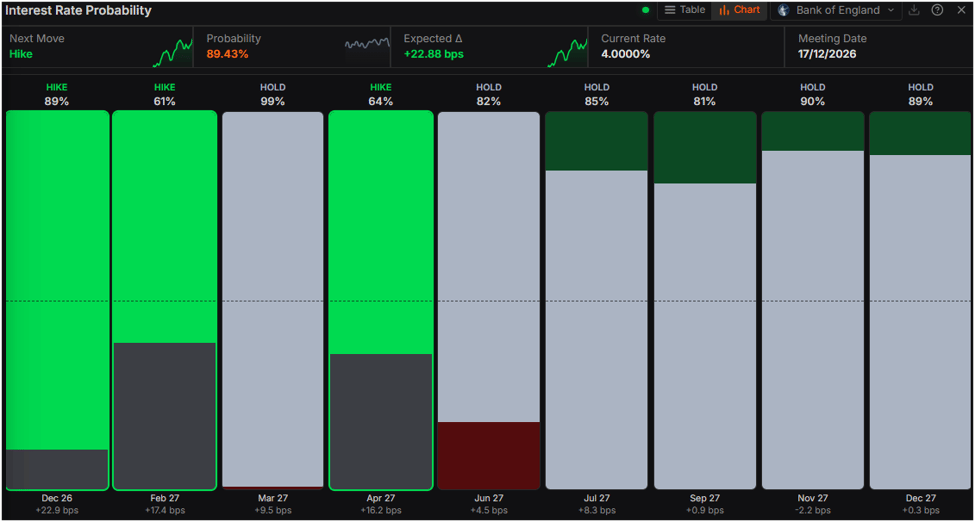
The swaps market, a key barometer of future interest rate expectations, reflected the market’s assessment of the BoE’s stance. Data from Prime Terminal indicated that the swaps market had priced in an 89% probability that the Bank of England would raise its benchmark Bank Rate to 4.25%. This anticipated rate level would notably match the expected rates in the US, suggesting a potential convergence in monetary policy settings between the two major economies. This alignment could have significant implications for the GBP/USD exchange rate, as interest rate differentials are a primary driver of currency valuations.
GBP/USD: Navigating Competing Forces and Future Outlook
Given the complex interplay of these factors – holiday-thinned liquidity, robust US economic data, the Federal Reserve’s unwavering commitment to combating inflation, and the Bank of England’s struggle with persistent domestic inflation compounded by geopolitical energy risks – the GBP/USD pair finds itself at a critical juncture. While the BoE’s hawkish signals and the potential for matching US interest rates could theoretically provide a supportive backdrop for the Pound Sterling, enabling it to stage a recovery, this prospect is heavily contingent on broader market sentiment.
A pervasive "sour market mood" or a widespread shift towards risk aversion could significantly dampen the prospects for risk-sensitive currencies like Sterling. Factors contributing to such a mood often include escalating geopolitical conflicts, fears of a global economic slowdown, or concerns about aggressive monetary tightening leading to recession. In such environments, investors typically flock to safer assets like the US Dollar, putting downward pressure on pairs like GBP/USD.
Looking ahead, Friday’s economic calendar offers a few data points that could influence market sentiment as US markets return to full operation. The UK economic docket remains absent, leaving traders to continue processing Wednesday’s BoE statements. In the US, however, the release of the Goods Trade Balance and Wholesale Inventories, both for October, will be closely watched. The Goods Trade Balance provides insights into the health of US international trade, while Wholesale Inventories offer a snapshot of supply chain dynamics and future production expectations. While not typically market-movers on the scale of inflation or GDP reports, these figures could contribute to the overall economic narrative and subtly influence risk appetite.
Technical Analysis: A Bearish Undercurrent for GBP/USD
From a technical perspective, the GBP/USD pair, trading around 1.3105, continues to exhibit a near-term bearish bias on the daily chart. This bias is predominantly driven by the pair consistently holding beneath the latest reading of the triple simple moving average (SMA) cluster, currently positioned around 1.3274. The triple SMA is a common technical indicator used by traders to identify trend direction and potential areas of support or resistance. Its overhead position suggests that the path of least resistance for the pair remains downwards.
Adding to the bearish technical outlook are the descending resistance trend lines originating from higher swing points at 1.3869 and 1.3653. These trend lines effectively cap upward movements and underscore the prevailing downtrend that has been in place for a significant period. The Relative Strength Index (RSI) with a 14-period setting, currently at 38, further reinforces this outlook. An RSI reading below 50 generally indicates that momentum favors the downside. While not yet in outright oversold territory (typically below 30), the current reading suggests lingering downside pressure, implying that selling interest remains present without being exhausted.
For a potential recovery, GBP/USD would first need to overcome immediate resistance near the upward-sloping trend line, currently around 1.3140. A decisive break above this level would then bring the formidable triple simple moving average cluster, approximately at 1.3274, into focus. Surmounting this cluster would be a more significant technical achievement, potentially signaling a shift in short-term momentum. Beyond this, the next notable resistance barrier emerges at the downtrend break zone near 1.3350. However, the broader descending structure, defined by the major downtrend lines from 1.3653 and 1.3869, is likely to cap any substantial rallies unless the price can reclaim these levels with strong conviction and sustained buying pressure. A failure to clear these resistances would likely lead to renewed selling pressure, potentially pushing the pair towards fresh lows.
(The technical analysis of this story was written with the help of an AI tool. Know more.)
Pound Sterling Performance Across Major Currencies
An examination of the Pound Sterling’s performance against other major currencies on Thursday reveals a mixed picture, indicative of the broader market uncertainty and holiday-induced thin trading. The accompanying table illustrates the percentage change of GBP against a basket of key currencies, offering a granular view of its relative strength or weakness.
The British Pound emerged as the strongest performer against the Swiss Franc (CHF), registering a gain of 0.30%. This performance could be attributed to a combination of factors, including the Swiss National Bank’s (SNB) comparatively dovish stance relative to other central banks, or simply lower liquidity exacerbating minor capital flows. The CHF often acts as a safe-haven currency, and its relative underperformance against the GBP could suggest a marginal, albeit temporary, ebb in extreme risk aversion.
Conversely, the Pound Sterling showed weakness against the Australian Dollar (AUD) and the New Zealand Dollar (NZD), declining by 0.19% and 0.19% respectively. These commodity-linked currencies often benefit from periods of improved risk sentiment or positive global growth outlooks. Their relative strength against GBP might hint at a nuanced market view, where certain growth-sensitive currencies are preferred over others, or reflect specific domestic factors within Australia and New Zealand.
Against the US Dollar, as noted, GBP experienced a modest decline of 0.10%, while against the Euro (EUR) it fell by 0.08%. These small movements underscore the sideways trading environment, where neither currency pair showed a significant directional bias. The performance against the Japanese Yen (JPY) was also slightly negative, with GBP down 0.06%, reflecting JPY’s traditional safe-haven appeal and perhaps some repatriation flows ahead of the weekend. The Pound did manage a slight gain against the Canadian Dollar (CAD), rising by 0.15%, which could be influenced by commodity price fluctuations or Canada’s own economic data.
The heat map visualization, which details percentage changes of major currencies against each other, provides a comprehensive overview of these interrelationships. By selecting the British Pound from the left column and tracing across to the US Dollar in the top row, the displayed percentage change directly represents the GBP (base)/USD (quote) movement. This tool allows traders and analysts to quickly identify relative strengths and weaknesses across the entire G8 currency complex, offering valuable insights into broader market dynamics and capital flows.
In conclusion, the Pound Sterling’s trajectory against the US Dollar remains highly sensitive to the evolving narratives surrounding monetary policy, global inflation, and geopolitical stability. While holiday-thinned conditions led to a temporary pause in significant movement, the underlying forces of central bank tightening, robust US economic performance, and the BoE’s ongoing battle with persistent inflation—exacerbated by energy price concerns—continue to exert considerable influence. As markets return to full activity, the interplay of these fundamental and technical factors will likely dictate the pair’s direction in the coming sessions.