Ena Muazin
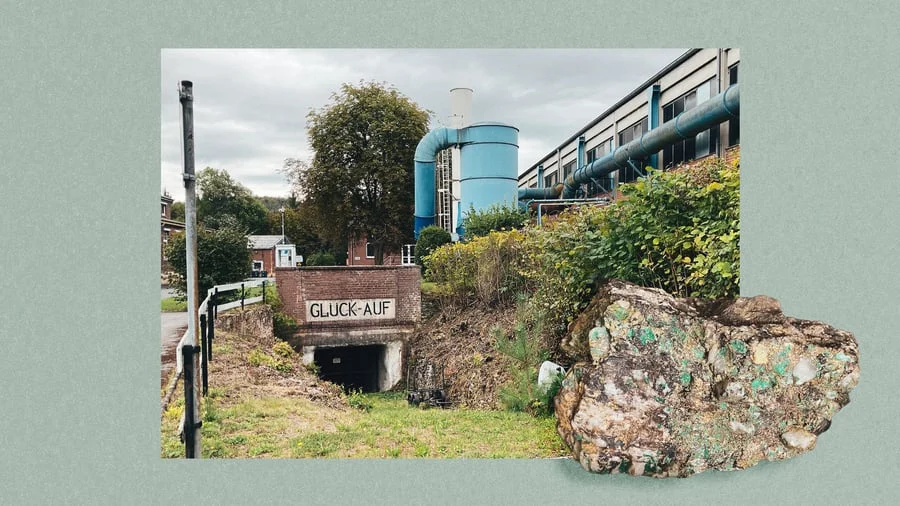
The air hangs heavy with a quiet anticipation in the remote region of East Hesse, Germany, as Ben Stoikovich stands before the imposing gates of a dormant factory. It’s one of the few cooler days of a summer that has otherwise been marked by persistent warmth, with the distant rumble of thunder heralding an approaching shower. A man, likely in his early forties and one of the few remaining caretakers of this industrial relic, opens the gate, allowing Stoikovich entry. He is led towards a forgotten mine shaft, its entrance bearing the faded inscription, "Glück auf" – a traditional miner’s greeting, though no ore has been extracted here for decades. This silence, however, is poised to be broken.
Stoikovich ventures a few steps into the dark, roughly two-meter-high tunnel. The damp ground reveals the faint outlines of old rail tracks. He turns back, explaining, "If we went further, we would encounter water," the Australian mining engineer states. His company, GreenX Metals, has ambitious plans: to revive copper mining in the Richelsdorfer Gebirge, an area where this industry has been considered dormant since the 1950s. Back then, a collapse in global market prices, driven by the significantly lower extraction costs in South American open-pit mines, effectively shuttered German operations.

The Shifting Global Landscape of Copper
Today, the economic calculus has dramatically shifted. The ore grades in the vast copper mines of South America are declining, while simultaneously, the demand for copper is skyrocketing. This surge is fueled by the global energy transition, which requires massive amounts of copper for renewable energy infrastructure and electric vehicles, and the burgeoning hype surrounding artificial intelligence (AI), which relies heavily on copper for its complex data centers and advanced computing hardware. These converging factors have led to elevated copper prices and a renewed interest in Europe’s own untapped mineral resources.
Geologically, a significant copper-bearing formation stretches from Poland, across Eastern Germany and Northern Hesse, all the way to England. While these deposits may not rival the sheer scale of South American reserves, they boast notably higher ore grades. Poland has successfully leveraged these resources for decades, with KGHM Polska Miedź S.A. emerging as one of Europe’s largest copper producers. Now, GreenX Metals aims to replicate this success story in Germany.
A Legacy of Mining and a New Approach
Copper mining in the Richelsdorfer Gebirge itself is not a new phenomenon. Between the 1930s and 1940s, copper was extracted here. However, the miners of that era primarily focused on the "Kupferschiefer," a thin, exceptionally rich layer of ore. GreenX’s strategy is to demonstrate that the surrounding rock strata also contain sufficient copper concentrations to make modern mining economically viable. The future of the project hinges on the success of this hypothesis.

The company’s approach is informed by historical data and a deep dive into the region’s mining past. A visit to the local Heimatmuseum (local history museum) in Nentershausen proved pivotal. "When I saw this locomotive, I knew: we’re not starting from scratch here," Stoikovich remarks, referring to an old mine train on display. It was within the museum’s archives that Stoikovich and geologist Gregor Borg from the University of Halle, who serves as a scientific advisor to GreenX, uncovered unexpected insights into the scale of past mining operations.
Unearthing Historical Data
During the 1930s, the Mansfeld AG operated three mine shafts in the area – Reichenberg, Wolfsberg, and Schnepfenbusch. The extracted ore was processed at a dedicated smelting plant and transported via what was then Europe’s longest aerial ropeway. The trail of historical evidence led them to the archives of the Hessian State Office for Nature Conservation, Environment and Geology (HLNUG). There, they discovered meticulous documentation of 95 deep boreholes drilled between 1935 and 1938, commissioned by the Nazi regime to survey the underground.
These boreholes provide crucial data for evaluating the deposit. Geologist Borg explains that the Mansfeld AG’s records from the 1930s, detailing the stratigraphy of the boreholes, offer a foundational understanding. These findings were long overlooked due to the mine’s operational base in East Germany while its West German operations were in the west, creating logistical and administrative challenges. "We also knew nothing about the samples at the beginning of the project," Borg admits. Fortunately, in addition to the archival data from the 95 boreholes in North Hesse, they have also located chemical analyses for 40 of these boreholes.

Leveraging Past Exploration Efforts
Adding to this historical treasure trove are core samples from an American company dating back to the 1980s, which had been stored for decades. "These drillings would cost us millions of euros today," Borg emphasizes. These core samples were borrowed from the Hessian State Office and re-examined in a certified laboratory. Furthermore, the state of Hesse itself has conducted boreholes for various purposes, including groundwater research and scientific exploration, providing a third category of valuable data.
Confirmed Copper Grades, Uncharted Potential
The historical boreholes from the 1930s already indicated significant copper concentrations. However, the geologists of that era believed the metal was almost exclusively confined to the thin Kupferschiefer layer. The analysis of the 1980s core samples has revealed a critical detail: the mineralization extends into the rock layers both above and below the Kupferschiefer. Based on this finding, GreenX has estimated an exploration target of 144 to 279 million tons of ore, potentially containing up to 3.9 million tons of copper metal. It is important to note that this is not yet a proven mineral resource, as the exploration data is still insufficient for such a classification.
Challenges and Opportunities in Modern Mining
The path from exploration to a functioning mine is fraught with challenges. Securing financing is a primary hurdle, as many resource projects falter at this stage. Beyond capital acquisition, obtaining the necessary permits can be a lengthy and complex process. While the EU’s "Critical Raw Materials Act" aims to expedite procedures for strategic resource projects, GreenX is still a considerable distance from achieving such a designation.

The Richelsdorfer Gebirge region itself faces economic challenges, with factories closing and jobs disappearing. Stoikovich is optimistic that the re-establishment of mining could create much-needed employment opportunities, a point he intends to convey to the local residents. Community acceptance is crucial for mining projects in Europe, as demonstrated by the delays and setbacks faced by projects like Rio Tinto’s lithium venture in Serbia and opposition to the K+S potash mine.
The Economic Realities of Copper Production
The success of the Polish copper mining industry, particularly KGHM, is partly attributed to the extraction of valuable by-products, most notably silver. The Kupferschiefer formation is known to contain over 30 different raw materials, including cobalt, nickel, gold, silver, platinum, and palladium. These by-products significantly enhance the economic viability of mining operations. GreenX also anticipates substantial silver recovery, estimating between 69 and 188 million ounces of silver within its projected copper reserves.
However, the economics of German copper projects, especially GreenX’s, are still in their nascent stages. While the ore grades are promising, the volumes are not comparable to the massive porphyry copper deposits found in South America. These South American deposits, often mined through open-pit methods, offer economies of scale that are difficult to match with underground mining operations in Germany. Experts like Torsten Graupner from the BGR (Federal Institute for Geosciences and Natural Resources) highlight that while German deposits may have higher concentrations, the mining would need to be conducted underground in relatively thin ore bodies, making the cost-benefit analysis more challenging.

A New Era for European Resource Security
The increasing demand for copper, driven by the green energy revolution and the digital transformation, underscores Europe’s strategic need to secure its own raw material supply chains. The reliance on imports, particularly from geopolitical rivals, poses significant risks. The declining ore grades in traditional South American mining regions, where concentrations have halved since 1990, further amplify this concern.
The European Union’s "Critical Raw Materials Act" reflects a broader recognition of this vulnerability. By promoting domestic extraction and processing, the EU aims to reduce its dependence on external suppliers and bolster its industrial resilience. Projects like GreenX’s, despite their early stage and inherent challenges, represent a potential component of this strategic objective.
Financial Backing and Future Prospects
GreenX’s ability to fund its exploration efforts is partly due to its financial history. The company, formerly known as Prairie Mining and active in coal mining, was awarded a substantial, nine-figure compensation settlement following a protracted arbitration case against Poland concerning denied licenses. While the majority of these funds are earmarked for shareholders, a portion is expected to fuel GreenX’s pivot towards critical raw materials, seeking to position itself as a key player in Europe’s evolving resource landscape.

The company plans to commence initial exploration drilling in the first quarter of 2027. The data gathered will inform a resource estimate according to the JORC (Australasian Code for Reporting of Exploration Results, Mineral Resources and Ore Reserves) standard. GreenX aims to conduct its first economic feasibility studies by early 2028.
A Long Road Ahead
The prospect of copper mining returning to the Richelsdorfer Gebirge is still speculative. The coming years, marked by further drilling and detailed analysis, will determine whether this long-dormant region will once again echo with the sounds of industry. The success of GreenX, and potentially other similar ventures across Germany and Europe, will depend on a complex interplay of geological potential, technological innovation, economic viability, regulatory support, and crucially, community acceptance. The silent mines of Germany may hold the key to a more secure and sustainable future for critical resources, but unlocking that potential will be a long and challenging endeavor.