Reynand Wu

The Sterling’s recovery was set against a backdrop of intensifying expectations for monetary policy tightening from both the Bank of England (BoE) and the US Federal Reserve (Fed), though with nuances that occasionally favored the UK currency. While the overall market mood experienced a cooling as Wall Street opened on the back foot, influenced by profit-taking in high-growth tech stocks following an extended rally in companies like Nvidia, this shift in risk appetite contributed to a broader strengthening of the Greenback. However, specific hawkish commentary from BoE officials provided a counterbalancing force for the Pound. Adding layers of complexity to the global economic outlook, the US Treasury recently imposed sanctions on subsidiaries of Chinese companies based in Singapore, and reports from the Wall Street Journal indicated that the United States is preparing to escalate trade tensions by raising tariffs on goods from China, the European Union (EU), and 14 other nations, signaling a potential resurgence of protectionist policies.
Sterling’s Resurgence Amidst Heightened Monetary Tightening Signals
The Pound Sterling’s ability to recover from its yearly nadir underscores the market’s sensitivity to central bank rhetoric, particularly as global inflation persists. The UK currency, which had been under pressure due to a combination of domestic economic challenges and a robust US Dollar, found a temporary reprieve as expectations for aggressive policy tightening by the Bank of England solidified. This sentiment was significantly bolstered by explicit statements from a key policymaker, indicating a clear trajectory for interest rate hikes.
Bank of England’s Hawkish Stance Takes Center Stage
A pivotal moment for the Sterling on Tuesday came from Megan Greene, a member of the Bank of England’s Monetary Policy Committee (MPC). Speaking at a roundtable event organized by Signum, Greene delivered a stark message, emphasizing the central bank’s imperative to "tighten policy faster, unless there’s a miraculous turnaround in data or in the war." This unequivocal declaration from an MPC member resonated strongly with investors, signaling the BoE’s commitment to tackling stubbornly high inflation, even at the risk of impeding economic growth.
The UK economy has been grappling with significant inflationary pressures, largely driven by elevated energy prices, persistent supply chain disruptions exacerbated by global events, and a tight labor market contributing to wage growth. The Consumer Price Index (CPI) in the UK has consistently remained well above the BoE’s 2% target, prompting a series of interest rate hikes throughout the year. As of its most recent meeting, the BoE had already raised its benchmark interest rate several times, moving from historically low levels to address the inflationary surge. Greene’s comments suggest that the committee perceives the current pace of tightening as insufficient to bring inflation back to target within a reasonable timeframe, barring unforeseen positive developments.
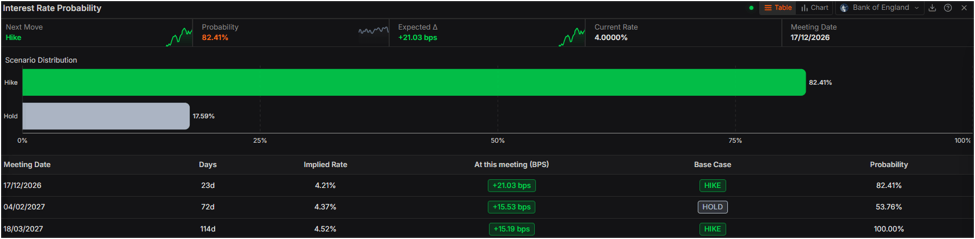
Money markets swiftly recalibrated their expectations following Greene’s remarks. According to data from Prime Terminal, the swaps market immediately priced in an 82% probability of a 25-basis-point (bps) hike at the BoE’s upcoming monetary policy meeting. This heightened probability indicates that traders are now largely convinced that the central bank will opt for another rate increase, reflecting a more aggressive stance than some had previously anticipated. The BoE’s dilemma lies in balancing the need to control inflation with concerns about a potential economic slowdown or recession, a challenge common to many major central banks globally. However, Greene’s assertiveness suggests that inflation control currently takes precedence.
The Dollar’s Enduring Strength and Shifting Global Dynamics
Despite the Sterling’s intraday gains, the US Dollar maintained an underlying resilience, driven by its own set of strong fundamentals, the Federal Reserve’s consistent hawkish narrative, and a broader flight to safety triggered by escalating geopolitical tensions. The Greenback’s status as the world’s primary reserve currency often sees it benefit during periods of global uncertainty or when risk appetite wanes.
Federal Reserve’s Unwavering Resolve Against Inflation
The Federal Reserve’s steadfast commitment to bringing inflation back to its 2% target continues to be a primary driver of US Dollar strength. The Fed has embarked on one of its most aggressive tightening cycles in decades, rapidly increasing the federal funds rate to combat price pressures that have reached multi-decade highs. Recent commentary from Fed officials consistently reinforces this hawkish stance, suggesting that the central bank is prepared to maintain a restrictive policy for an extended period.
On Monday, New York Federal Reserve President John Williams articulated this resolve, stating unequivocally that "the Fed has work to do on inflation." Williams provided a longer-term outlook, projecting that inflation would likely end near 3.5% in 2026 and only reach the Fed’s desired 2% goal by 2028. This extended timeline underscores the deep-seated nature of current inflationary pressures and implies that the Fed anticipates a prolonged period of elevated interest rates. Such statements tend to reinforce market expectations for continued tightening, thereby supporting the Dollar through higher anticipated returns on US assets.
The latest economic data from the US also played a role in shaping market sentiment regarding the Fed’s path. The ADP Employment Change 4-week average, a gauge of private sector job creation, showed a slight dip from 23,000 to 21,000. While this indicates a marginal softening in the US labor market, it still points to stability, suggesting that employment conditions remain robust enough to allow the Fed to continue its tightening without immediately fearing a sharp economic downturn. Furthermore, the Conference Board (CB) reported that consumer confidence in November surged to 103.3, significantly exceeding estimates of 92.5 and October’s reading of 91.9. This unexpected jump in consumer sentiment suggests underlying economic resilience, providing the Fed with further justification to pursue its anti-inflationary policies.
Money markets are largely aligned with the Fed’s hawkish stance. According to the CME FedWatch Tool, traders are pricing in an almost certain 96% chance that the Fed will increase rates by another 25 basis points at its upcoming December 8-9 meeting. This high probability reflects the market’s conviction that the Fed will deliver another rate hike, further solidifying the "higher for longer" narrative that has characterized US monetary policy in recent months. The prospect of sustained higher interest rates in the US typically translates to a stronger Dollar, as it increases the attractiveness of US dollar-denominated assets for global investors seeking yield.
Geopolitical Tensions and the Flight to Safety
Beyond monetary policy, geopolitical developments played a crucial role in underpinning the US Dollar’s safe-haven appeal. The fading of an upbeat market mood on Wall Street was partly attributed to a broader cooling of investor enthusiasm for risk assets, particularly after an extended rally in the tech sector. This shift was exacerbated by renewed concerns over international trade relations and heightened geopolitical friction.
The US Treasury’s decision to impose sanctions on subsidiaries of Chinese companies located in Singapore signals a continuing escalation of economic tensions between the two global powers. These sanctions typically aim to restrict financial transactions and access to US markets for targeted entities, often citing national security concerns or human rights issues. Such actions inject uncertainty into global supply chains and trade flows, prompting investors to seek refuge in safer assets.
Further compounding these concerns, reports from the Wall Street Journal indicated that the US is preparing to significantly raise tariffs on imports from China, the European Union (EU), and 14 other countries. If implemented, these measures would mark a substantial resurgence of protectionist trade policies, reminiscent of earlier trade disputes. Increased tariffs can lead to higher import costs, retaliatory measures from affected countries, reduced global trade volumes, and ultimately, slower economic growth. The potential for a new wave of trade wars creates a significant headwind for global economic stability and fosters a risk-off environment, where the US Dollar, as a traditional safe-haven currency, tends to appreciate. This complex interplay of economic policy and geopolitical maneuverings contributes to a volatile market landscape, where currency movements are dictated by a delicate balance of perceived risks and opportunities.
Key Economic Indicators Shaping Future Monetary Policy
The market’s immediate focus now shifts to an upcoming barrage of critical economic data from the United States, which will provide further insights into the health of the economy and potentially influence the Federal Reserve’s future policy decisions. These indicators are not merely statistics; they are vital barometers that guide central banks in their dual mandate of maintaining price stability and maximizing employment.
US Labor Market and Consumer Resilience
The ADP Employment Change, while not directly correlated with the official Non-Farm Payrolls (NFP) report, serves as an important precursor, offering an early glimpse into the health of the private sector labor market. The reported dip from 23,000 to 21,000 in the 4-week average indicates a slight moderation in job creation. However, in the context of a historically tight labor market, where unemployment rates remain low and wage growth robust, this figure suggests a controlled cooling rather than a sharp downturn. A stable labor market provides the Fed with the necessary flexibility to continue its inflation-fighting efforts without immediate concerns about a significant rise in unemployment. Investors will be scrutinizing future ADP reports alongside the official NFP data, weekly jobless claims, and the JOLTS Job Openings and Labor Turnover Survey to ascertain the true trajectory of the US employment landscape.
Equally significant is the Conference Board Consumer Confidence Index. The robust jump to 103.3 in November, surpassing both estimates and prior readings, is a strong indicator of consumer optimism regarding current business and labor market conditions, as well as their short-term outlook for income, business, and employment. High consumer confidence typically translates into sustained consumer spending, which is a significant component of economic activity in the US. This resilience in consumer sentiment, despite elevated inflation and rising interest rates, reinforces the notion that the US economy possesses underlying strength, potentially allowing the Fed more room to maneuver with its monetary policy without immediately triggering a deep recession. Conversely, a sharp decline in confidence could signal an impending slowdown in consumption, prompting the Fed to reconsider its aggressive tightening path.
Anticipating Crucial US Inflation and Growth Data
Eyes now turn to Wednesday’s busy US economic docket, which features two highly anticipated data releases: the Core Personal Consumption Expenditures (PCE) Price Index and Gross Domestic Product (GDP) figures. These are arguably the most crucial economic indicators for the Federal Reserve.
The Core PCE Price Index is the Fed’s preferred inflation gauge. Unlike the Consumer Price Index (CPI), which includes volatile food and energy prices, Core PCE strips out these components to provide a clearer picture of underlying inflationary trends. The Fed targets a 2% annual rate for the PCE. A higher-than-expected Core PCE reading would reinforce the Fed’s hawkish stance, potentially leading to further Dollar strength as markets price in more aggressive or prolonged tightening. Conversely, a lower-than-expected figure could temper rate hike expectations, potentially weighing on the Dollar. Analysts will be closely comparing the month-over-month and year-over-year figures against forecasts to discern the pace of disinflation.
Gross Domestic Product (GDP) figures provide a comprehensive measure of the nation’s economic output. The GDP report, released quarterly, offers insight into the overall health and growth trajectory of the US economy. A strong GDP reading would suggest that the economy is resilient enough to withstand ongoing interest rate hikes, giving the Fed confidence to continue its fight against inflation. A weaker-than-expected GDP, however, could signal an economic slowdown or even a contraction, which might prompt the Fed to adopt a more cautious approach to monetary policy, balancing inflation control with the risk of recession. Both the headline GDP growth rate and its underlying components (consumer spending, business investment, government spending, and net exports) will be meticulously analyzed by market participants for clues regarding the economic outlook. The confluence of these critical data points will undoubtedly shape market sentiment and influence currency valuations in the days to come.
Broader Market Implications and Investor Outlook
The complex interplay of divergent central bank policies, escalating geopolitical tensions, and mixed economic signals has profound implications for global financial markets. Investors are navigating a landscape characterized by heightened volatility and uncertainty, necessitating a cautious approach to asset allocation.
The differing paces and communication styles of the Federal Reserve and the Bank of England create a significant policy divergence that impacts capital flows. When one central bank signals a more aggressive tightening path than another, it can attract investment to the country offering higher relative yields, thereby strengthening its currency. This dynamic has largely favored the US Dollar throughout much of the current tightening cycle, as the Fed was among the first major central banks to embark on aggressive rate hikes. However, the BoE’s recent hawkish pivot, as evidenced by Megan Greene’s comments, suggests a narrowing of this divergence, which could provide some support for the Pound.
The resurgence of protectionist trade policies, as indicated by the potential for new US tariffs on a wide range of countries, poses a significant threat to global economic growth. Trade wars disrupt supply chains, increase costs for businesses and consumers, and reduce international trade volumes. Such developments typically foster a "risk-off" environment, where investors reduce exposure to riskier assets like equities and emerging market currencies, opting instead for safe-haven assets such as the US Dollar, gold, and government bonds. This shift in risk appetite can exacerbate market volatility and lead to broader corrections in asset prices.
For businesses, the implications are multi-faceted. Higher interest rates increase borrowing costs, potentially slowing down investment and expansion plans. Geopolitical tensions and trade barriers disrupt global supply chains, forcing companies to re-evaluate their sourcing strategies and potentially absorb higher input costs. Consumers, meanwhile, face the dual challenge of persistent inflation eroding purchasing power and rising borrowing costs for mortgages, loans, and credit cards. The cumulative effect of these factors could lead to a slowdown in global economic activity, making the outlook for corporate earnings and employment less certain. Investors will be closely watching corporate guidance and economic forecasts for signs of how these macro trends are impacting various sectors.
GBP/USD Technical Analysis: Navigating the Bearish Undercurrents
From a technical perspective, the GBP/USD pair currently trades near 1.3112, with its recent rebound challenging a firmly established bearish near-term bias. The daily chart indicates that spot prices remain beneath a cluster of key simple moving averages (SMAs) and significant trend levels, suggesting that any upward movement faces substantial resistance.
The latest triple SMA reading, situated around 1.3285, acts as a robust ceiling above the current price, reinforcing the notion that the broader market tone remains capped within a descending structure. Furthermore, a series of downward resistance lines, originating from previous peaks at 1.3869 and 1.3653, continues to exert downward pressure, underscoring the long-term bearish trend that has characterized the pair’s movement. These trend lines signify areas where selling interest has historically emerged, preventing sustained rallies.
Momentum indicators also lean bearish. The Relative Strength Index (RSI 14) currently stands at 38.4. Remaining below the neutral 50 line, this indicates persistent, albeit not extreme, selling pressure. While the FXS Fed Sentiment Index suggests an edging higher of Fed sentiment, which typically supports the Dollar, the RSI’s positioning implies that the path of least resistance for GBP/USD is still to the downside.
Looking at potential resistance levels on the topside, initial challenges for any bullish momentum are likely to emerge near the upward-sloping support trend anchors at 1.3140 and 1.3159. A decisive break above these levels would be required to signal a stronger short-term rebound. Beyond this immediate zone, the prior resistance trend-line break around 1.3195 is poised to act as a further cap, potentially halting any significant advances. Should the pair manage to clear these hurdles, the daily triple SMA zone at approximately 1.3285 would present a much stronger barrier, representing a confluence of technical resistance. A more distant and challenging level to reclaim to ease the current bearish structure lies near the downtrend resistance break at 1.3353.
Conversely, the absence of meaningful support mapped below 1.3112 in the current dataset indicates that intraday dips remain vulnerable. This suggests that without the establishment of fresh demand levels on the chart, the pair could experience further downside movements if selling pressure intensifies or if broader market sentiment shifts unfavorably for the Sterling. The technical outlook thus suggests that while the GBP/USD saw an intraday bounce, it remains firmly entrenched in a bearish trend, with significant obstacles to overcome for a sustained recovery.
In conclusion, the Pound Sterling’s modest recovery against the US Dollar on Tuesday reflects a temporary tug-of-war between strong central bank hawkishness in the UK and the underlying strength of the Greenback, driven by Fed policy expectations and a broader flight to safety amid escalating geopolitical tensions. As investors brace for crucial US inflation and growth data, the complex interplay of monetary policy divergence, trade protectionism, and shifting risk appetite will continue to define the trajectory of the GBP/USD pair and global financial markets in the near term.