Reynand Wu

London, UK – The British Pound Sterling demonstrated a notable appreciation against the US Dollar on Thursday, with the GBP/USD pair trading at 1.3340, marking a 0.19% increase. This upward movement for Sterling occurred despite a flurry of unexpectedly strong economic data emerging from the United States, including higher-than-forecast Gross Domestic Product (GDP) figures, an uptick in inflation, and continued resilience in the job market. The seemingly counterintuitive market reaction suggests that investor focus may be shifting towards anticipated monetary policy actions by the Bank of England (BoE) in the coming week, overshadowing the immediate strength of the US economy.
The Resilience of the US Economy: A Closer Look at the Data
The latest economic indicators from the United States painted a picture of robust growth, reinforcing expectations for continued monetary policy tightening by the Federal Reserve. The preliminary read of the Gross Domestic Product (GDP) for the third quarter registered an impressive 3.4% year-on-year expansion, comfortably exceeding analysts’ forecasts of 3.2% and marking a significant acceleration from the 2.2% recorded in the second quarter. This robust growth rate signals a strong underlying economic momentum, particularly when considering the global headwinds and ongoing inflationary pressures.
A primary driver of this economic vigor was consumer spending, which remained remarkably resilient. It expanded by 3.6% year-on-year, surpassing the previous print of 3.4%. Consumer expenditure, accounting for roughly two-thirds of the US economy, is a critical barometer of economic health. Its continued strength indicates that households are maintaining their purchasing power and confidence, even in an environment of rising prices and interest rates. This sustained consumer demand suggests that the economy is not merely recovering but actively "heating up," a condition that often precedes further inflationary pressures.
Alongside robust growth, inflation data also presented a challenging scenario for policymakers. The Federal Reserve’s preferred inflation gauge, the Core Personal Consumption Expenditures (PCE) Price Index, expanded by 3.1% year-on-year. While this figure was in line with market expectations, it remains significantly above the Fed’s long-term target of 2%. Core PCE strips out volatile food and energy components, providing a clearer picture of underlying inflationary trends. Its persistence above target strengthens the argument for continued restrictive monetary policy to bring price growth back to sustainable levels.
The US labor market also continued to demonstrate remarkable resilience. For the week ending October 24, initial jobless claims dipped to 194,000, a slight decrease from the previous week’s 195,000 and notably below economists’ forecasts of a 199,000 jump. This consistently low level of jobless claims underscores a tight labor market, where employers are retaining staff and new unemployment filings are minimal. A strong labor market typically supports wage growth, which, in turn, can contribute to inflationary pressures through increased consumer spending.
Chronology of Key Economic and Policy Events
The sequence of recent events provides critical context for Thursday’s GBP/USD movements:
- Wednesday, October 25: The Federal Reserve concluded its monetary policy meeting, deciding to hold interest rates steady after a series of aggressive hikes. However, its accompanying statement and commentary indicated a readiness to resume tightening if inflation does not show clear signs of decelerating towards the 2% target.
- Thursday, October 26 (Morning, US time): Release of preliminary Q3 US GDP figures, Core PCE Price Index data, and weekly jobless claims. The robust nature of these reports immediately fueled speculation of further Fed action.
- Thursday, October 26 (Throughout the day): Market reactions unfold. Despite strong US data, the Pound gains against the Dollar, suggesting other factors are at play, notably expectations surrounding the Bank of England.
- Upcoming Week (Early November): The Bank of England’s monetary policy committee is scheduled to hold its next meeting, with market participants widely anticipating a rate hike.
Implications for US Monetary Policy and Market Expectations
The confluence of strong GDP growth, persistent core inflation, and a tight labor market significantly increased the probability of another interest rate hike by the Federal Reserve at its upcoming December 9 meeting. Traders swiftly reacted to the data, pricing in an 81% chance of a 25-basis-point move. This market consensus reflects a belief that despite the Fed’s recent pause, the underlying economic conditions necessitate further tightening to anchor inflation expectations and cool demand. The Fed’s dual mandate of maximum employment and price stability means that with employment robust, their primary focus remains on taming inflation. A sustained period of high inflation, even with strong growth, could lead to economic instability in the long run.
The UK’s Fiscal and Monetary Landscape: A Divergent Path?

While the US data dominated global headlines, developments within the United Kingdom also played a crucial role in shaping the Pound’s trajectory. Finance Minister John Healey presented the Autumn Budget, outlining a series of fiscal adjustments aimed at managing the nation’s finances and addressing pressing economic challenges.
The Autumn Budget: Revenue and Support Measures
The budget included proposals to raise taxes on several sectors and groups, reflecting a governmental effort to shore up public finances and potentially redistribute wealth. These measures included:
- Banks: An increase in the bank surcharge, aiming to ensure that financial institutions contribute more to the national purse, particularly given their recent profitability. This move is often framed as balancing the books and ensuring fairness across the economy.
- Gambling Industry: Higher taxes on gambling profits, a common approach to generate revenue while potentially addressing social concerns related to problem gambling.
- Savers: Adjustments to taxation on savings income, potentially affecting higher-earning savers. This measure is likely intended to increase tax revenue and could be seen as a progressive step.
- Landlords: Changes to property taxation or deductions for landlords, which could be aimed at cooling the housing market, increasing rental supply, or generating more tax revenue from property investments.
- Online Shopping: New levies or taxes related to online retail, potentially designed to level the playing field with high street retailers or to fund digital infrastructure. Such measures often spark debate about consumer impact and the competitiveness of the digital economy.
Conversely, the budget also committed to introducing measures designed to mitigate the impact of high energy prices on households and businesses. The UK has faced a significant energy crisis, exacerbated by global supply disruptions and geopolitical events. These support measures, likely involving subsidies, price caps, or direct aid, are critical for safeguarding living standards and preventing widespread economic hardship, although they come with significant fiscal costs. The delicate balance between raising revenue and providing support underscores the complex economic challenges facing the UK government.
Bank of England: The Looming Rate Hike
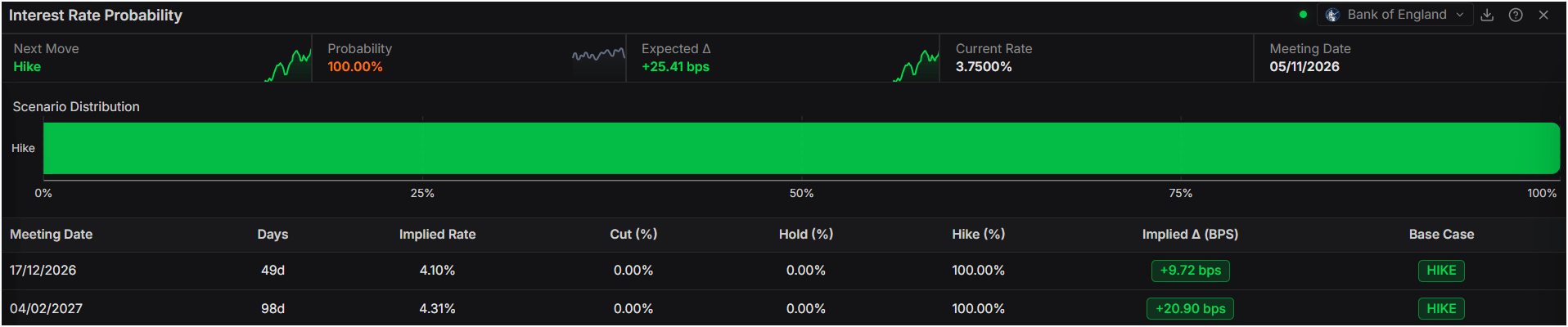
Beyond the immediate fiscal announcements, the primary driver for GBP/USD traders was the anticipation surrounding the Bank of England’s forthcoming policy meeting. The market, as revealed by Prime Terminal data, has largely priced in a 25-basis-point hike in November, followed by another similar increase in February. This aggressive forward guidance from market participants suggests a strong belief that the BoE will continue its tightening cycle to combat persistent inflation within the UK economy.
The BoE faces its own battle against elevated inflation, which has consistently outpaced its 2% target. While economic growth in the UK has shown signs of fragility, the central bank’s primary mandate to ensure price stability often necessitates tough decisions on interest rates, even if they risk dampening economic activity. Higher interest rates typically strengthen a currency by making it more attractive for foreign investors seeking higher returns on their assets. The expectation of further tightening by the BoE appears to be providing a stronger impetus to the Pound compared to the already well-telegraphed and priced-in actions of the Federal Reserve.
The Interplay of Global Economic Forces and Currency Dynamics
The seemingly paradoxical appreciation of the Pound against the Dollar, despite robust US economic data, can be understood through the lens of relative monetary policy expectations and market positioning. While strong US data typically implies a stronger Dollar due to higher interest rate prospects, the market had likely already largely "priced in" a hawkish Fed stance. Therefore, when the data arrived, it merely confirmed existing expectations rather than delivering a significant new surprise that would push the Dollar even higher.
In contrast, the detailed pricing of two specific BoE rate hikes in the near future—November and February—suggests that the market sees a more defined and potentially aggressive tightening path for the UK central bank relative to the Fed’s current trajectory or what was previously priced in. This shift in relative interest rate differentials makes Sterling more attractive to yield-seeking investors. Capital tends to flow towards currencies where interest rates are rising more rapidly or are expected to remain higher for longer, offering better returns on fixed-income investments.
Furthermore, broader market sentiment and risk appetite can also influence currency movements. While the original article does not detail global risk sentiment, a shift towards risk-on conditions could sometimes benefit growth-linked currencies, though this is less directly applicable to the GBP/USD paradox described. The core explanation remains the perceived divergence in the pace and certainty of future monetary tightening between the two central banks.
Technical Outlook for GBP/USD: Navigating Key Levels
From a technical analysis perspective, the GBP/USD pair is currently trading around 1.3368, maintaining a mildly bearish undertone despite Thursday’s gains. The spot price remains capped beneath a cluster of simple moving averages (SMAs) around 1.3385, which typically act as dynamic resistance levels, and a descending trend-line resistance positioned at 1.3393. The confluence of these resistance points suggests that the pair faces significant hurdles in attempting a sustained upward movement.
The pair has managed to reclaim some ground from its recent lows, indicating a degree of buying interest. The Relative Strength Index (RSI 14), a momentum oscillator, is currently at 54.4. An RSI reading above 50 generally suggests that bullish momentum is gaining traction. However, the fact that the price is still trading below former rising support lines, which have now transitioned into resistance near 1.3652 and 1.3830, reinforces the notion of a capped recovery rather than a definitive shift towards a clear bullish trend. These former support lines now act as formidable overhead barriers, indicating that any upward move would likely encounter strong selling pressure.
Key Technical Levels to Watch:
- Initial Resistance: The immediate challenge for GBP/USD bulls lies at the simple moving average cluster around 1.3385.
- Stronger Resistance: Closely following is the descending trend-line barrier at 1.3393. A sustained break and close above this level would be a crucial signal, indicating a potential shift in short-term sentiment.
- Upside Targets: Should the pair successfully breach and hold above 1.3393, the path would open towards more significant resistance levels. These include the former upward-sloping supports, now acting as resistance, near 1.3652 and subsequently 1.3830. Reaching these levels would signify a more substantial recovery attempt.
- Key Support: On the downside, the nearest notable underlying demand is identified at the prior downward resistance trend-line break around 1.3253. This level is anticipated to act as a strong support zone, where buyers are likely to step in and attempt to slow or halt any corrective pullback, potentially offering a rebound opportunity. The principle of "resistance turns support" is at play here, where a previously broken resistance level often acts as a new floor for the price.
The technical setup suggests that while there is some improving momentum, the broader structure indicates that the current appreciation might be part of a corrective phase within a larger bearish trend rather than the initiation of a new bullish cycle. Traders will closely monitor these key technical levels in conjunction with upcoming fundamental releases to gauge the pair’s next directional move.
Broader Economic Implications and Forward Look
The current economic landscape presents a complex picture for both the UK and US economies. For the UK, the budget’s blend of tax increases and energy support measures will have varied impacts across different sectors and income groups. While the energy support is crucial for consumer welfare, the tax hikes could dampen economic activity in specific areas, potentially impacting investment and discretionary spending. The BoE’s anticipated rate hikes, while necessary to combat inflation, will increase borrowing costs for businesses and households, potentially slowing economic growth and impacting the housing market.
In the US, the persistent strength in GDP and employment, coupled with elevated inflation, will keep the Federal Reserve on a vigilant path. While a soft landing remains the central bank’s goal—taming inflation without triggering a severe recession—the continued economic vigor suggests that more work may be needed to achieve price stability. This could translate into a period of higher-for-longer interest rates, impacting global capital flows and the cost of borrowing internationally.
The GBP/USD pair’s performance will remain highly sensitive to the evolving narrative from both central banks, alongside incoming economic data. The upcoming Bank of England meeting is poised to be a pivotal event, potentially cementing the Pound’s short-term trajectory. Investors will be scrutinizing every word from policymakers for clues regarding the future path of interest rates, as these decisions will ultimately dictate the strength and stability of both currencies in the dynamic global financial markets.
Pound Sterling Price Today
The table below shows the percentage change of British Pound (GBP) against listed major currencies today. British Pound was the strongest against the Australian Dollar.
| USD | EUR | GBP | JPY | CAD | AUD | NZD | CHF | |
|---|---|---|---|---|---|---|---|---|
| USD | -0.09% | -0.32% | 0.02% | -0.06% | 0.29% | -0.02% | -0.14% | |
| EUR | 0.09% | -0.23% | 0.11% | 0.00% | 0.38% | 0.06% | -0.05% | |
| GBP | 0.32% | 0.23% | 0.34% | 0.24% | 0.63% | 0.30% | 0.18% | |
| JPY | -0.02% | -0.11% | -0.34% | -0.11% | 0.26% | -0.08% | -0.18% | |
| CAD | 0.06% | -0.01% | -0.24% | 0.11% | 0.37% | 0.05% | -0.06% | |
| AUD | -0.29% | -0.38% | -0.63% | -0.26% | -0.37% | -0.31% | -0.44% | |
| NZD | 0.02% | -0.06% | -0.30% | 0.08% | -0.05% | 0.31% | -0.08% | |
| CHF | 0.14% | 0.05% | -0.18% | 0.18% | 0.06% | 0.44% | 0.08% |
The heat map illustrates the percentage changes of major currencies against each other. The base currency is selected from the left column, while the quote currency is selected from the top row. For instance, if you choose the British Pound from the left column and trace across the horizontal line to the US Dollar, the displayed percentage change represents the movement of GBP (base) against USD (quote).