Reynand Wu
The New Zealand Dollar concluded the trading week on a decidedly stronger note against its US counterpart, registering a 0.55% gain to close at 0.5652. This upward movement was primarily driven by a broader weakening of the Greenback, as investor skepticism mounted regarding the likelihood of a Federal Reserve interest rate hike in October, despite recent US economic data pointing to persistent inflationary pressures. The market’s pivot away from immediate Fed tightening has redirected significant attention towards upcoming inflation figures from New Zealand, which could dictate the Reserve Bank of New Zealand’s (RBNZ) next policy steps.
US Economic Indicators and the Federal Reserve’s Policy Conundrum
Friday’s slate of US economic data, typically a market mover, largely failed to sway investor sentiment towards a more hawkish Fed stance. The Federal Reserve’s report indicating a robust 0.7% month-over-month growth in Industrial Production for September, surpassing both estimates and August’s 0.1% expansion, was overshadowed by the ongoing inflation debate. The core focus remained on consumer and producer price dynamics, which painted a picture of stubbornly high inflation.
The release of the US Consumer Price Index (CPI) revealed an annual inflation rate of 3.7% year-over-year, exceeding economists’ forecasts of 3.6%. Simultaneously, producer-level inflation, as measured by the Producer Price Index (PPI), registered an alarming 6.3% year-over-year, a full percentage point higher than the anticipated 5.3%. Historically, such elevated inflation figures would typically bolster expectations for aggressive monetary tightening. However, current market sentiment, as reflected in Prime Terminal data, placed the probability of an October Fed rate hike at a mere 16%.
This apparent disconnect between robust inflation data and subdued rate hike expectations underscores a complex dilemma facing the Federal Reserve. A series of aggressive rate hikes over the past year has pushed the federal funds rate to its highest level in over two decades, currently residing in the 5.25%-5.50% range. While some Fed officials, including Cleveland Fed President Beth Hammack, have publicly voiced concerns over inflation remaining persistently above the 2% target for an extended period, others have adopted a more cautious tone. The prevailing narrative among several policymakers suggests a preference for "patience," hinting that any further tightening is more probable in December than in October. This sentiment was further reinforced by a speech from former Fed Governor Kevin Warsh at the IMF forum on Friday, where he acknowledged the underlying strength of the US economy but refrained from offering explicit forward guidance on future interest rates, disappointing some investors seeking clearer signals.
The market’s skepticism also reflects broader concerns about the potential for overtightening to trigger an economic downturn. After an unprecedented tightening cycle that saw rates rise by 525 basis points since March 2022, the Fed is navigating a delicate balance between taming inflation and avoiding a recession. This "wait-and-see" approach has led to a temporary weakening of the US Dollar, providing a window for currencies like the NZD to gain ground. Despite this, the significant interest rate differential, with US rates currently 125 basis points higher than those in New Zealand, continues to favor the Greenback from a carry trade perspective, suggesting that the NZD/USD pair still faces inherent downward pressure in the medium term.
New Zealand’s Economic Docket and the RBNZ’s Stance

In stark contrast to the US, New Zealand’s economic calendar remained relatively quiet at the close of the week. However, the focus is rapidly shifting to a critical week ahead, dominated by key economic releases that could profoundly influence the Reserve Bank of New Zealand’s monetary policy trajectory. On October 18, the Trade Balance figures are expected, offering insights into the country’s export and import dynamics. This will be swiftly followed by the highly anticipated Consumer Price Index (CPI) for the third quarter, slated for release on both a quarterly and yearly basis.
The Q3 CPI data holds immense significance for the RBNZ, which, like many central banks globally, is grappling with inflationary pressures. The RBNZ’s primary mandate is to maintain price stability, targeting an inflation rate between 1% and 3% over the medium term, with a particular emphasis on keeping it near the 2% mid-point. Should next week’s New Zealand CPI come in hotter than expected, it could act as a catalyst for investors to fully price in an RBNZ rate hike at its upcoming October 28 monetary policy meeting.
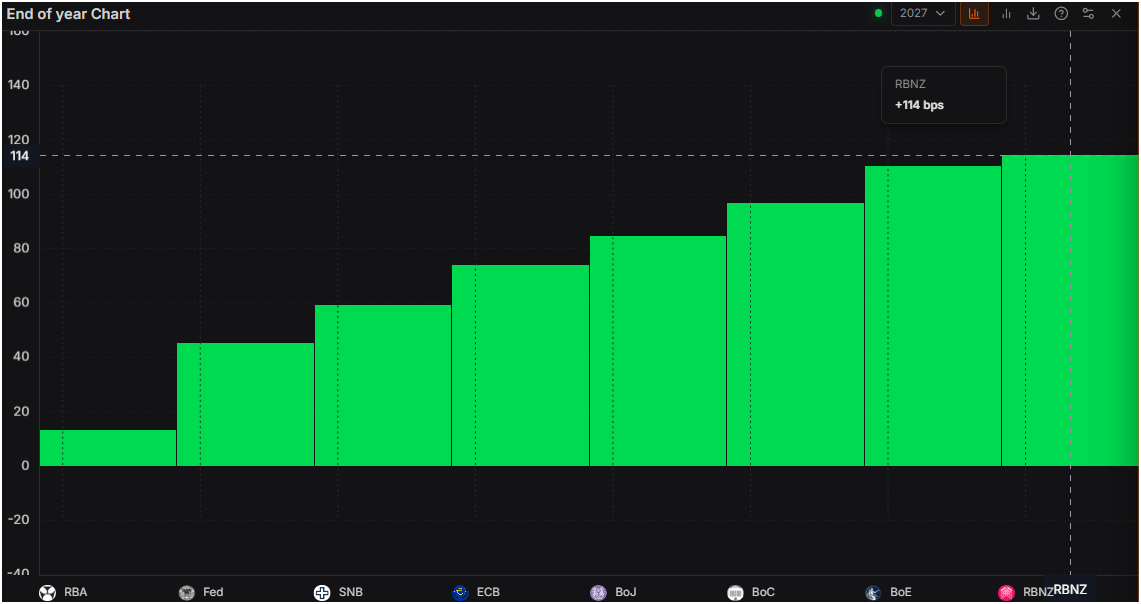
Currently, market odds, based on money market pricing, suggest an 85% probability of the RBNZ holding its Official Cash Rate (OCR) steady. However, a strong inflation print could rapidly shift these expectations. Furthermore, the market is already pricing in approximately 40 basis points of further tightening by the RBNZ towards the end of the year, underscoring the central bank’s perceived hawkishness. Looking further ahead, money markets have priced in a substantial 114 basis points of tightening for 2027, reflecting a robust belief in the RBNZ’s commitment to inflation control, positioning it as one of the more hawkish central banks among major currencies.
Factors Influencing the New Zealand Dollar (NZD)
The "Kiwi" dollar is influenced by a confluence of factors beyond domestic interest rates. Its value is inextricably linked to the health of the New Zealand economy and the RBNZ’s policy decisions. However, several unique particularities also play a crucial role:
- China’s Economic Performance: China stands as New Zealand’s largest trading partner. Consequently, any significant developments or shifts in the Chinese economy tend to have a direct impact on the NZD. A slowdown in China, for instance, could lead to reduced demand for New Zealand’s exports, negatively affecting the Kiwi.
- Dairy Prices: New Zealand’s dairy industry is a cornerstone of its export economy. High global dairy prices typically boost export income, contributing positively to the nation’s economic health and, by extension, strengthening the NZD. Conversely, a decline in dairy prices can exert downward pressure on the currency.
- Global Risk Sentiment: The NZD is often categorized as a "commodity currency" and tends to perform well during periods of "risk-on" sentiment. When global market risks are perceived as low and investors are optimistic about economic growth, they tend to seek higher-yielding or growth-sensitive assets, benefiting currencies like the Kiwi. Conversely, during times of market turbulence or economic uncertainty, investors often gravitate towards safer haven assets, leading to a weakening of the NZD.
- Macroeconomic Data: Beyond CPI, other key macroeconomic data releases in New Zealand, such as GDP growth, unemployment figures, and business confidence surveys, are closely watched. A robust economy characterized by strong growth, low unemployment, and high confidence can attract foreign investment and potentially prompt the RBNZ to raise interest rates, thereby boosting the NZD.
Global Macroeconomic Backdrop and Currency Dynamics
The broader context of the US Dollar’s recent weakening is multifaceted. While domestic Fed expectations are a primary driver, global macroeconomic factors also play a significant role. A general increase in global risk appetite, perhaps stemming from improved sentiment around global growth or easing geopolitical tensions, can often lead to a rotation out of the safe-haven USD into other currencies. Furthermore, the actions and rhetoric of other major central banks, such as the European Central Bank (ECB) or the Bank of England (BoE), can indirectly influence the USD’s relative strength.
The carry trade dynamic, where investors borrow in low-interest-rate currencies and invest in higher-yielding ones, remains a foundational element of foreign exchange markets. The current 125-basis-point interest rate differential between the US and New Zealand means that holding NZD assets (relative to USD assets) typically incurs a negative carry, making it less attractive from a pure yield perspective. However, if market participants anticipate a narrowing of this differential through future RBNZ hikes or a perceived cessation of Fed hikes, the NZD could find more sustained support.
Technical Analysis of NZD/USD: A Potential Turning Point?
From a technical perspective, the NZD/USD pair has shown signs of bottoming out, establishing a base around the 0.5580-0.5600 region. This support level triggered a subsequent rally, propelling the pair to an 11-day high of 0.5674 before it settled at its current levels. While the daily Simple Moving Averages (SMAs) — typically lagging indicators — continue to signal a bearish bias, suggesting the broader downtrend remains intact, the Relative Strength Index (RSI) offers a glimmer of hope for bulls. The RSI’s upward trajectory indicates a potential shift in momentum towards the bullish side, hinting that while the overarching downtrend persists, the market might be witnessing the nascent stages of a reversal.
For a more definitive bullish continuation, the NZD/USD pair would need to decisively reclaim the 0.5750 resistance level. A successful breach of this psychological and technical barrier could pave the way for a more substantial move towards the confluence of the 50-day and 100-day SMAs, currently situated in the 0.5775-0.5781 range. Surpassing these moving averages would further bolster bullish sentiment and potentially open the door for a challenge of the more significant 200-day SMA, positioned above the 0.5800 milestone at 0.5838. Traders will be closely monitoring these levels for signs of a sustained upward breakout.
Conversely, for the bearish momentum to reassert itself and continue the downtrend, the NZD/USD pair must fall below the October 14 swing low of 0.5564. A decisive break beneath this support would signal renewed selling pressure, potentially targeting the significant psychological mark of 0.5500. A move below this level could indicate a resumption of the broader downtrend, with further downside potential.
Implications for Investors and the Wider Economy
The current dynamics in the NZD/USD pair present both opportunities and risks for investors. The short-term bounce, fueled by US Dollar weakness and Fed skepticism, could be attractive for those looking for tactical long positions. However, the underlying interest rate differential and the potential for the Fed to eventually resume tightening, especially if US inflation proves even more intractable, suggest caution for longer-term bullish bets.
For New Zealand’s economy, a stronger Kiwi can make imports cheaper, potentially helping to ease inflationary pressures, but it can also make exports more expensive, impacting the competitiveness of key sectors like dairy and tourism. Conversely, a weaker Kiwi can boost export revenues but raises the cost of imported goods, fueling domestic inflation. The upcoming CPI data will be a crucial determinant of the RBNZ’s immediate policy decisions, which in turn will heavily influence the NZD’s trajectory and have broader implications for New Zealand businesses and consumers.
Globally, the evolving narrative around central bank policy, particularly from the Fed and RBNZ, continues to shape currency markets. Investors will remain attuned to any shifts in official rhetoric, alongside incoming economic data, to gauge the future direction of interest rates and, by extension, the relative valuations of major currency pairs like NZD/USD. The interplay between inflation, economic growth, and central bank credibility will remain at the forefront of financial market analysis in the weeks and months ahead.