Clara Shinta
Tokenization is rapidly reshaping traditional financial markets, with equities emerging as a significant focal point in this digital transformation. While the impressive $3.3 billion in tokenized equities currently onchain, as reported by RWA.xyz, garners substantial attention, some of the most profound innovations are occurring in the very fabric of market operation—specifically, extending trading far beyond the conventional hours of Wall Street. This phenomenon suggests a fundamental shift in how global liquidity is accessed and distributed, pushing the boundaries of traditional finance into a 24/7 digital reality.
The Dawn of 24/7 Equities Trading: A Global Phenomenon
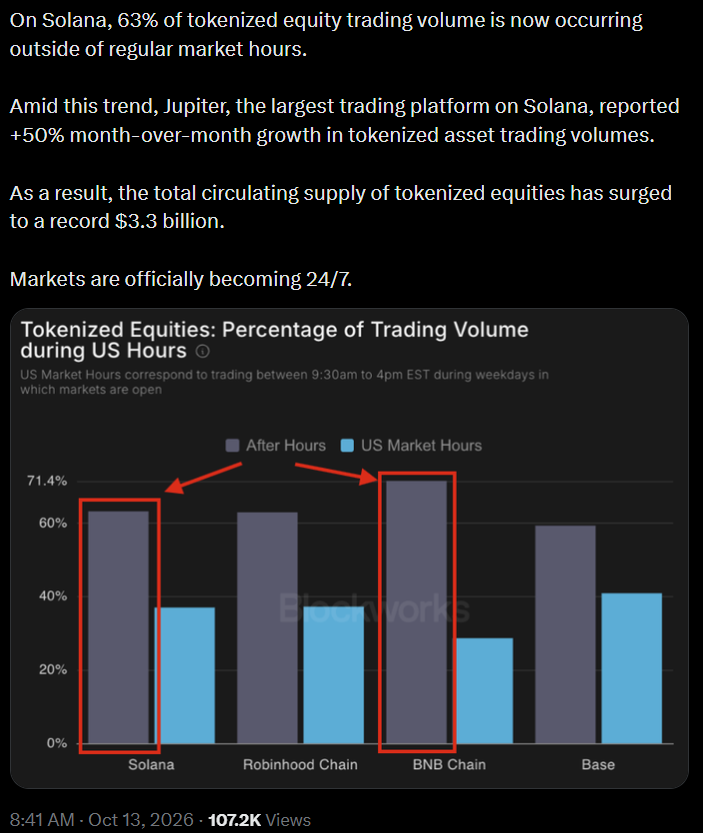
A striking trend in the nascent tokenized equities market is the overwhelming volume of trading activity occurring outside regular U.S. market hours. Latest industry data reveals that more than 70% of tokenized stock trading volume on BNB Chain now takes place beyond the traditional 9:30 AM to 4:00 PM Eastern trading window. Similar patterns are observed on other prominent blockchains, with Solana recording 63% and Base nearly 60% of their tokenized equity trading volumes occurring during off-hours. This signals a powerful demand for continuous access to U.S. stocks, unshackling investors from geographical and temporal constraints.
The concept of tokenized equities involves representing shares of traditional stocks as digital tokens on a blockchain. This innovation allows investors worldwide to trade U.S. stocks seamlessly across different time zones, eliminating the need to wait for the New York Stock Exchange or Nasdaq’s opening bell. For an investor in Asia or Europe, this means the ability to react to market news, manage portfolios, and execute trades in real-time, regardless of their local time, effectively bridging the gap between global financial hubs. This round-the-clock accessibility is not merely a convenience; it represents a potential paradigm shift in how liquidity is distributed and how price discovery occurs throughout the global day, fostering a more interconnected and responsive market.
The growth in this sector is undeniable. Jupiter, a prominent decentralized exchange aggregator, recently reported a 50% month-over-month increase in tokenized asset trading volume, underscoring the accelerating interest and participation in this new asset class. Concurrently, RWA.xyz data highlights that the total value of tokenized stocks has climbed 15% over the past 30 days, reaching nearly $3.3 billion. This robust growth trajectory suggests a strong market appetite for digital representations of traditional financial instruments, particularly those offering enhanced accessibility and operational efficiency.
Navigating the Regulatory Landscape: A Cautious Embrace in the U.S.
Despite the burgeoning activity and evident benefits, the regulatory environment for tokenized equities remains complex, particularly within the United States. Many of the platforms currently driving this after-hours trading volume, such as xStocks and Ondo Global Markets, largely remain off-limits to American investors. This restriction stems from the intricate web of securities regulations that govern financial markets, necessitating careful consideration of investor protection, market integrity, and anti-money laundering protocols.
However, U.S. regulators are beginning to acknowledge and address the emergence of tokenized stock trading. The Securities and Exchange Commission (SEC) has introduced an "innovation exemption," a significant development that opens the door for qualifying platforms to trade tokenized U.S.-listed stocks on public blockchains. This exemption, while a positive step, comes with stringent requirements, including robust disclosure obligations and comprehensive shareholder protection mechanisms. It reflects a cautious but pragmatic approach by the SEC, aiming to foster innovation while upholding its mandate to protect investors and maintain orderly markets.

Industry analysts view the SEC’s move as a tentative yet crucial acknowledgment of the potential of blockchain technology in capital markets. "The SEC’s innovation exemption is a cautious but necessary first step towards integrating tokenized securities into the mainstream," commented a senior analyst at a leading blockchain research firm. "It signals a recognition of the technology’s transformative power, but the strictures around disclosure and shareholder protection highlight the ongoing regulatory imperative to mitigate risks in this evolving landscape." The challenge for platforms will be to meet these rigorous compliance standards, while for regulators, the task is to strike a balance between encouraging innovation and preventing systemic risks. The ongoing dialogue between innovators and regulators will be critical in shaping the future trajectory of tokenized equities, especially in ensuring broader domestic participation in this rapidly expanding market.
Strive’s Strategic Bitcoin Accumulation: Leveraging Investor Confidence
In parallel with the evolution of tokenized equities, the corporate world continues to deepen its engagement with digital assets, particularly Bitcoin. Strive, a company focused on Bitcoin treasury management, significantly expanded its cryptocurrency reserves last week, demonstrating a strong conviction in the digital asset’s long-term value. This strategic move was facilitated by the exercise of investor warrants, effectively leveraging existing capital commitments to increase the company’s Bitcoin exposure per share.
During the week ending October 9, Strive announced, in a filing with the SEC, that it purchased an additional 3,311 BTC. These acquisitions were made at an average price of approximately $84,500 per coin, pushing Strive’s total Bitcoin holdings to an impressive 32,773 BTC. This substantial increase, representing an 11% boost to its existing reserves, solidifies Strive’s position as the fifth-largest publicly traded corporate Bitcoin holder globally, trailing only major players like MicroStrategy, Marathon Digital, and Hut 8 Mining. The continuous accumulation by such entities underscores a growing trend among corporations to incorporate Bitcoin into their balance sheets, viewing it as a strategic asset for diversification, inflation hedging, and long-term value preservation.
Matt Cole, CEO of Strive, confirmed that investors exercised $208 million in warrants, with approximately $15.3 million still outstanding before Tuesday’s expiration. Warrants provide holders the right, but not the obligation, to purchase a company’s stock at a predetermined price within a specified timeframe. The robust exercise rate indicates strong investor confidence in Strive’s strategy and its commitment to Bitcoin. Furthermore, Strive amended its governing documents to establish a binding $100 minimum issuance price for its SATA preferred shares. This move, while the shares were trading slightly below at $99.40, reflects a strategic effort to stabilize and potentially enhance the value proposition of its preferred equity, aligning it with the company’s long-term growth objectives. At the time of the announcement, Bitcoin was trading near $83,300, slightly below Strive’s average purchase price for the week, while its common stock, ASST, remained relatively stable at $27.52.
This latest acquisition by Strive serves as a compelling case study for the broader corporate adoption of Bitcoin. It highlights how companies are using traditional financial instruments, like warrants, to fund their digital asset strategies. For many, Bitcoin represents not just a speculative asset but a core component of a modern treasury management strategy, offering a hedge against currency debasement and a store of value in an increasingly uncertain global economic landscape. The increasing number of publicly traded companies holding significant Bitcoin reserves signals a maturation of the asset class and its gradual integration into mainstream corporate finance.
Bitcoin Miners Eyeing AI: A Costly but Strategic Diversification
The Bitcoin mining industry, historically focused on securing the Bitcoin network, is undergoing a significant strategic evolution, with many companies actively exploring and investing in artificial intelligence (AI) and high-performance computing (HPC). This pivot is driven by a desire to diversify revenue streams, leverage existing infrastructure, and potentially mitigate the impact of Bitcoin’s halving events, which periodically reduce mining rewards. However, this ambitious transition comes with substantial financial hurdles, as securing the necessary capital for large-scale AI data center projects proves to be both challenging and costly.
According to BlocksBridge Consulting’s Miner Weekly report, while securing AI customers is a crucial initial step, the greater challenge lies in financing the colossal infrastructure required. Miners need billions of dollars to construct state-of-the-art facilities, acquire specialized AI hardware (like advanced GPUs), and secure robust power infrastructure. Lenders, acutely aware of the significant capital expenditure and inherent risks associated with these complex projects, are increasingly scrutinizing financing terms, making them heavily dependent on the certainty of customer contracts and the likelihood of project completion. This has led to a widening gap in borrowing costs compared to traditional, lower-risk infrastructure projects.
The financial disparity is evident in recent deals within the sector. IREN, a prominent Bitcoin miner, secured $3.65 billion in financing in June at a blended interest rate of 6%. Just two months later, in August, the company obtained another $2.4 billion, but this time at a fixed rate of 9%. While these agreements covered different projects and therefore are not directly comparable on a one-to-one basis, they illustrate the fluctuating and often escalating cost of capital for these ambitious ventures. This trend highlights the lenders’ increasing risk assessment and the premium they demand for financing projects in the rapidly evolving and capital-intensive AI sector.
The scale of financing required is staggering. A June analysis by BlocksBridge, citing VanEck data, estimated that publicly traded Bitcoin miners would collectively need approximately $50 billion to fund their AI infrastructure ambitions. Individual companies face immense funding gaps: IREN alone was projected to require $21.1 billion, followed by Riot Platforms at $7.2 billion, and HIVE Digital Technologies at $4.6 billion. These figures underscore the sheer magnitude of investment necessary for miners to successfully transition into a dual-purpose computing model. The success of this pivot will depend not only on technological prowess but also on the ability to attract substantial and competitively priced capital in a market increasingly wary of unproven ventures. Industry experts suggest that strategic partnerships and innovative financing structures will be key to overcoming these formidable financial barriers.
U.S. Accounting Proposal: A Boost for Corporate Stablecoin Adoption
A significant development on the regulatory front that could bolster corporate engagement with digital assets comes from the Financial Accounting Standards Board (FASB). A proposed change to U.S. accounting standards could make stablecoins considerably more attractive to corporate treasuries by allowing qualifying tokens to be treated as cash equivalents on company balance sheets, according to a recent report from payments blockchain Tempo. This seemingly technical change has profound implications for how businesses view and utilize stablecoins.
Under current U.S. accounting practices, stablecoin holdings are generally not classified as cash or cash equivalents. Instead, they are often treated as intangible assets, subject to complex fair value adjustments and potential impairment losses. This classification can significantly impact a company’s reported liquidity ratios, working capital, and even compliance with loan covenants, even if the stablecoins are fully backed by U.S. dollars and are readily redeemable. The inability to count stablecoins as cash equivalents has been a major impediment to their widespread adoption in corporate treasury management, as it distorts traditional financial metrics and complicates reporting.
The FASB proposal aims to rectify this by establishing specific conditions under which stablecoins could be categorized as cash equivalents. A critical condition highlighted by Tempo is the requirement for companies to possess direct redemption rights with the stablecoin issuers. This means that simply purchasing a stablecoin like USDC through a cryptocurrency exchange might not suffice; companies would need a direct contractual relationship with the issuer (e.g., Circle for USDC) to ensure they can redeem the tokens for fiat currency on demand. This distinction is vital for ensuring the liquidity and stability criteria typically associated with cash equivalents.
Coinbase, a leading cryptocurrency exchange, has already adopted a similar approach. In its 2025 annual report, Coinbase classified USDC and other payment stablecoins as cash equivalents, a practice supported by its direct redemption arrangement with Circle. This proactive classification by a major industry player provides a precedent and illustrates the operational feasibility of the proposed FASB rules. The FASB proposal is currently open for public comment until November 19, allowing stakeholders to provide feedback on the suggested changes. Following this period, FASB will review the input before determining the final rules and their effective date. This move represents a crucial step towards providing much-needed clarity for corporations, potentially unlocking significant institutional capital for the stablecoin market and further integrating digital assets into the mainstream financial ecosystem. If adopted, it could simplify financial reporting, enhance transparency, and encourage a broader range of businesses to utilize stablecoins for payments, treasury management, and cross-border transactions.
The Evolving Digital Frontier
These developments collectively paint a picture of a financial landscape in rapid flux. Tokenized equities are democratizing access to global markets, challenging traditional trading hours and geographical barriers. Companies like Strive are demonstrating robust confidence in Bitcoin, integrating it strategically into their corporate treasuries. Bitcoin miners are strategically diversifying into the burgeoning AI sector, albeit facing significant financing challenges. And finally, proposed accounting rule changes could pave the way for stablecoins to achieve broader corporate acceptance, streamlining their integration into mainstream financial operations. As these trends converge, the traditional boundaries of finance continue to blur, ushering in an era where digital assets play an increasingly central role in global commerce and investment.