Clara Shinta
The cryptocurrency landscape across Asia is experiencing a period of intense regulatory scrutiny, divergent growth trajectories, and innovative integration, reflecting the region’s complex and often contradictory approach to digital assets. From Beijing’s hardened stance linking crypto to national security threats to Singapore’s burgeoning institutional activity, and from Seoul’s reconsideration of market-making rules to Tokyo’s embrace of crypto payments, the continent remains a pivotal battleground for the future of digital finance. Hong Kong, meanwhile, is solidifying its regulatory framework while a major bank prepares to launch a Hong Kong dollar-backed stablecoin.
China’s Escalating Rhetoric: Cryptocurrencies as "Accomplices" in Espionage
In a significant escalation of its anti-crypto narrative, China’s Ministry of State Security (MSS) has publicly labeled cryptocurrencies as "accomplices" in espionage, money laundering, and cyberattacks. This pronouncement marks a tightening of Beijing’s rhetoric, underscoring its long-held concerns about the financial stability and national security implications of decentralized digital assets. The MSS, China’s principal intelligence and security agency, published an article on social media asserting that "overseas anti-China hostile forces" frequently exploit cryptocurrencies to disrupt financial order and undermine national interests.
The core of Beijing’s latest warning centers on the perceived anonymity of cryptocurrencies, a feature often touted by proponents but consistently challenged by authorities. The MSS specifically highlighted that "overseas intelligence agencies would try to dispel the concerns of people they were trying to recruit as spies by claiming that the circulation of virtual currencies was hard to verify." This statement is widely interpreted as a direct and coded warning to potential foreign agents operating within China, challenging the misconception that crypto transactions offer impenetrable privacy. While certain privacy-focused cryptocurrencies like Monero and Zcash offer enhanced anonymity when used correctly, the vast majority, including Bitcoin and Ethereum, operate on public blockchains where transactions, though pseudonymous, are ultimately traceable through advanced analytical techniques. The message from Beijing is clear: "We’re watching the blockchain."
This latest move by the MSS is not an isolated incident but rather the latest chapter in China’s protracted crackdown on cryptocurrencies. The nation has a history of banning various aspects of the crypto industry, beginning with initial restrictions in 2013, followed by a comprehensive ban on cryptocurrency exchanges in 2017. The most definitive measure came in 2021, when China declared all cryptocurrency-related business activities illegal and initiated a widespread ban on crypto mining, effectively eradic expelling the industry from the mainland. These actions were driven by a confluence of factors, including concerns over capital flight, financial stability risks, the environmental impact of mining, and the potential for illicit activities. The ongoing development and promotion of China’s central bank digital currency (CBDC), the digital yuan (e-CNY), further underscore the government’s desire for a controlled, traceable digital financial system, positioning it as a direct alternative to decentralized cryptocurrencies. The MSS’s recent declaration reinforces the narrative that private digital currencies pose a fundamental threat to state control and national security, solidifying China’s position as one of the most restrictive environments for cryptocurrencies globally.
Singapore’s Institutional Crypto Boom Defies Regional Downturn
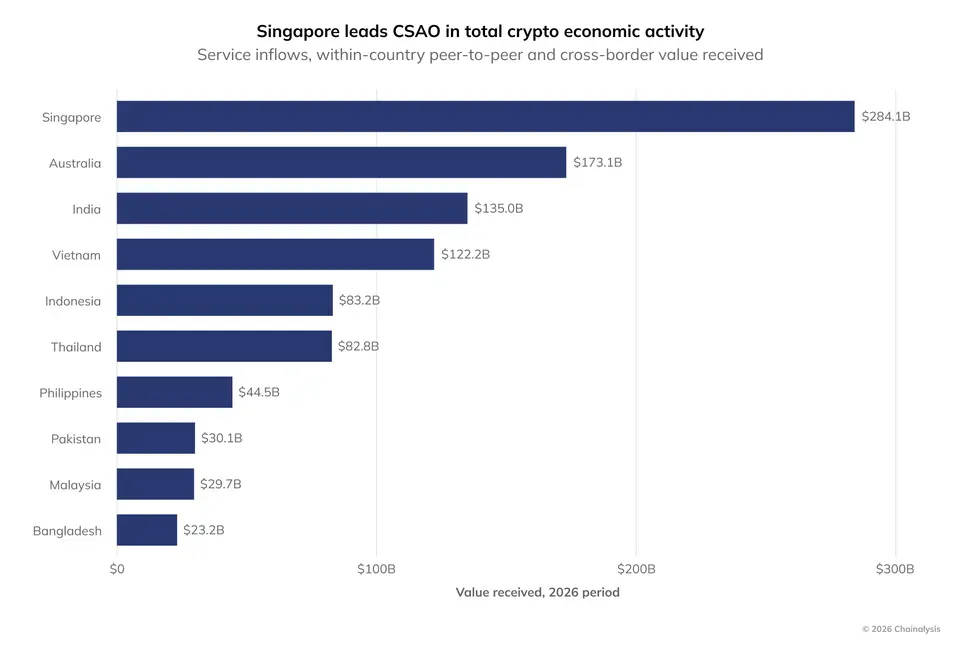
In stark contrast to China’s prohibitive stance, Singapore has cemented its position as a leading global hub for digital assets, experiencing a remarkable surge in crypto activity. According to a report by blockchain analytics firm Chainalysis, Singapore’s crypto economy expanded by an impressive 55.4% to reach $284 billion in the year ended June 2026. This growth not only bucked a broader regional contraction but also allowed Singapore to regain its status as the largest crypto economy in Central and Southeast Asia and Oceania (CSAO).
The lion’s share of this growth was attributed to institutional platform activity, which witnessed a staggering 94% increase, reaching $60 billion over the same period. This institutional engagement was highly concentrated among a select group of established market makers, over-the-counter (OTC) trading firms, and institutional brokerages. Chainalysis noted that this growth was "very concentrated and marked by mostly high-volume activity by existing platforms rather than the dynamic entry of new services." This suggests a deepening of engagement from established players rather than a widespread influx of new entities, indicating maturity in the institutional segment. In contrast, the broader CSAO crypto economy experienced a 6.8% contraction during the same timeframe, highlighting Singapore’s unique trajectory and resilience.
Singapore’s success can be attributed to its forward-thinking and well-defined regulatory framework. The Monetary Authority of Singapore (MAS) has adopted a pragmatic approach, aiming to foster innovation while ensuring robust risk management and consumer protection. The Payment Services Act (PSA), enacted in 2020, provides a clear licensing regime for digital payment token (DPT) service providers, offering legal certainty to businesses operating in the crypto space. This regulatory clarity, combined with Singapore’s reputation as a stable financial center, has attracted significant institutional investment and talent. The city-state has actively courted major crypto firms, exchanges, and blockchain innovators, offering a conducive environment for development and growth. The sustained institutional interest underscores Singapore’s strategic positioning as a bridge between traditional finance and the burgeoning digital asset economy, attracting sophisticated players seeking regulatory certainty and a robust financial infrastructure.

South Korea Considers Market Makers Amid Liquidity Challenges
South Korea, a nation with a vibrant and often volatile cryptocurrency market, is currently grappling with challenges related to market stability and liquidity. The Financial Services Commission (FSC), the country’s top financial regulator, announced it is seriously "considering a market-making system for digital assets." This consideration comes in the wake of a recent incident where a yen-backed stablecoin, JPYC, traded for as much as four times its pegged value on a major South Korean crypto exchange, highlighting significant liquidity issues.
On September 17, crypto exchange Upbit initiated trading for JPYC. Within just an hour of its market opening at 12 Korean won per JPYC, the stablecoin’s price soared to 37.6 Korean won, an astonishing deviation from its intended 1:1 peg with the Japanese yen. This dramatic spike was directly attributed to the limited liquidity available on Upbit for JPYC, leading to extreme price volatility with even small trading volumes.
Yoo Young-joon, director of digital finance policy at the FSC, acknowledged the need for regulatory intervention, stating, "We will also review the need to introduce systems such as market-making activities to increase the efficiency and stability of the digital asset landscape." Market makers play a crucial role in traditional financial markets by continuously quoting both buy and sell prices for an asset, thereby providing liquidity and narrowing the bid-ask spread. Their presence helps absorb large orders without causing significant price fluctuations, contributing to overall market efficiency and stability.
The absence of a formal market-making system in South Korea’s crypto markets stems from the country’s Virtual Asset User Protection Act. While designed to safeguard investors, the act currently lacks an exemption for market-making activities from its stringent market manipulation provisions. This legislative gap has effectively deterred professional market makers from operating in the Korean crypto space, leading to the kind of liquidity shortages and price anomalies observed with JPYC. A move by the FSC to introduce such exemptions would represent a significant step towards maturing South Korea’s digital asset ecosystem, aligning it more closely with global best practices for financial market infrastructure.
Adding to the dynamic South Korean market, United States payments and infrastructure firm MoonPay recently announced the launch of its South Korean subsidiary. MoonPay plans to collaborate with local financial institutions on various services, including remittances, payments, settlements, and digital asset distribution. While the company is still in the process of securing the necessary regulatory approvals, its entry signals growing international interest in South Korea’s crypto market and the potential for enhanced infrastructure and services once regulatory frameworks are clarified.
Japan Embraces Crypto Payments with Binance Pay and PayPay Integration
Japan, a nation known for its technological adoption and a comparatively progressive stance on digital assets, is witnessing further integration of cryptocurrencies into its mainstream payment ecosystem. Binance Pay, the crypto payment service of the world’s largest cryptocurrency exchange, has announced a groundbreaking partnership that will allow eligible overseas users visiting Japan to spend over 100 cryptocurrencies at the vast majority of PayPay-supported merchants. This service, which commenced recently, leverages the HIVEX payment interoperability framework.
HIVEX acts as a crucial bridge, connecting various overseas QR payment services to Japan’s extensive network of PayPay-supported merchants. Binance Pay utilizes Tether USDt (USDT) as its backend settlement layer. When a user makes a payment, the crypto is converted to USDT, then HIVEX settles with PayPay, and finally, PayPay disburses the equivalent amount in Japanese yen to the merchant. This seamless process means merchants do not need to separately opt-in or adapt their existing infrastructure, as they are already integrated with PayPay.
Binance highlighted that this initiative marks a significant milestone, making it the first crypto payment service to gain access to PayPay’s merchant network through HIVEX. PayPay is Japan’s dominant cashless payment service, boasting millions of acceptance points nationwide, including major retail chains, small businesses, vending machines, taxis, and public transportation. Its widespread adoption ensures that this integration offers substantial utility for crypto holders visiting Japan, allowing them to use digital assets for everyday transactions. While HIVEX already supports nine other overseas payment services, primarily from China, Hong Kong, and Taiwan, Binance Pay’s entry signifies a major step towards normalizing cryptocurrency as a practical payment method for international visitors.
Japan has a history of embracing digital assets, being one of the first countries to establish a comprehensive regulatory framework for cryptocurrency exchanges, overseen by the Financial Services Agency (FSA). This regulatory clarity has fostered an environment where innovation can coexist with consumer protection, differentiating Japan from more restrictive jurisdictions. The integration of Binance Pay with PayPay underscores Japan’s ongoing efforts to leverage digital innovation, particularly in areas like tourism and payment efficiency, further solidifying its reputation as a crypto-friendly nation.
Hong Kong’s Regulatory Evolution: Oversight Expansion and Stablecoin Launch
Hong Kong, aspiring to be a leading global virtual asset hub, is actively refining its regulatory environment to ensure robust oversight and foster responsible innovation. In a significant move, Hong Kong’s Securities and Futures Commission (SFC) and the Accounting and Financial Reporting Council (AFRC) have signed an agreement to expand their cooperation on the financial reporting and audits of licensed crypto firms.
This Memorandum of Understanding (MOU) establishes a comprehensive framework for enhanced collaboration between the two regulatory bodies. It facilitates information sharing, case referrals, mutual assistance, and coordinated inspections and investigations specifically targeting licensed virtual asset service providers (VASPs). The agreement aims to bolster the integrity of financial reporting and audit standards within the burgeoning crypto sector, ensuring that licensed firms adhere to the same rigorous accounting and transparency requirements as traditional financial institutions. This move is crucial for building investor confidence and mitigating risks associated with the often opaque nature of digital asset operations, signaling Hong Kong’s commitment to developing a well-regulated and trustworthy crypto ecosystem.
Further cementing Hong Kong’s strategic pivot into the digital asset space, HSBC, one of the world’s largest banking and financial services organizations, is preparing for the phased rollout of its new Hong Kong dollar-backed stablecoin, provisionally named "RedCoin." The bank plans to initially launch RedCoin for person-to-person (P2P) and merchant payments, with future expansion into corporate and institutional use cases.
The introduction of RedCoin by a major traditional financial institution like HSBC is a significant development. It reflects a growing recognition within established finance of the potential utility and demand for stablecoins, particularly those pegged to local fiat currencies. HSBC also plans to launch an extensive education campaign alongside RedCoin’s rollout, emphasizing the importance of public awareness to prevent scams and ensure safe usage of digital currencies. This proactive approach to investor education highlights the regulator’s and industry’s focus on consumer protection as the digital asset market matures. RedCoin could significantly enhance the efficiency of cross-border payments, facilitate instant settlements, and potentially integrate with Hong Kong’s broader digital payment infrastructure, positioning the city at the forefront of stablecoin adoption within a regulated framework.
The developments across China, Singapore, South Korea, Japan, and Hong Kong paint a vivid picture of Asia’s diverse and dynamic engagement with the cryptocurrency revolution. From Beijing’s unwavering hostility driven by national security and control to Singapore’s strategic embrace of institutional players, and from South Korea’s pragmatic adjustments to market realities to Japan’s consumer-friendly payment integrations, the region continues to shape the global narrative of digital assets. Hong Kong, with its measured approach to regulation and the entry of traditional finance into the stablecoin arena, is carefully carving out its niche as a sophisticated, compliant hub for virtual assets, offering a potential model for other jurisdictions balancing innovation with stability. The coming years will undoubtedly see further evolution in these distinct national strategies, each contributing to the complex tapestry of the global crypto economy.