Lina Wu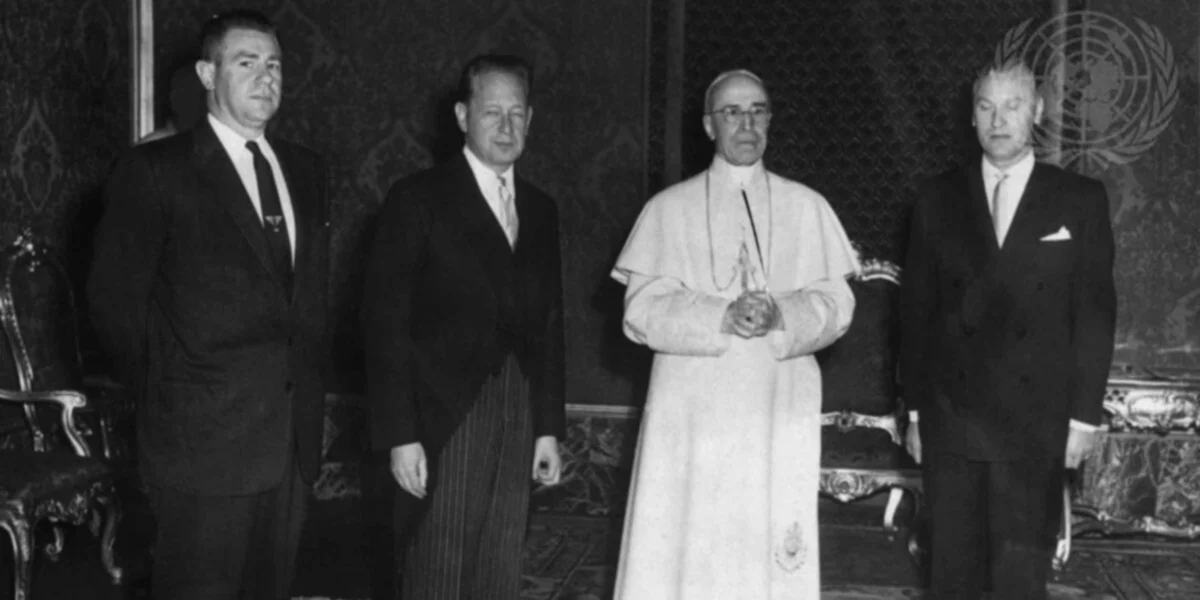
TOKYO — In a moment of profound recognition during the turbulent mid-20th century, Pope Pius XII, the spiritual leader of the Catholic world, declared to United Nations Secretary-General Dag Hammarskjold that he considered the Swedish diplomat his "lay counterpart." This significant assertion, documented in Emery Kelen’s biography of Hammarskjold, offers a compelling glimpse into the shared understanding of global responsibility that existed between two of the era’s most influential figures, despite their vastly different spheres of influence. The meeting, which took place in Rome in 1957, occurred against a backdrop of escalating Cold War tensions and a burgeoning United Nations striving to establish itself as a crucial mediator in international disputes.
The year 1957 was a pivotal moment in global affairs. The world was deeply entrenched in the ideological struggle between the United States and the Soviet Union, a conflict that permeated every aspect of international relations and posed a constant threat of devastating warfare. The United Nations, founded in the aftermath of World War II with the ambitious goal of preventing future conflicts, was actively seeking to assert its authority and efficacy in a world still deeply divided. Dag Hammarskjold, who had assumed the role of Secretary-General in 1953, was at the forefront of these efforts, tirelessly working to navigate complex geopolitical landscapes and foster dialogue among nations.
Pope Pius XII, who reigned from 1939 to 1958, was a prominent figure on the global stage, wielding considerable moral and spiritual authority over hundreds of millions of Catholics worldwide. His pontificate was marked by significant challenges, including the Second World War, the Holocaust, and the subsequent ideological divisions of the Cold War. While the Vatican’s diplomatic reach was distinct from that of the UN, the Pope’s pronouncements and moral guidance carried significant weight, often influencing public opinion and even governmental policy in Catholic-majority nations.
The meeting between Pope Pius XII and Dag Hammarskjold, as described by Kelen, was more than a mere diplomatic courtesy; it was an acknowledgment of shared purpose in promoting peace and stability in a fractured world. By calling Hammarskjold his "lay counterpart," the Pope implicitly recognized the vital role of secular leadership in addressing the complex challenges of global governance and conflict resolution. This designation suggests a deep respect for Hammarskjold’s mission and an understanding that the pursuit of peace required the concerted efforts of both spiritual and secular authorities.
The Context of a World in Flux
To fully appreciate the significance of this encounter, it is crucial to understand the specific historical context of 1957. The world was still reeling from the Korean War (1950-1953), a stark demonstration of the proxy conflicts that characterized the Cold War. The Suez Crisis of 1956 had further highlighted the limitations and complexities of international intervention, while also underscoring the UN’s potential role in de-escalating regional conflicts. In this environment, the UN, under Hammarskjold’s leadership, was grappling with issues such as decolonization, the burgeoning arms race, and the urgent need for humanitarian aid in various parts of the globe.
Pope Pius XII, too, was actively engaged in addressing the moral and ethical dimensions of these global challenges. His encyclicals and addresses often touched upon themes of peace, justice, and the dignity of the human person, providing a moral compass for Catholics and influencing broader international discourse. The Vatican, with its extensive network of diplomatic ties and charitable organizations, played a unique role in humanitarian efforts and in advocating for human rights.
A Meeting of Minds: The Vatican Encounter
The specific details of the 1957 meeting between Pope Pius XII and Dag Hammarskjold, beyond Kelen’s biographical note, are not widely publicized. However, the phrase "lay counterpart" speaks volumes. It suggests that the Pope perceived in Hammarskjold a fellow traveler on the arduous path of peace-making, albeit through different means. Hammarskjold, as Secretary-General, was tasked with implementing the decisions of the UN Security Council and General Assembly, often requiring intricate diplomacy, negotiation, and the deployment of peacekeeping forces. His role was inherently pragmatic, focused on managing immediate crises and building consensus among sovereign states with often competing interests.
Pope Pius XII, on the other hand, operated from a position of moral authority. His influence stemmed from his spiritual leadership, his pronouncements on ethical matters, and his ability to mobilize the global Catholic community. While the Vatican did not command armies or enforce resolutions, its moral weight could sway public opinion and exert diplomatic pressure. The Pope’s recognition of Hammarskjold as his "lay counterpart" implies an understanding that both men, in their distinct capacities, were working towards a common objective: the alleviation of human suffering and the promotion of a more peaceful and just world order.
Chronology of Influence: Key Milestones
- 1945: The United Nations is founded, aiming to prevent future wars and foster international cooperation.
- 1948: The Universal Declaration of Human Rights is adopted by the UN General Assembly, a foundational document for international human rights law.
- 1953: Dag Hammarskjold is appointed Secretary-General of the United Nations, tasked with navigating the complexities of the Cold War.
- 1956: The Suez Crisis highlights the UN’s role in peacekeeping and de-escalation, with Hammarskjold playing a crucial mediating role.
- 1957: Pope Pius XII meets with Dag Hammarskjold in Rome. Kelen’s biography later documents the Pope’s remark calling Hammarskjold his "lay counterpart."
- 1958: Pope Pius XII passes away.
- 1961: Dag Hammarskjold tragically dies in a plane crash while on a peace mission in the Congo.
This timeline underscores the overlapping periods of influence for both figures, a period characterized by intense global ideological competition and the nascent development of international institutions.
Supporting Data: The UN’s Growing Role and the Vatican’s Global Reach
By 1957, the United Nations had already begun to establish itself as a significant actor in international affairs. Membership had grown to 82 states, reflecting a broader global participation in multilateral diplomacy. The UN peacekeeping operations, though still in their early stages, were proving to be a vital tool for managing post-conflict situations and preventing the escalation of violence. For example, the UN Emergency Force (UNEF I), established in response to the Suez Crisis, demonstrated the potential of a multinational force deployed with the consent of the parties involved to create a buffer and facilitate withdrawal.
The Vatican, too, maintained a significant global presence. In 1957, the Catholic Church had a global following estimated to be in the hundreds of millions, with a presence in nearly every country. The Holy See maintained diplomatic relations with a large number of states, and its extensive network of dioceses, religious orders, and charitable organizations allowed it to exert influence and provide assistance on a global scale. The Vatican’s pronouncements on issues of peace, human rights, and social justice were closely watched and often debated by international policymakers.
Official Responses and Inferred Reactions
While official statements from the Vatican or the UN regarding this specific meeting are not readily available, the documented remark by Pope Pius XII itself serves as a powerful indicator of his perspective. The use of the term "lay counterpart" suggests a profound respect for Hammarskjold’s secular leadership and an acknowledgment of the distinct but complementary roles they played in the pursuit of global well-being.
One can infer that Hammarskjold, a seasoned diplomat deeply committed to the ideals of the UN, would have welcomed such an endorsement from a globally respected spiritual leader. Such a statement from the Pope could have lent additional moral authority to Hammarskjold’s mission and, by extension, to the United Nations itself, particularly in countries where Catholic influence was substantial. This shared understanding could have facilitated a more collaborative, albeit informal, approach to addressing global humanitarian and peace-building efforts.
Broader Impact and Implications
The encounter between Pope Pius XII and Dag Hammarskjold, though perhaps a fleeting moment in their respective careers, carries broader implications for understanding the dynamics of 20th-century global leadership. It highlights the recognition that effective peace-building and humanitarian action require the engagement of diverse forms of authority – both spiritual and secular.
In an era often defined by ideological divides, this acknowledgment of a shared purpose between the leader of the Catholic Church and the chief administrator of the United Nations suggests a common ground for action, even amidst profound differences. It underscores the enduring relevance of moral and ethical considerations in international affairs, even when driven by pragmatic political and strategic imperatives.
The legacy of both men is intertwined with the challenges of maintaining peace and human dignity in a complex world. Hammarskjold’s tireless efforts at the UN, culminating in his tragic death in the pursuit of peace, cemented his reputation as a dedicated international servant. Pope Pius XII, despite facing criticism for his approach during the Holocaust, was a significant moral voice during a period of immense global upheaval.
The statement from Pope Pius XII to Dag Hammarskjold serves as a reminder that the pursuit of peace and justice is a multifaceted endeavor, requiring the collaboration and mutual respect of leaders across different domains. It suggests that in the pursuit of a better world, the spiritual and the secular, the moral and the pragmatic, are not necessarily opposing forces but can, in fact, be complementary pillars of progress. This understanding remains relevant today as the international community continues to grapple with complex global challenges that demand a holistic approach to peace and human welfare.